Caffeine-free coffee jelly: Japan's wobbly kissaten dessert, rebuilt with herbal coffee
Coffee jelly is just brewed coffee, sugar, and a gelling agent, set until it wobbles. A gelling agent doesn't care what's in the liquid — which means the 1914 Japanese recipe and the Filipino condensed-milk version both work exactly the same way with herbal coffee instead of beans.

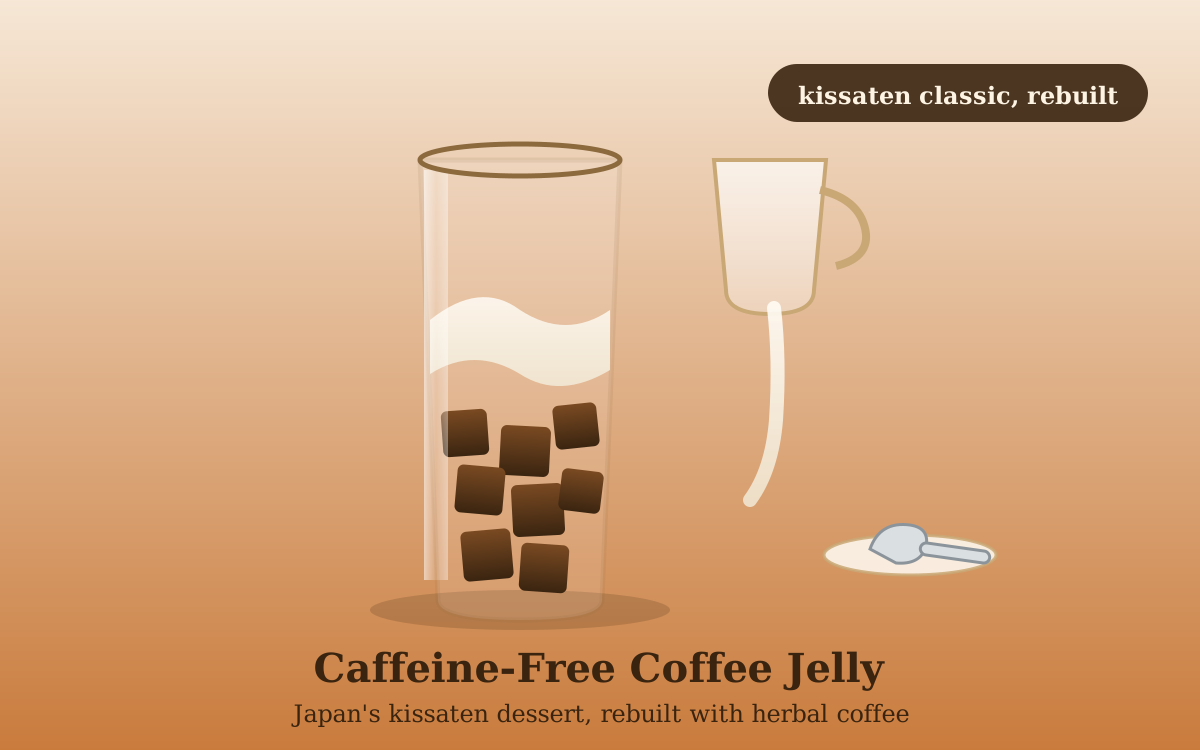
A reader question that’s been sitting in our inbox since the cafe-orders piece went up, paraphrased: “Is there anything that’s actually a dessert, not a drink pretending to be one?” Coffee jelly is the answer, and it’s a strange one to have never covered, because it’s arguably the simplest coffee recipe on this entire site. It’s brewed coffee, sugar, and a gelling agent, cooked together for two minutes and left alone for the rest of the work. Japan has served it in kissaten cafes since the 1960s. The Philippines has its own version, built around a can of condensed milk. And it turns out to be one of the cleanest caffeine-free swaps we’ve tested, because the whole dessert rests on a fact this site cares about constantly: a gelling agent has no idea what’s dissolved in the liquid it’s setting. It reacts to water, sugar, and — with gelatin — protein. Not to caffeine, and not to whether the dark liquid in the pot came from a coffee bean or a bag of roasted chicory.
The dessert that’s just brewed coffee, set
If you haven’t had it: coffee jelly is brewed coffee that’s been thickened with agar or gelatin into cubes or a soft set, then served cold under cream. It isn’t coffee-flavored gelatin dessert in the Jell-O sense — there’s no fruit-punch sweetness to it, and the bitterness of the brew is the point, cut by whatever’s poured over the top. It sits in the same family as the fruit jellies and aspics that were fashionable across Europe in the 1800s, except built on coffee instead of gelatin and juice, and it’s had two very different lives since: a nostalgic, quietly elegant kissaten menu item in Japan, and a sweeter, condensed-milk-forward dessert in the Philippines that shares more DNA with buko pandan and mango sago than with anything served in a Tokyo coffee house.
How it actually works — and why the liquid doesn’t matter
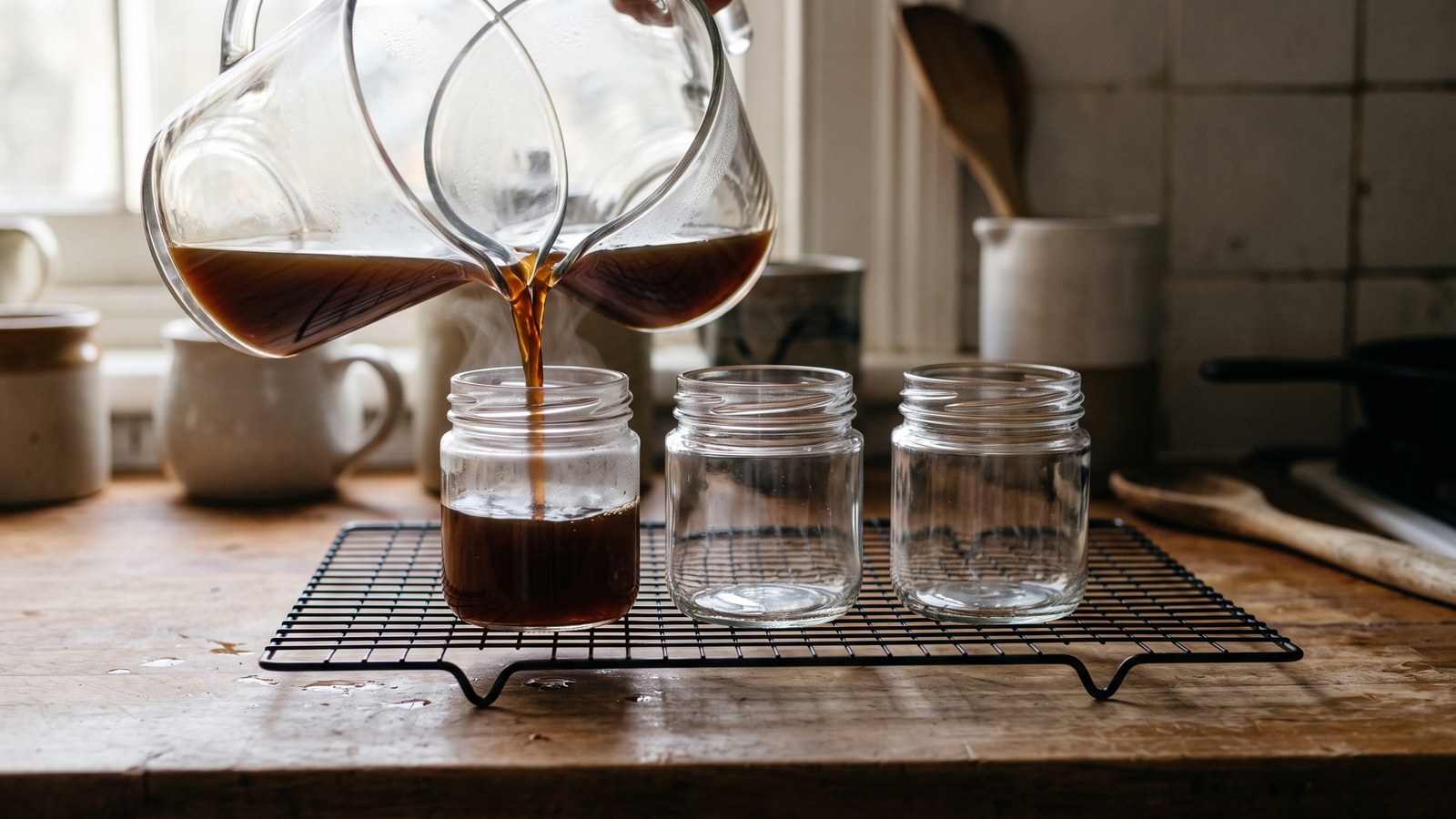
Agar (sold as kanten powder in Japanese recipes) and gelatin work by completely different mechanisms, and knowing which is which is most of what you need to adapt this dessert. Agar is a plant-based polysaccharide extracted from red algae, and it needs an actual boil — roughly two minutes at a full boil, whisked constantly — to fully dissolve and activate. Once it cools, it sets at room temperature and holds a firm, sliceable shape even somewhere warm; that’s why kissaten cafes could serve it out of a case rather than straight from a fridge. Gelatin is an animal protein extracted from collagen, and it works in reverse: it should never be boiled hard, or its long protein strands break down and the set weakens. It’s bloomed in cold or warm water, dissolved into a warm (not boiling) liquid, and it only holds its shape refrigerated — left on a warm counter, it slumps and eventually liquifies again.
Neither of those reactions has anything to do with what’s brewed in the liquid. Agar sets because of temperature and its own polysaccharide chemistry; gelatin sets because its unwound protein strands re-tangle into a mesh as they cool, trapping water in the gaps. Coffee doesn’t participate in either reaction — it’s just the flavored water the gelling agent is suspended in. Herbal coffee, being roasted chicory, carob, barley or a blend of those, is also just flavored water from a gelling agent’s point of view. The one real risk to a gelatin set is a handful of fresh proteolytic enzymes — the ones in raw pineapple, papaya, kiwi, and fresh ginger, which chop up gelatin’s protein strands before they can re-tangle. Roasted chicory, carob, and barley carry none of those enzymes, roasted or raw, so there’s no substitution risk to plan around here at all.
The recipe: caffeine-free coffee jelly, two ways
Both versions below start from published recipes — a Japanese kanten method and a Filipino condensed-milk method — with one swap: brewed herbal coffee in place of brewed coffee, brewed strong (more on that below). Everything else is unchanged.
Kissaten-style, spoonable (agar or gelatin)
- 2 cups strongly brewed herbal coffee, hot
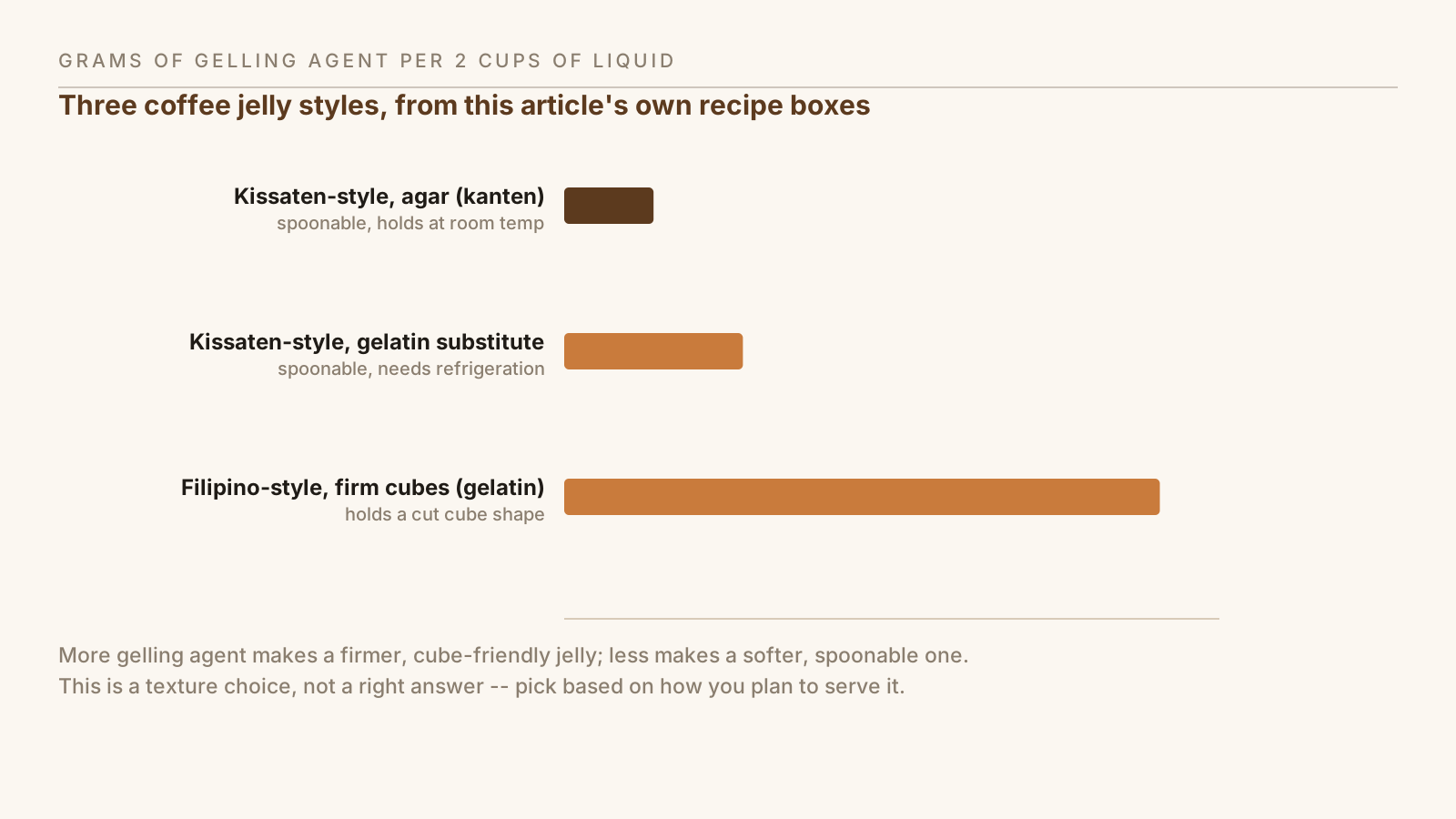
- 1 rounded teaspoon agar/kanten powder (or 2 teaspoons powdered gelatin as a substitute)
- 3 tablespoons sugar
Combine all three in a small saucepan. If using agar: bring to a full boil, whisking constantly, for a full 2 minutes — this is not optional, agar needs the heat to activate. If using gelatin: warm gently, stirring until the sugar and gelatin fully dissolve, but don’t let it come to a hard boil. Pour into a shallow dish or small jars. Cool at room temperature for 45–60 minutes, then refrigerate at least 4 hours (agar sets firm enough to cut into cubes at this point; gelatin stays soft enough to spoon straight from the dish).
Filipino-style, firm cubes with condensed-milk cream
- 2 cups strongly brewed herbal coffee (or 2 tablespoons instant herbal coffee granules dissolved in 2 cups just-boiled water)
- 2 cups just-boiled water
- 2 tablespoons (about 20g) powdered gelatin
- ½ cup sugar
- For the cream: 2 cups chilled heavy cream whisked with one 14oz can sweetened condensed milk
Sprinkle the gelatin over the 2 cups of just-boiled water and stir until fully dissolved. Stir in the brewed herbal coffee and sugar until the sugar dissolves. Pour into a shallow dish and refrigerate until firm, at least 4 hours. Cut into small cubes, spoon into a glass, and pour the whipped condensed-milk cream over the top just before serving.
Brewing the herbal coffee strong enough
The single most common way this recipe goes wrong has nothing to do with the gelling agent — it’s brewing the herbal coffee at normal drinking strength. Chilling mutes flavor, and diluting a jelly with cream mutes it further, which is the exact same problem this site has covered before with iced herbal coffee tasting watery: a brew that tastes balanced hot and at full strength reads thin once it’s cold and cut with something else. Brew roughly 1.5 times the grounds you’d normally use for the same water volume — the chicory-brewing methods here all scale the same way — and expect the set jelly to taste noticeably milder than the hot brew you poured, simply from the sugar and cream still to come.
For depth without bitterness spiking past what the sugar and cream can balance, we’ve had good results with Teeccino’s French Roast — a chicory, carob, barley, date and almond blend — brewed double-strength; the carob and dates round out a color and gentle sweetness that a single-ingredient chicory brew can taste thin without at this concentration. Any dark-roasted chicory or herbal coffee blend works the same way; that’s just what’s on our own shelf.
Two toppings: Japan’s cream, the Philippines’ condensed milk
The two traditions split hardest here, and it’s worth choosing on purpose rather than defaulting to whichever recipe you found first. The Japanese kissaten version is served understated: a small amount of sweetened condensed milk thinned with an equal part of regular milk, poured over the jelly, sometimes with a small amount of unsweetened whipped cream on top — bitter jelly, barely-sweet cream, meant to taste like coffee first and dessert second. The Filipino version inverts that ratio entirely: equal parts chilled heavy cream and full-fat sweetened condensed milk, whisked together into something closer to a sweetened whipped cream, poured generously over cubed jelly in a tall glass. It’s a genuinely sweeter dessert, and it’s the version that shares the most with other Filipino jelly-and-cream desserts like buko pandan and mango sago.
Neither is more “correct” — they’re two different desserts wearing the same base. If you want something that reads as an actual coffee experience, use the thin Japanese-style topping. If you want a dessert that reads as a dessert, use the Filipino cream.
Where this came from: a 1914 newspaper column to a Karuizawa cafe
Coffee jelly’s earliest documented recipe isn’t Japanese at all — English cookbooks recorded fruit and meat jellies set with gelatin as early as 1813, and coffee jelly specifically by 1817. Japan’s own version arrived later and took a different technical path: the Yomiuri Shimbun newspaper published a coffee jelly recipe on April 3, 1914, during the Taisho period, describing it as Japan’s answer to those British molded jellies — but built on kanten (agar) rather than imported animal gelatin, since agar was already a staple of Japanese confectionery. It stayed a home-kitchen, seasonal recipe for decades.
The commercial turn came in 1963, when Mikado Coffee, a cafe in the mountain resort town of Karuizawa, added coffee jelly to its summer menu and marketed it as “eating coffee.” It was an immediate hit, and by 1970 supermarkets had started selling ready-made versions — the point where coffee jelly stopped being a homemade specialty and became an everyday convenience-store dessert, which is roughly the era that made it a fixture of kissaten cafe menus generally, alongside iced coffee and cream soda floats, and gave it the nostalgic, retro-cafe association it still carries in Japan today.
The Philippines’ version arrived through a different, less documented route — most accounts describe it simply as an adaptation that took hold as coffee-and-dessert culture spread regionally, with the condensed-milk cream topping as the one distinguishing local touch, rather than through any single dated event the way Japan’s commercial history is recorded. It’s had a smaller, quieter presence there than in Japan, and by most accounts is currently regaining popularity rather than newly arriving.
Variations worth trying
A few directions this recipe scales in cleanly, all keeping the same brewed-herbal-coffee-plus-gelling-agent base:
- Mocha jelly: stir a tablespoon of unsweetened cocoa powder into the brewed herbal coffee before adding the gelling agent, and reduce the sugar slightly to account for the cocoa’s own bitterness.
- Layered jelly: set a thin layer of plain sweetened cream or condensed milk on the bottom of the jar, then pour the warm coffee-jelly liquid on top and refrigerate — it sets as two distinct layers rather than needing to be assembled after the fact.
- A frozen version: coffee jelly cubes hold up well blended into the caffeine-free frappé recipes covered here in place of ice, adding both texture and flavor instead of diluting the drink the way plain ice does. If you’d rather keep the dessert side of this going, the caffeine-free granita and popsicle recipes use the same brewed-and-frozen logic in a different format.
If you make this and land on a ratio or topping you like better than what’s above, we’d genuinely like to hear it — the cafe-orders piece exists because a reader’s comment improved on what we’d published, and this recipe is exactly the kind of thing a home kitchen tends to refine past what any single write-up gets right the first time.
Sources & further reading
- Japanese Coffee Jelly コーヒーゼリー (opens in a new tab) — Just One Cookbook
- Coffee Jelly — History, Recipe and Restaurants (opens in a new tab) — Food in Japan
- Coffee Jelly (opens in a new tab) — Ang Sarap
- How much caffeine is in decaf, really? — CoffeeAlternatives.com
Reader conversation (5)
We read every response. Selected reader notes below.
My grandparents ran a small kissaten for almost forty years and coffee jelly was always the one item on the menu nobody had to explain twice. Good to see the Mikado Coffee “eating coffee” history written down accurately — most English write-ups just skip straight to “it’s a Japanese summer dessert” without the actual origin.
One addition from home: a lot of Filipino households use gulaman bars (the dried agar strips) rather than powdered gelatin, especially older recipes, which gets you the firmer agar texture with the condensed-milk cream rather than the softer gelatin version described here. Both are genuinely “Filipino style” — it splits more by household than by any single standard.
That’s a really useful distinction and I should have flagged it — gulaman bars are agar, just sold in strip form rather than powder, so anyone using them should follow the agar boiling instructions above rather than the gelatin ones, even though the topping stays the same. Thank you for catching that gap.
Made the kissaten-style version with Teeccino French Roast brewed extra strong, agar version. Set beautifully and held a clean cube edge, which I wasn’t expecting from anything other than actual coffee. Flavor reads more “toasted grain” than “coffee” once it’s cold and cut with cream, for what that’s worth if anyone’s expecting an exact coffee clone.
Appreciate that the vegan option (agar) got real space here instead of a footnote. Does the agar version freeze well, or does it break down the way some agar desserts do after freezing and thawing?
It doesn’t hold up well frozen solid and thawed — agar gels tend to weep and turn grainy once ice crystals form and melt back out, the same issue a lot of agar-based desserts have. If you want a make-ahead frozen version, the granita and popsicle recipes linked in the variations section are built for freezing from the start rather than adapting a fridge-set jelly after the fact.
Skeptical about the “no enzyme in chicory” claim so I tried it two ways side by side, plain gelatin with water versus gelatin with strong-brewed chicory. Both set at the same rate as far as I could tell with a kitchen timer and a wobble test, so — for whatever an unscientific home test is worth — that part checks out.
Have something to add? Email us and we may include it in a future update.