Does caffeine cause tinnitus? A study of 65,000 women found the opposite, and a trial found quitting doesn't help
Many people are told to cut caffeine for ringing in the ears. A large Harvard-affiliated cohort found higher caffeine intake linked to lower tinnitus risk in women, and a controlled trial found caffeine abstinence didn't change tinnitus severity. Here is what each study can and can't tell you.

When people hear that a ringing in their ears has started, one of the first pieces of advice, from friends, forums and sometimes clinicians, is to cut the coffee. I wanted to know whether that advice has anything behind it, so I read the three papers that most directly test it. They don’t agree with the advice, and they don’t quite give the opposite answer either.
The short answer
Caffeine is widely suspected of causing or worsening tinnitus. The best evidence we found doesn’t support that suspicion. A large prospective study of women found higher caffeine intake linked to a lower risk of developing tinnitus, and a small controlled trial found that cutting caffeine did not change tinnitus severity, while it did cause withdrawal symptoms. A 2014 review of caffeine and ear, nose and throat conditions reached a similar place: there is little evidence that caffeine causes or aggravates these conditions, and in tinnitus, withdrawal may actually worsen symptoms.
None of that makes caffeine a treatment, and none of it settles the question for every person. It means “quit caffeine for your tinnitus” is not an evidence-based default.

What 65,000 nurses’ data found
The study most often cited here is a 2014 paper from Harvard-affiliated researchers in the American Journal of Medicine. It used the Nurses’ Health Study II, a long-running cohort. The authors followed 65,085 women, aged 30 to 44 and free of tinnitus when they joined in 1991. Participants completed lifestyle questionnaires every two years and food-frequency questionnaires every four years. Tinnitus was identified from a 2009 questionnaire, and a case meant reporting symptoms “a few days a week” or “daily.”
Over 18 years of follow-up, 5,289 women developed tinnitus. Average caffeine intake at the start was about 242 mg a day. The researchers compared each intake band with women who consumed under 150 mg a day, which they noted is about one 8-ounce cup of coffee. The adjusted hazard ratios were:
- 450 to 599 mg a day: 0.85 (95% confidence interval 0.76 to 0.95)
- 600 mg a day or more: 0.79 (95% confidence interval 0.68 to 0.91)
The authors described a significant inverse association: more caffeine, less incident tinnitus.
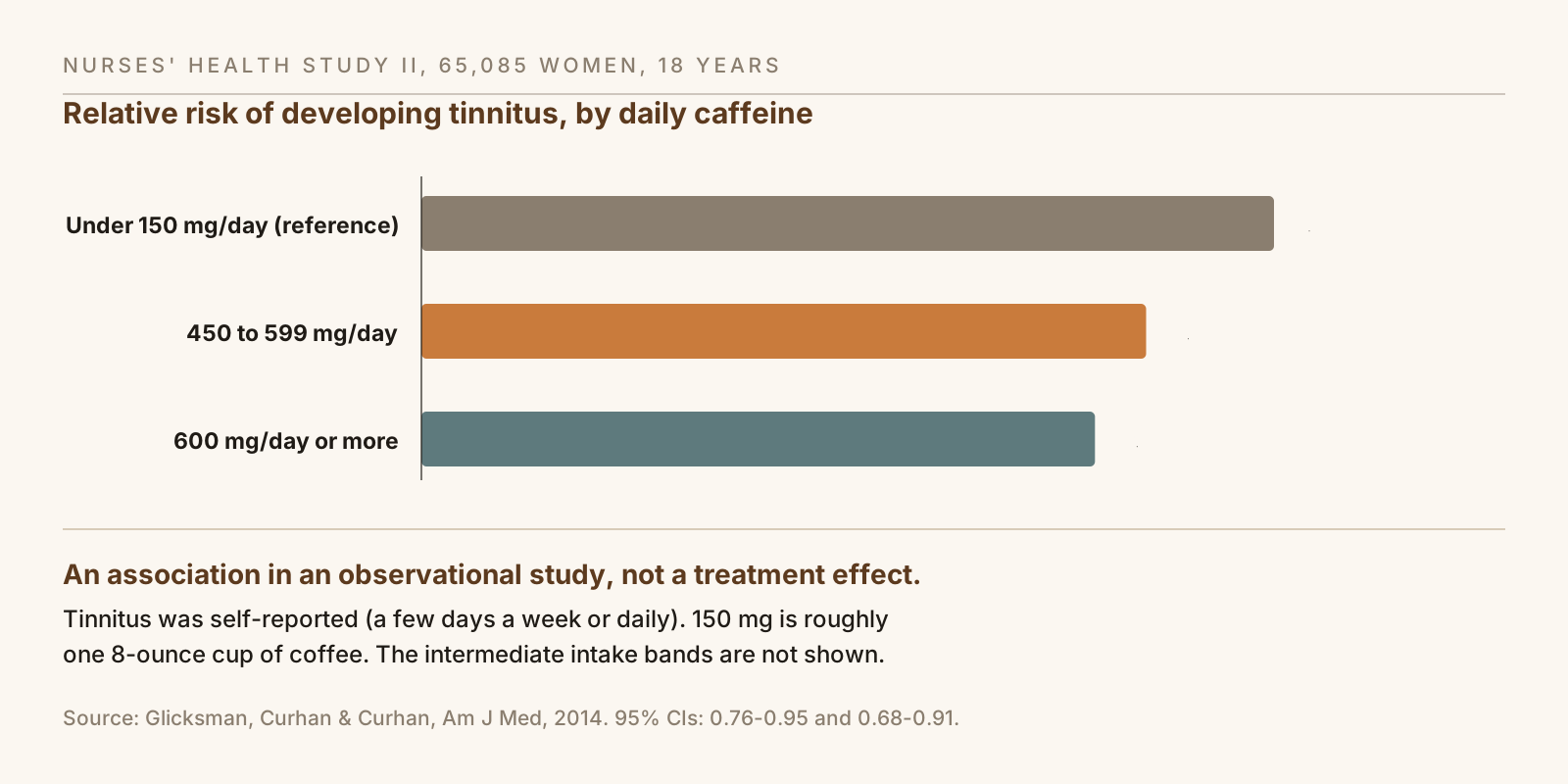
Two cautions before anyone reads this as “drink more coffee.” First, this is an observational study. People who drink a lot of coffee differ from people who don’t in ways a questionnaire can’t fully capture, and the authors adjusted for what they could measure, not for everything. Second, 600 mg a day is well above the roughly 400 mg a day often cited as a ceiling for healthy adults. Nothing here is a reason to raise your own.
What happened when people actually quit
A cohort tells you what happens to people who already drink different amounts. A trial tests what happens when you change it. A 2010 paper in the International Journal of Audiology did exactly that.
Researchers at the University of Bristol recruited 66 volunteers who had tinnitus and usually consumed at least 150 mg of caffeine a day. Participants swapped their usual tea or coffee for supplies that were either caffeinated or decaffeinated, and neither they nor the researchers knew which was which. Each person went through both a maintenance condition and a phased withdrawal over 30 days, in different orders. Tinnitus severity was scored with the Tinnitus Questionnaire on days 1, 15 and 30.
The result: caffeine had no effect on tinnitus severity. The mean difference between caffeinated and decaffeinated days was -0.04 points, with a 95% confidence interval of -1.99 to 1.93 (p = 0.97). In other words, the data were consistent with no change at all. Participants did report significant acute symptoms of caffeine withdrawal. The authors’ conclusion was blunt: they found no evidence to justify caffeine abstinence as a tinnitus therapy, and noted that the acute effects of withdrawal might add to the burden of tinnitus. The paper’s title calls it “an ineffective and potentially distressing tinnitus therapy.”
This is a small trial that ran for a month. But it is the kind of design that can test the question directly, and it didn’t find the effect the folk advice predicts.
What a wider literature review concluded
In 2014, a team at Norfolk and Norwich University Hospital reviewed what is known about caffeine across ear, nose and throat conditions: tinnitus, Ménière’s disease, reflux-related throat conditions, voice problems and others. They screened hundreds of abstracts and ended up using 36 studies. Their summary was that there is little evidence in the literature to support the notion that caffeine causes or aggravates these conditions, that in tinnitus its withdrawal may actually worsen symptoms, and that more research is needed so clinicians can give informed advice.
I’d read that review as a statement about the state of the evidence, not about biology. “Little evidence that caffeine causes it” is different from “evidence that caffeine never does.”
Why “cut the caffeine” keeps getting repeated
I can’t prove why, and I’d rather say that than invent a tidy story. Two plausible reasons, both my inference rather than anything the studies tested:
- It’s cheap and feels like action. Tinnitus is distressing and has no simple fix. Changing something in your routine is easier than waiting for an appointment.
- Some people do notice a pattern. Caffeine can make you feel more wired and more aware of bodily sensations, and quiet sounds are easier to notice when you’re alert. That is a perception effect we’re guessing at, and the trial did not measure it. Anyone who notices their own pattern should take it seriously as their own data.
What these studies can’t tell you
- The cohort is women only. It tells us nothing directly about men.
- Tinnitus was self-reported, and defined as a few days a week or more, so milder or occasional ringing isn’t counted.
- The trial is small. Sixty-six people over 30 days can rule out a large effect on average, not an effect that varies a lot from person to person.
- Caffeine isn’t the only thing in coffee. Neither study separates caffeine from other compounds in coffee or tea.
- Tinnitus has many causes. Noise exposure, hearing loss, medications, jaw and neck problems and more can all be involved. A new, sudden or one-sided ringing, or ringing with hearing loss or dizziness, deserves a prompt exam by a doctor or audiologist, not a diet experiment.
If you want to cut back anyway
Plenty of people have good reasons to cut caffeine that have nothing to do with their ears: sleep, anxiety, a racing heart, cost. If that’s you, the studies above suggest two things worth keeping in mind.
First, don’t expect it to quiet the ringing. The only trial we found didn’t show that, so if it happens, treat it as a bonus rather than a promise. Second, taper rather than stop. Withdrawal symptoms were significant in the trial, and the review’s note that withdrawal may worsen tinnitus is another reason to avoid an abrupt cutoff. Our guides to quitting caffeine without the headache and what a realistic two-week timeline looks like cover the practical side, and the half-life explainer helps you decide when your last cup of the day should be.
If you want something warm to drink while you taper, caffeine-free herbal coffees made from roasted chicory, carob or dandelion root are one option. Teeccino’s French Roast (opens in a new tab) is one of several, alongside Pero and Dandy Blend. It is caffeine-free, but it contains barley (so it is not gluten-free) and almonds, so check the label against your own needs. None of these has been shown to do anything for tinnitus, and we’re not suggesting they do. Our comparison of herbal coffee and decaf explains the difference in caffeine content.
The bottom line
The assumption that caffeine causes tinnitus is common, and the evidence we found doesn’t back it. A large prospective cohort of women found lower tinnitus risk at higher caffeine intakes, a controlled trial found that quitting didn’t change tinnitus severity but did bring withdrawal symptoms, and a literature review found little evidence either way for harm. The honest summary is “probably not the cause, probably not the fix, and not a reason on its own to white-knuckle a quit.”
If ringing in your ears is new, sudden, in one ear, or comes with hearing changes or dizziness, get it looked at. That matters more than anything in your cup. If you want to read more about how caffeine and sleep interact, what caffeine does to sleep architecture is a good next stop.
This article is educational and is not medical advice. Tinnitus has many causes; questions about your own symptoms belong with a doctor or audiologist.
Sources & further reading
- A prospective study of caffeine intake and risk of incident tinnitus (opens in a new tab) — Glicksman JT, Curhan SG, Curhan GC, American Journal of Medicine, 2014
- Caffeine abstinence: an ineffective and potentially distressing tinnitus therapy (opens in a new tab) — St Claire L, Stothart G, McKenna L, Rogers PJ, International Journal of Audiology, 2010
- The role of caffeine in otorhinolaryngology: guilty as charged? (opens in a new tab) — Trinidade A, Robinson T, Phillips JS, European Archives of Oto-Rhino-Laryngology, 2014
Reader conversation (4)
We read every response. Selected reader notes below.
I was told to give up tea when my ears started ringing and spent a miserable week with a headache for no benefit. It’s a relief to see the trial results laid out plainly. My audiologist never suggested cutting it, which now makes more sense.
That headache is the part the trial participants reported too. Thank you for sharing the timeline, and I’m glad your audiologist focused on the cause rather than your cup.
Good that you flagged it’s women only. I’m a 52-year-old man with ringing after years of concerts and I’ve been wondering whether any of this applies to me. Sounds like the honest answer is we don’t know.
I do notice mine is louder on days I’m short on sleep and have had three coffees. I appreciated that you took the personal-pattern point seriously instead of waving it away. I’ll keep a note for a month and bring it to my appointment.
The bit about 600 mg being above what anyone should aim for is a good reminder. Plenty of headlines would have turned that chart into “coffee protects your hearing.”
Agreed, and that’s why the chart caption leads with it being an association. An observational result like this one can’t tell us what a change in your own habit would do.
Have something to add? Email us and we may include it in a future update.