Does coffee raise eye pressure? For most people, not much. For people with glaucoma, the research is less comfortable
Caffeine can nudge eye pressure up for an hour or two, and the studies disagree about whether coffee matters for glaucoma itself. Here is what five papers found, who the caution applies to, and why it isn't a reason to panic.

If you’ve ever been told to go easy on coffee because of your eyes, you may have wondered whether that’s real. I read five papers on caffeine and eye pressure: a very large UK cohort, a pooled analysis of trials, an Australian population study, a small crossover experiment and an even smaller one with eye drops. The short version is that the effect is real but small and brief, and the people it might matter for are a specific group.
The short answer
Caffeine can raise the pressure inside the eye for an hour or two. In people with healthy eyes the rise looks small, and regular drinkers seem to get less of it. In people who already have glaucoma or high eye pressure, the studies are more worrying but also smaller, and they disagree with each other.
Nothing here shows that coffee causes glaucoma. And nothing here is a reason to change your treatment. If you have glaucoma, this is a conversation for your eye doctor, who has your actual numbers.
What eye pressure has to do with glaucoma
Intraocular pressure, or IOP, is the fluid pressure inside the eye, measured in millimeters of mercury (mmHg). High IOP is one of the main risk factors for glaucoma, a group of conditions that damage the optic nerve, and lowering IOP is the standard way clinicians treat it. That’s why researchers keep asking whether everyday things, caffeine included, move the number.
A caution before the studies: a bump in pressure lasting an hour or two is not the same thing as developing glaucoma. Several of these papers measure the first and are used to speculate about the second.
In healthy eyes: a small, brief bump
The cleanest evidence is a 2011 systematic review and meta-analysis by Li and colleagues. They pooled six randomized trials covering 144 people, 103 with normal eyes and 41 with glaucoma or ocular hypertension (raised pressure without optic nerve damage). In the normal group, eye pressure measured at 30, 60 and 90 minutes after caffeine was not significantly different from placebo. The authors noted the risk of bias in the trials was uncertain and called for better ones.
A newer experiment did find a rise in healthy people. In 2019, a team at the University of Granada gave 40 healthy adults either caffeine (4 mg/kg) or a placebo in a double-blind crossover design and measured eye pressure at 30, 60 and 90 minutes. Caffeine produced an acute rise in IOP. So the two sources point in slightly different directions for healthy eyes: no significant change when six small trials were pooled, a measurable rise in one larger crossover study. The honest summary is “small and inconsistent.”
Regular drinkers see less of it
The Granada study’s most interesting result was about habit. It split the 40 volunteers into low-caffeine consumers (21 people) and high-caffeine consumers (19 people). The biggest change came 90 minutes after the dose: eye pressure rose by 3.4 mmHg in the low-caffeine group and 1.2 mmHg in the high-caffeine group.
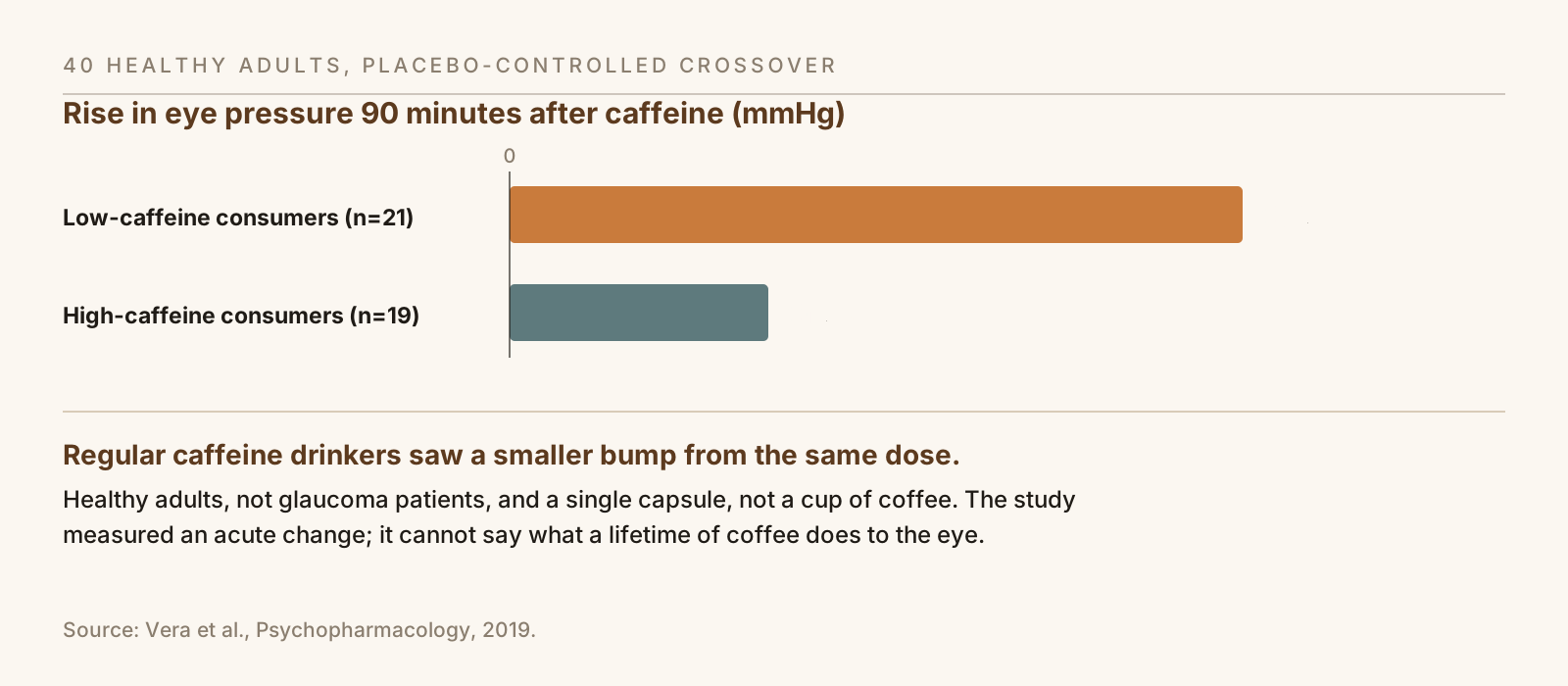
The authors read this as tolerance: the eye’s response to caffeine fades with regular use, possibly through changes in the adenosine receptor system, the same system behind caffeine’s effects on alertness. That is their interpretation, not something the study tested directly. Still, if it holds, it means someone who rarely has caffeine may notice more of an effect from a single strong dose than someone who drinks coffee daily.
Worth saying clearly: this was healthy volunteers and a single capsule. The authors said future studies were needed to see whether the same applies to patients with glaucoma.
In people with glaucoma or high pressure
Here the evidence gets less comfortable, and also less consistent.
- The pooled trials. In the 2011 meta-analysis, the 41 participants with glaucoma or ocular hypertension did show a rise. Pressure was up by an average of about 0.35 mmHg at 30 minutes, 2.4 mmHg at 60 minutes and 2.0 mmHg at 90 minutes. The authors concluded caffeine raised IOP in these patients and called for more high-quality trials.
- The Blue Mountains Eye Study. This Australian population study examined 3,654 people aged 49 and over. Among those with open-angle glaucoma, regular coffee drinkers had a higher average eye pressure (19.63 mmHg) than non-drinkers (16.84 mmHg). People consuming 200 mg of caffeine or more a day also had higher pressure (19.47 versus 17.11 mmHg), though that second result did not reach statistical significance after full adjustment. People with ocular hypertension but not glaucoma, and people without glaucoma, showed no association.
- A small eye-drop experiment. To test whether caffeine itself was responsible, a 2011 Indian study put 1% caffeine eye drops into the eyes of five people with open-angle glaucoma or ocular hypertension. Eye pressure stayed about the same, including after a week of repeated drops. The authors suggested that any effect in coffee drinkers might come from other coffee compounds, or from drinking a lot of fluid. With five participants and a home-made preparation, that is a clue, not a conclusion.
Taken together: the effect in people with glaucoma looks bigger than in healthy eyes, but the sample sizes are small, the Blue Mountains data is cross-sectional (a snapshot, not a before-and-after), and the one study that tried to isolate caffeine didn’t find a direct effect.
The UK Biobank gene-and-diet study
By far the largest dataset is from a 2021 study in Ophthalmology by Kim and colleagues using the UK Biobank. It covered 121,374 people with eye-pressure measurements, and looked at 9,286 glaucoma cases against 189,763 controls.
Three results stand out:
- A genetics-based approach did not support a causal effect. Mendelian randomization, which uses inherited variants linked to coffee intake as a stand-in for coffee drinking, did not support coffee causing a change in eye pressure.
- Higher caffeine went with slightly lower pressure. The highest-intake group (232 mg a day or more) had pressure 0.10 mmHg lower than the lowest (under 87 mg a day). That is tiny.
- Glaucoma overall: null. There was no association between caffeine intake and glaucoma across the whole group.
Then the twist. People were also scored on a “polygenic risk” for high eye pressure, based on 111 genetic variants. Among those in the highest-risk quarter, drinking more than 480 mg of caffeine a day went with 0.35 mmHg higher pressure than under 80 mg a day. And compared with the lowest-risk quarter who consumed no caffeine, people in the highest-risk quarter consuming 321 mg a day or more had a 3.9-fold higher glaucoma prevalence.
So for most people the large dataset found nothing worrying. For people carrying a strong genetic predisposition to high eye pressure, high caffeine intake lined up with more glaucoma. That’s a cross-sectional finding, which can’t say which came first, and a polygenic score is not something most people can look up. But it is the kind of finding that supports “talk to your doctor if glaucoma runs in your family and you’re a heavy coffee drinker” rather than “everyone should worry.”
Is it the caffeine?
Hard to say. The 2019 and 2011 trials point at caffeine, since they gave caffeine capsules or caffeine versus placebo. The eye-drop study found no effect when caffeine was applied directly and speculated that other compounds from roasting, or fluid load, could be involved. The Blue Mountains and Biobank studies measured coffee or caffeine intake in daily life, where it’s tangled up with everything else about a person.
I also found no study that compared decaf with regular coffee for eye pressure, so I can’t tell you decaf is safer, or that it isn’t. If you’d like background on what’s left in a decaf cup, we cover that here.
What these studies can’t tell you
- Most are small. The trials in the pooled analysis covered 144 people in total, and the eye-drop study had five.
- The effects are short. The trials track pressure for 90 minutes. They can’t show what years of coffee do.
- Healthy volunteers aren’t patients. The cleanest recent experiment used healthy adults.
- Population studies show association only. People who drink more coffee differ in many ways, and the Blue Mountains study was a one-time snapshot.
- A rise in pressure isn’t a diagnosis. None of these studies shows that a brief rise leads to optic nerve damage.
- I found nothing on herbal coffees. The question of chicory, carob or barley blends and eye pressure simply isn’t studied in what I read.
If you have glaucoma, or are cutting back
This is not medical advice. A few practical notes.
- Ask your eye doctor rather than guessing. They know your pressure, your medication and your family history. “Should I limit caffeine?” is a fair question to bring to the next appointment.
- Keep your treatment as it is. Nothing here is a reason to alter or skip glaucoma drops or procedures.
- Notice the dose. The Granada study used a fixed 4 mg/kg dose. For a 70 kg adult that works out to 280 mg in one go, which is a bigger single dose than many people take at once. How much caffeine your own cup holds varies a lot by brew and size, so a study dose is hard to map onto your morning routine.
- If you do decide to cut back, taper. Stopping suddenly causes headaches and fatigue for many people. Our guide to quitting caffeine without the headache lays out a gradual step-down, and how long caffeine stays in your body explains the timing.
- Ask before swapping. Caffeine-free herbal coffees are popular substitutes, and our comparison of herbal coffee and decaf explains how they differ on caffeine. But the eye-pressure question hasn’t been studied for them, so check with your eye doctor, particularly if you have glaucoma.
- Related questions. Does caffeine raise blood pressure? is a separate, better-studied question, and caffeine and migraine covers another place where caffeine’s effects depend on the person.
The bottom line
Caffeine can briefly raise eye pressure, a little in healthy people and perhaps more in people who already have glaucoma or high pressure. Regular drinkers appear to see less of an effect. The largest study found no link between caffeine and glaucoma overall, and a genetics-based analysis did not support coffee causing a pressure change, but it did find a worrying pattern in people with a strong genetic predisposition.
What the evidence can’t do is tell you what to drink. The studies are small, short and sometimes at odds with each other. If glaucoma is part of your life, your eye doctor is the right person to put it in context.
This article is educational and is not medical advice. Questions about glaucoma, eye pressure or caffeine in your own situation belong with your eye doctor.
Sources & further reading
- Intraocular Pressure, Glaucoma, and Dietary Caffeine Consumption: A Gene-Diet Interaction Study from the UK Biobank (opens in a new tab) — Kim J, Aschard H, Kang JH and colleagues, Ophthalmology, 2021
- The effect of caffeine on intraocular pressure: a systematic review and meta-analysis (opens in a new tab) — Li M, Wang M, Guo W, Wang J, Sun X, Graefe's Archive for Clinical and Experimental Ophthalmology, 2011
- Effects of caffeine on intraocular pressure: the Blue Mountains Eye Study (opens in a new tab) — Chandrasekaran S, Rochtchina E, Mitchell P, Journal of Glaucoma, 2005
- Effects of caffeine on intraocular pressure are subject to tolerance: a comparative study between low and high caffeine consumers (opens in a new tab) — Vera J, Redondo B, Molina R and colleagues, Psychopharmacology, 2019
- Effect of caffeine on the intraocular pressure in patients with primary open angle glaucoma (opens in a new tab) — Chandra P, Gaur A, Varma S, Clinical Ophthalmology, 2011
Reader conversation (4)
We read every response. Selected reader notes below.
I have been on eye drops for pressure for six years and never once asked my doctor about coffee. Writing it on my list for the next visit.
That is a good use of the appointment, Harold. These studies are small and short, and your doctor has your actual readings.
The tolerance result was new to me. It makes sense that a daily drinker would react less than someone who has one strong coffee once in a while.
Glaucoma runs in my family, so the gene study caught my eye. Thank you for saying it is a snapshot and not proof of what causes what.
Good to see the five-person eye-drop study described as a clue and nothing more. Most write-ups would have run with it.
Have something to add? Email us and we may include it in a future update.