Does caffeine make restless legs worse? Sleep guidelines say check it first, but the studies of coffee drinkers don't agree
Sleep specialists list caffeine as a factor to address first for restless legs. A large cohort found no link, and two student surveys point opposite ways. What the evidence shows and how to test it for yourself.


If your legs get fidgety and uncomfortable in the evening, it’s natural to wonder about the afternoon coffee. Sleep specialists do list caffeine as something to look at. The studies behind that advice are thinner than the advice itself, and they don’t agree with each other.
The short answer
- A 2025 sleep-medicine guideline says addressing factors such as caffeine should be the first step in managing restless legs syndrome (RLS). It labels this expert consensus.
- A large cohort that followed more than 55,000 people found no significant link between caffeine intake and developing RLS.
- Two surveys of medical students point in opposite directions on coffee and symptoms.
- Nothing here shows caffeine causes RLS or that quitting treats it. If you have symptoms, a clinician should be part of the picture.
What the sleep guideline says
The 2025 American Academy of Sleep Medicine guideline (opens in a new tab) on treating RLS includes three “good practice statements.” The second says the first step in management should be addressing exacerbating factors, and it lists alcohol, caffeine, antihistamine, serotonergic and antidopaminergic medications, and untreated obstructive sleep apnea.
The guideline describes these statements as based on expert consensus. So when a clinician asks about your coffee, they’re following sensible practice, but it isn’t the result of a trial that cut caffeine and measured symptoms. The first statement asks clinicians to check iron levels, which connects to a different caffeine question we cover in caffeine and iron absorption.
What the studies of coffee drinkers found
Three studies we could read in abstract form give a feel for how mixed this is.
A large cohort found nothing. In a Harvard-based prospective study (opens in a new tab), 12,812 men and 42,728 women who were free of RLS at the start were followed for four to six years, and 1,538 developed it. Normal weight, regular physical activity, not smoking and some alcohol went with lower risk. Caffeine intake showed no significant association with RLS risk in men or women.
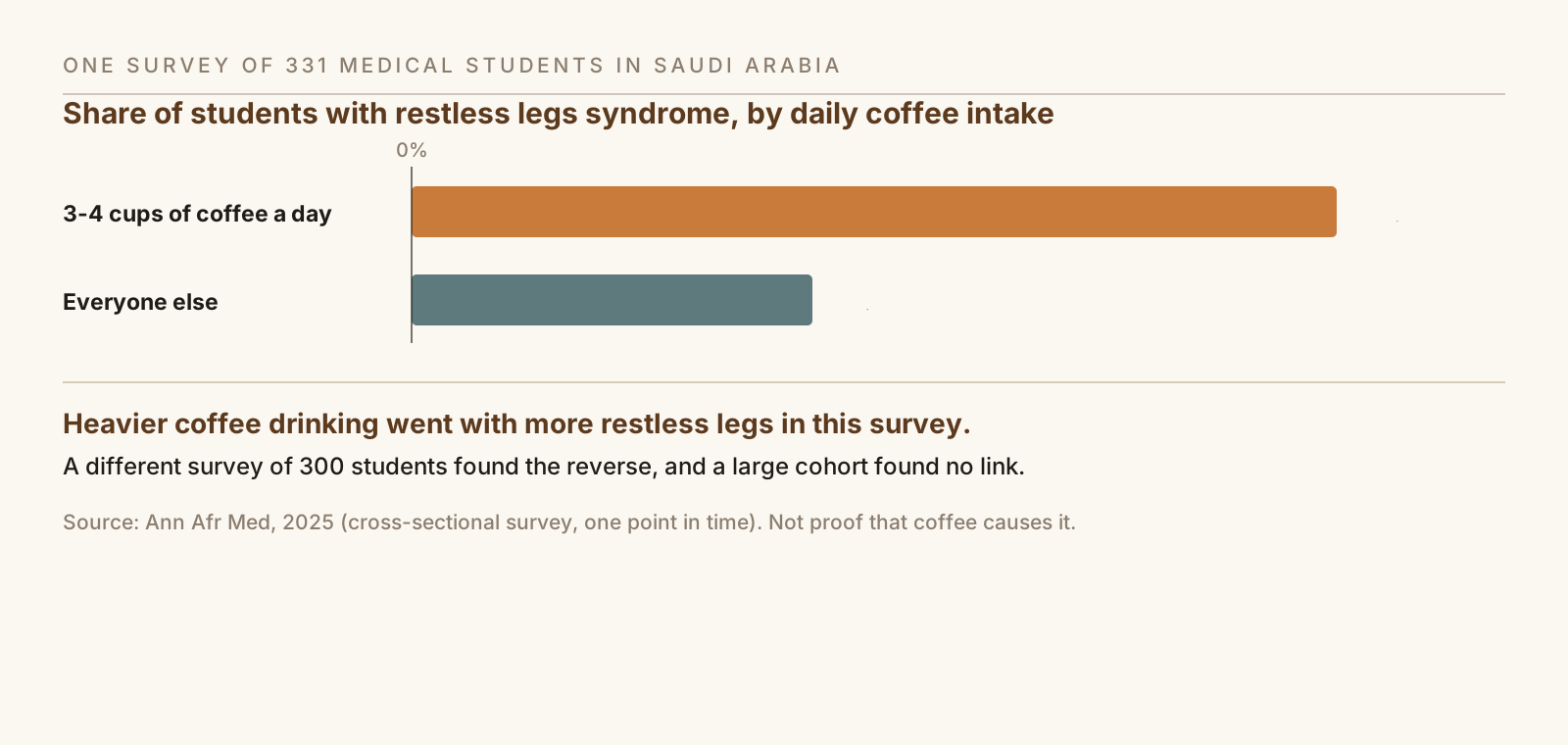
One survey found more RLS among heavy coffee drinkers. A cross-sectional survey of 331 medical students in Saudi Arabia (opens in a new tab) reported RLS in 42.9% of students who had 3 to 4 cups of coffee a day, compared with 18.6% of the others. The authors called caffeine and smoking risk factors.
Another survey found the reverse. A 2025 survey of 300 medical students (opens in a new tab) reported that higher caffeine consumption went with milder RLS symptoms (r = -0.383), even though it went with worse sleep quality. Students who had caffeine in the morning reported the best sleep and the lowest symptom severity. The authors concluded that heavier caffeine use was associated with lower reported intensity, and that late-day coffee hurt sleep.
Why the studies disagree
We can’t settle this, but the design of each study explains some of the mismatch.
- Different questions. The cohort asked who develops RLS. The surveys asked how common or severe it is among people who already drink coffee. Caffeine could be unrelated to onset and still matter for a bad night.
- Snapshots, not sequences. Cross-sectional surveys capture one moment. They can’t show whether coffee came before the symptoms.
- Reverse causation is possible. This is our reading, not the authors’. Someone whose symptoms flare in the evening might already have moved to coffee earlier, or less, which could blur or even flip a pattern.
- Narrow groups. Both surveys were of medical students, so they tell us little about older adults or people with other health conditions.
- Self-reported intake. Cups per day from a questionnaire are rough.
None of the three used a trial. We found no randomized study that changed someone’s caffeine and tracked RLS symptoms.
Testing it for yourself
Because the research can’t predict who notices a difference, the most honest approach is a small, careful experiment, alongside your clinician’s advice.
- Keep a two-week log. Note when you had caffeine, when symptoms began and how bad they were. Patterns can show up that no study will tell you.
- Move the cutoff earlier, not to zero. Shifting your last cup to the morning is gentler than stopping, and one student survey linked morning-only caffeine with better sleep. Our piece on caffeine and sleep architecture explains why timing matters on its own.
- Change one thing at a time. Alcohol, new medications and poor sleep can all muddy the result.
- If you stop entirely, taper. A sudden stop brings headaches that are easy to mistake for something else. How to quit caffeine without a headache walks through it.
- Don’t change medications yourself. Several of the factors in the guideline are prescriptions. Raise them with whoever prescribes them.
If you want a warm evening drink while you experiment, herbal coffee versus decaf is a place to start. Decaf still has a little caffeine, and we found no research on how herbal blends affect restless legs either way.
The bottom line
Sleep specialists tell people with restless legs to look at caffeine first, and that advice rests on expert consensus. Studies of coffee drinkers don’t agree, a large cohort found no link to developing it, and nothing shows quitting treats it. A short, structured experiment with an earlier cutoff, and a conversation with your care team, is a reasonable place to start.
Sources & further reading
- Treatment of restless legs syndrome and periodic limb movement disorder: an American Academy of Sleep Medicine clinical practice guideline (opens in a new tab) — Winkelman JW and colleagues, Journal of Clinical Sleep Medicine, 2025
- Lifestyle Factors and Risk of Restless Legs Syndrome: Prospective Cohort Study (opens in a new tab) — Batool-Anwar S and colleagues, Journal of Clinical Sleep Medicine, 2016
- Prevalence and Risk Factors of Restless Legs Syndrome among Medical Students in Saudi Arabia: An Observational Study (opens in a new tab) — Annals of African Medicine, 2025
- Exploring the Link Between Caffeine Intake, Sleep Quality, and Restless Legs Syndrome Among Medical Students (opens in a new tab) — Singla B and colleagues, Cureus, 2025
Reader conversation (4)
We read every response. Selected reader notes below.
My neurologist asked about my afternoon coffee before anything else, and I thought it was a throwaway question. Helpful to see it’s actually in the guideline, and that it’s consensus rather than proof.
Thanks, Colleen. It’s a reasonable first question precisely because it’s cheap to check, even though the trial evidence isn’t there yet.
The two student surveys pointing opposite ways is the most honest part. I kept a log like you suggest and moving my last cup from 3 p.m. to noon made no difference for me. Your mileage may vary, clearly.
Appreciate the note that the big cohort looked at who develops it, not who flares. That distinction got lost in everything else I read.
Good reminder to taper rather than quit cold. I’d have blamed any headache on the legs.
Right, Dale. A change of one thing at a time keeps the log readable.
Have something to add? Email us and we may include it in a future update.