Does coffee protect against dementia? Pooled studies disagree, and the cohort-only analysis found no clear effect for coffee
Three meta-analyses reach different answers on coffee and dementia. Tea looks more consistent than coffee, and every result is rated low-certainty. What the research shows, and why it can't tell you whether to start or stop.


If you’re quitting coffee and a relative has dementia, you’ve probably seen a headline saying coffee protects the brain and wondered if you’re giving something up. The research is real, but it points in more than one direction, and the details matter more than the headline.
The short answer
- Three published meta-analyses, which pool many studies, reach different conclusions about coffee and dementia.
- The largest and most recent, limited to cohort studies, found no clear link for coffee. Tea looked better.
- Every result in it was rated low or very low certainty.
- All of this is observational. It describes what people already drank, not what happens if you change your habits.
Three meta-analyses, three answers
A meta-analysis combines results from many studies into one pooled estimate. The three we read ask nearly the same question and don’t land in the same place.
- 2015, Neuroepidemiology. Twenty studies with 31,479 participants (opens in a new tab) gave a pooled estimate of 0.82 for caffeine from coffee or tea, with an interval (0.67 to 1.01) that included no effect. The authors concluded that caffeine from coffee or tea was not associated with cognitive disorders. Coffee alone came out at 0.83 (0.70 to 0.98).
- 2024, Nutrition Reviews. An updated analysis of 22 prospective and 11 case-control studies (opens in a new tab) with 389,505 participants found a pooled relative risk of 0.73 (0.60 to 0.86) for coffee and cognitive disorders. It reported stronger results for men than for women.
- 2024, Food & Function. A cohort-only analysis (opens in a new tab) found coffee close to no effect for dementia. More on that below.
A relative risk below 1.0 means a lower risk in the highest-intake group compared with the lowest. A range that stays entirely below 1.0 is the usual bar for calling a result statistically clear.
What the biggest one found
The Food & Function analysis pooled 38 cohorts covering 751,824 participants, with 13,017 dementia cases and 17,341 Alzheimer’s disease cases. Comparing the highest to the lowest intake groups:
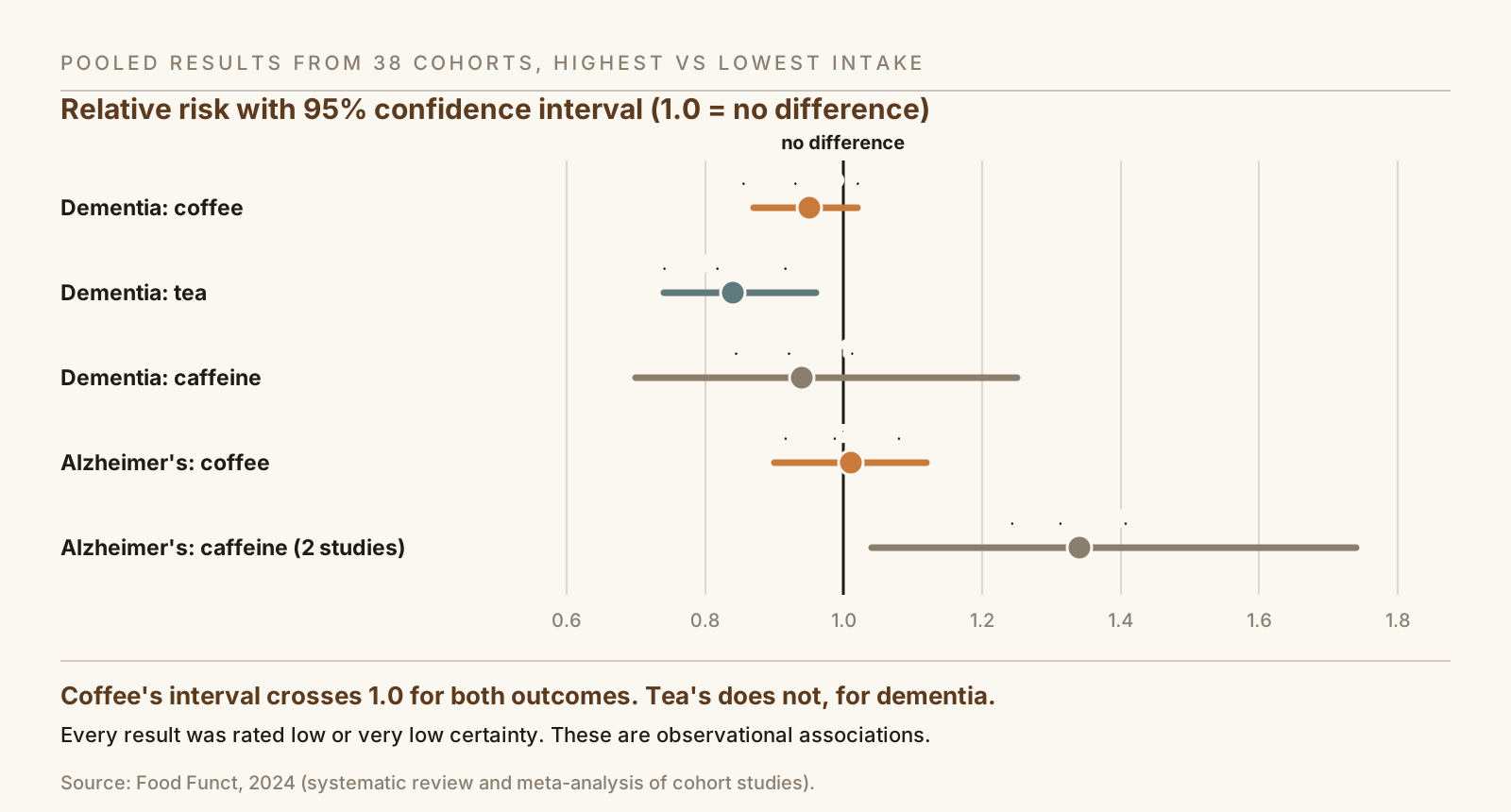
- Coffee and dementia: 0.95 (0.87 to 1.02), a range that includes no effect.
- Tea and dementia: 0.84 (0.74 to 0.96), the one clearly lower result for dementia.
- Coffee and Alzheimer’s disease: 1.01 (0.90 to 1.12), essentially flat.
- Caffeine and Alzheimer’s disease: 1.34 (1.04 to 1.74), but that rests on only two studies and was rated very low certainty. We wouldn’t read much into it in either direction.
The authors rated every one of these low or very low certainty on the GRADE scale. They also reported a non-linear pattern for coffee, with the lower-risk association at around 1 to 3 cups a day. That is a curve fitted to observational data, and it sits beside a headline result that includes no effect.
Why the results don’t line up
The 2015 analysis offers the clearest hint. When it split coffee results by study design, the pooled estimate was 0.70 for cross-sectional studies, 0.82 for case-control studies and 0.90 for cohort studies, and only the first excluded 1.0. In other words, the more the design could show what came first, the closer the number moved toward no effect. That’s a pattern in those numbers, not proof of why.
A few reasons that could plausibly matter, offered as our reading rather than the authors’ conclusions:
- Reverse causation. Dementia starts years before diagnosis. Someone with early memory or sleep changes may drink less coffee, which can make coffee drinkers look healthier.
- Who drinks what. Coffee and tea drinkers differ from non-drinkers in income, education, smoking and activity, and statistics only partly adjust for that.
- Mixed outcomes. Dementia, Alzheimer’s disease, cognitive impairment and cognitive decline are different endpoints, and the analyses blend them differently.
- Self-reported intake. “Cups a day” is a rough memory, often from a single questionnaire.
- Different people. The 2024 Nutrition Reviews analysis found ethnicity, sex and outcome type all changed the results.
None of the three is a trial. We found no randomized study that gave people coffee to see whether dementia was less likely.
What this means for your cup
If you’re weighing coffee against something gentler, this research shouldn’t be the deciding factor.
- Don’t start coffee for your brain. The better-designed pooled analysis didn’t show a clear coffee benefit, and observational links can’t tell you what a change would do.
- Don’t feel you’ve lost something by quitting. If you’re cutting back for sleep, anxiety or withdrawal-free mornings, the evidence here doesn’t say that costs you anything clear.
- Sleep is worth protecting on its own. Late caffeine can fragment it, which we explain in caffeine and sleep architecture.
- If memory worries you, talk to a clinician. A drink can’t stand in for an assessment.
If you want a warm cup without caffeine, herbal coffee versus decaf covers the differences. The studies above were about coffee, tea and caffeine, so they say nothing, good or bad, about chicory, carob or other herbal blends. If you’re wondering how much caffeine decaf still carries, we cover that too.
The bottom line
Studies of coffee drinkers and dementia don’t agree. The largest cohort-only analysis found no clear effect for coffee, a modest lower risk for tea, and low certainty throughout, and earlier analyses mixing study designs looked more favorable. Nothing here shows coffee protects the brain or that quitting harms it. Enjoy your cup, or don’t, for other reasons.
Sources & further reading
- Tea, coffee, and caffeine intake and risk of dementia and Alzheimer's disease: a systematic review and meta-analysis of cohort studies (opens in a new tab) — Food & Function, 2024
- Moderate coffee or tea consumption decreased the risk of cognitive disorders: an updated dose-response meta-analysis (opens in a new tab) — Nutrition Reviews, 2024
- Caffeine intake from coffee or tea and cognitive disorders: a meta-analysis of observational studies (opens in a new tab) — Neuroepidemiology, 2015
Reader conversation (4)
We read every response. Selected reader notes below.
My mother’s neurologist said the same thing in plainer words: the coffee studies are interesting but not a reason to change anything. Nice to see the confidence intervals spelled out instead of just the headline number.
Thanks, Patricia. The interval is where most of the story sits in this one, so it was worth slowing down on.
The point about reverse causation made me stop. I hadn’t thought that someone in the early stages might already be drinking less coffee.
I gave up coffee last spring for my sleep and kept worrying I’d just lost a brain benefit. This was reassuring without overpromising.
Surprised tea comes out a bit better than coffee. Would love to know whether the studies separated green from black.
Good question, Tom. The abstracts we read didn’t split tea by type, so we can’t say. It would be worth checking the full papers.
Have something to add? Email us and we may include it in a future update.