Quitting caffeine on a long-haul route: the coffee that cuts crash risk can also cost you the 10-hour reset
Truck drivers who use caffeine report 63 percent fewer crashes than those who don't — but the heaviest users report more crashes, not fewer. The difference isn't the drug, it's the timing, and the FMCSA's mandatory 10-hour break only does its job if your last cup isn't still half-active when it starts.

If you drive for a living, caffeine probably isn’t a preference. It’s equipment. And most of the advice aimed at people quitting caffeine assumes a life that isn’t yours — a kitchen, a set bedtime, a boss who doesn’t care what time you show up as long as you’re not late. None of that applies at 2am on I-40 with four hours left on your clock.
So this isn’t a piece about quitting caffeine like it’s a New Year’s resolution. It’s about two numbers that are both true, a federal rule most drivers know the shape of but not the chemistry behind, and what changes if you time your last cup instead of just drinking it whenever the tank feels empty.
The short answer
Caffeine use is genuinely associated with fewer crashes among long-haul drivers — a 2013 case-control study out of Australia found drivers who used caffeinated substances were 63 percent less likely to have been in a crash than drivers who didn’t. But a separate, larger 2020 study comparing light and heavy habitual users found the heaviest-caffeine drivers reported more crashes than the lightest, along with shorter sleep and more daytime sleepiness. Those aren’t contradictory findings. They’re describing two different things: caffeine used deliberately, in moderate doses, as a fatigue countermeasure looks protective. Caffeine used constantly, in escalating amounts, as a substitute for sleep you’re not getting looks like exactly what it is — a sign the sleep debt got too big for a stimulant to cover.
The part almost nobody connects to that second finding: caffeine’s roughly 5-hour average half-life means a cup timed late in your shift is often still active when the FMCSA’s mandatory 10-hour off-duty period starts — quietly working against the one thing that break exists to protect.
The paradox in the data
The 2013 study, published in BMJ, compared 530 drivers who’d recently been in a crash against 517 crash-free control drivers, all long-distance commercial operators in New South Wales and Western Australia. Forty-three percent of drivers said they used caffeine — tea, coffee, tablets, energy drinks — specifically to stay awake at the wheel. After adjusting for age, health conditions, sleep patterns, and hours driven, caffeine users showed a 63 percent lower crash risk than non-users. Read uncharitably, that’s a headline that writes its own defense of the industry’s coffee habit.
Read against the 2020 study, the picture gets more honest. Researchers from Loughborough University and the Virginia Tech Transportation Institute split more than 3,000 drivers into a low-caffeine group (about one caffeinated drink a day) and a high-caffeine group (five or more a day, averaging 7.5). The high-use group reported being involved in more crashes than the low-use group, alongside shorter sleep, more daytime sleepiness, and poorer health behaviors generally — smoking and poor diet included. The study’s own framing is the useful part: habitual high-dose caffeine use has the potential to impair nighttime sleep, which increases sleepiness and crash risk on the next shift, which invites more caffeine to compensate. That’s not caffeine failing. That’s caffeine being asked to do a job — replace sleep — that it structurally cannot do.
So the honest summary isn’t “truckers should drink more coffee” or “truckers should quit coffee.” It’s that caffeine, used with real awareness of timing and dose, is a legitimate tool. Caffeine used as a running total that only ever climbs is a symptom, and dealing with the symptom by adding more of it eventually stops working.
The 10-hour collision
Here’s the mechanism that connects those two studies to a rule every driver already knows the shape of. Under FMCSA Hours of Service regulations (49 CFR Part 395), a property-carrying driver can drive up to 11 hours after 10 consecutive hours off duty, with all driving confined to a 14-hour on-duty window and a 30-minute break required after 8 cumulative hours behind the wheel. Weekly caps run 60 hours over 7 days or 70 over 8, reset by 34 consecutive hours off.
That 10-hour off-duty period is doing more than satisfying a regulation. It’s the block of time the rule assumes you’ll use to actually recover — which means its usefulness depends on your body being able to fall asleep once it starts, not several hours later. Caffeine’s average half-life is about 5 hours, with individual variation anywhere from roughly 2 to 10. Applied to a typical late-shift cup, the numbers look like this:
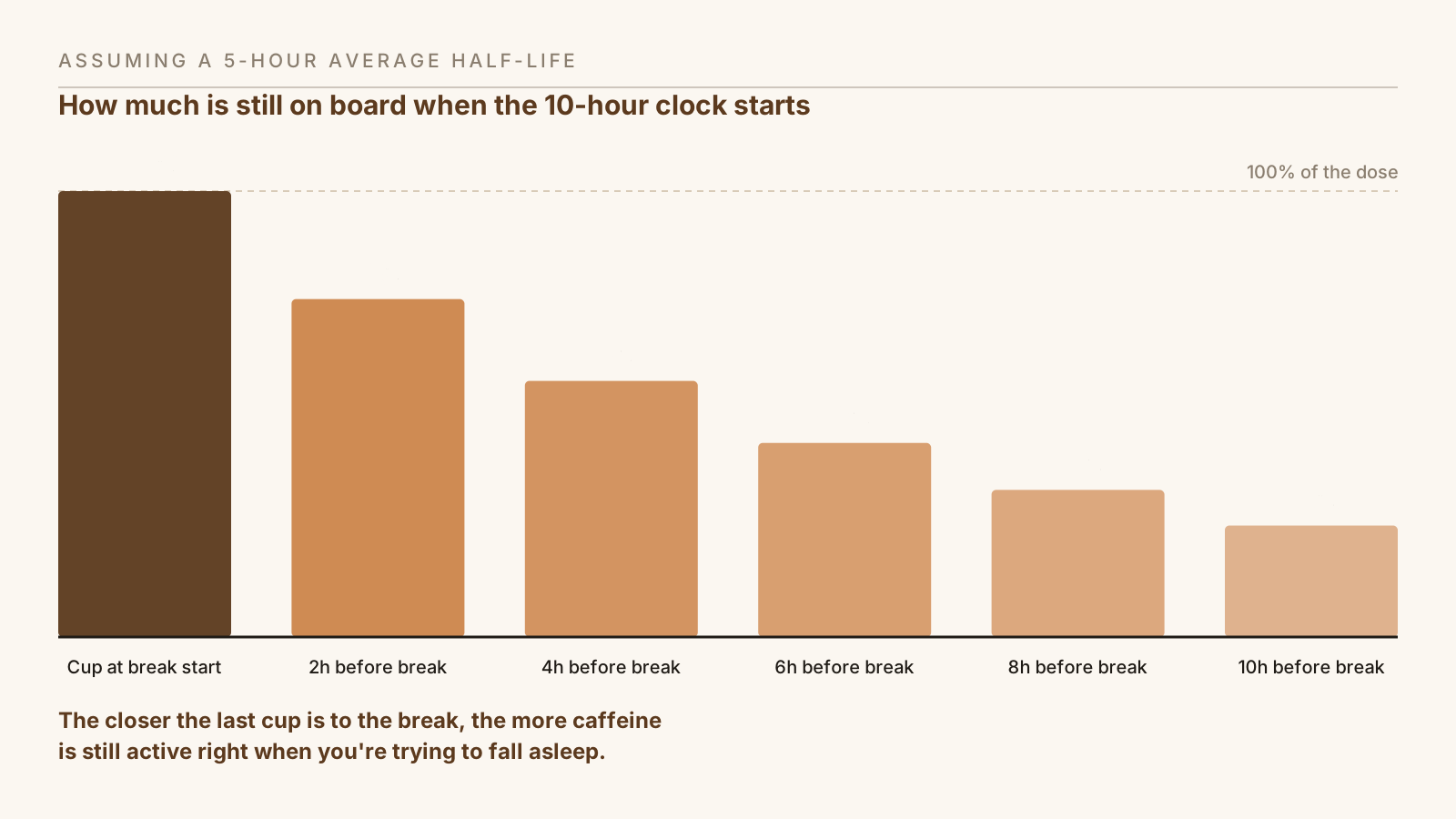
That’s the collision. The same cup that got you through the last stretch of a shift, taken too close to the end of it, is still measurably active during the exact window the federal government requires you to rest in. It doesn’t override the 10 hours — you can still lie in the sleeper for all 10 — but sleep you can’t fall into isn’t the recovery those 10 hours were designed to provide. A driver who does this nightly is, without necessarily realizing it, building the same pattern the 2020 study found in its heaviest-caffeine group: shorter effective sleep, more next-day sleepiness, more reach for caffeine on the following shift.
Timing your last cup, not just cutting it
None of this requires quitting. For most drivers the higher-leverage move is moving the cutoff earlier, not cutting the amount.
- Treat your last dose as due mid-shift, not whenever you feel the dip. If your on-duty window runs 14 hours, aim to have your last caffeine somewhere in the first half of it rather than reaching for one in the final few hours before you park.
- The afternoon or early-evening cup is usually the one doing the damage, not the morning one. The math above applies to whichever cup is closest to your break — pushing your last dose earlier by even 2 to 3 hours meaningfully changes how much is left when the 10 hours start.
- A short, deliberate nap beats a late cup for the last hour of a shift, if your schedule and a safe place to stop allow it. It doesn’t carry the same downstream cost against your next sleep period.
- Log it like you log hours. A rough mental note of “last cup around 6pm” is enough to notice a pattern of creeping later — the same way HOS logs exist so you notice a pattern of creeping hours.
Tapering before a multi-day run
If you’re trying to cut back or quit caffeine altogether rather than just retime it, a multi-day route is a legitimately bad place to do it cold. The withdrawal headache described in how to quit caffeine without the headache is a real, physiological event — not a character problem — and it doesn’t wait for a convenient moment to show up. Having it hit at hour 9 of an 11-hour driving day, with no kitchen, no quiet room, and no control over when you can pull over, is a worse version of a headache that’s manageable almost anywhere else.
The fix is the same taper shape used everywhere else on this site: cut by roughly a quarter to a third every few days rather than dropping to zero at the start of a run. If your schedule includes a multi-day break at a terminal or at home, that’s the natural place to land the roughest 2 to 3 days of the adjustment — the same logic behind why caffeine wrecks your afternoon applies here: the goal is giving your adenosine receptors time to recalibrate before you hit zero, not forcing the whole adjustment into one unlucky shift.
Drivers coming off rotating or overnight schedules have a second layer to manage — sleep that’s already irregular before caffeine even enters the picture. Day-sleep that actually works and a morning routine for shift workers both cover the mechanics of getting real rest on a schedule the rest of the world isn’t running on, which matters more, not less, while you’re tapering.
What to drink in the cab, if you want to keep the cup
One honest limitation first: most herbal coffees, Teeccino’s included, are ground blends you brew like real coffee — a French press, a percolator, or a 12V coffee maker handles it, but there’s no getting around needing hot water and a few minutes. That’s a real mismatch for a cab with no galley, and worth naming rather than glossing over.
If you’ve got the setup for it, a roasted-chicory or roasted-grain blend pours dark enough to keep the ritual — the cup in the console holder, the smell, the routine — even during the stretch of your taper where the caffeine amount is dropping toward zero. Teeccino’s French Roast (opens in a new tab) is one option, though it contains barley and almonds, so it’s not the pick if you’re avoiding gluten or tree nuts — Teeccino’s Dandelion Dark Roast is gluten-free if that’s the constraint. Pero and other roasted-grain blends work on the same principle. None of them will keep you alert; that’s not the job they’re doing. The full field, including brands with a genuine caffeine kick if that’s what you actually need, is in the best caffeine-free coffee alternatives.
For the hours where you do need real alertness, that’s a caffeine job, not an herbal-coffee job — and the timing guidance above matters more than the source you get it from.
The bottom line
Caffeine isn’t the enemy here, and it isn’t free, either. Long-haul drivers who use it deliberately have real, documented lower crash risk than drivers who don’t — and long-haul drivers whose use has climbed high enough to itself be wrecking sleep have real, documented higher crash risk than drivers using less. The difference between those two groups usually isn’t willpower. It’s timing: whether the last cup of a shift lands early enough to be mostly cleared by the time the mandatory 10-hour reset starts, or late enough to still be fighting it. Moving your cutoff earlier costs you nothing you’re not already giving up to fatigue. Whether you’re adjusting the timing or tapering off entirely before a run, the goal is the same one behind every other version of this advice on this site: let your body do the recovering the rules already gave it time to do.
This article is educational and not medical or safety-compliance advice. If you have a sleep disorder, a health condition, or questions about your specific carrier’s fatigue-management policy, talk to a doctor or your safety department before changing your caffeine routine.
Sources & further reading
- Use of caffeinated substances and risk of crashes in long distance drivers of commercial vehicles: case-control study (opens in a new tab) — BMJ, case-control study, 2013
- Associations between high caffeine consumption, driving safety indicators, sleep and health behaviours in truck drivers (opens in a new tab) — Safety Science, 2020
- FMCSA Hours of Service Rules Explained (11-Hr, 14-Hr, 70-Hr Full Guide) (opens in a new tab) — compliance guide summarizing 49 CFR Part 395
- Caffeine (opens in a new tab) — NCBI Bookshelf
- The DOT 5 Panel Drug Test: What To Know (opens in a new tab) — National Drug Screening
Reader conversation (5)
We read every response. Selected reader notes below.
27 years OTR and this is the first time I’ve seen someone actually do the math on the 10-hour break instead of just saying “don’t drink coffee too late” like that means anything specific. Moved my last cup up to around 3pm on a normal 14-hour day and I’m falling asleep faster at the truck stop. Small thing, added up over a month it isn’t small.
That’s the whole point of putting a number on it instead of a vibe — “too late” doesn’t tell you anything actionable, “still 57 percent on board at 4 hours” does. Really glad it’s translating to actual sleep at the stop.
My husband drives regional and I’ve been telling him this exact thing for years — that the 4pm energy drink is why he can’t sleep at the hotel even though he’s exhausted. He didn’t believe me until I showed him this article had a chart. Something about it being “a website” instead of his wife apparently helps.
Appreciate that you didn’t just say “quit caffeine” like every wellness article aimed at everyone else. Quitting cold on a route sounds like a genuinely bad idea and nobody who’s actually driven for a living would recommend it. The taper-around-your-scheduled-restart idea is the first practical version of this I’ve seen.
63% less likely to crash if you drink caffeine, sure, but that’s still just a correlation between “people who deliberately manage their fatigue” and “fewer crashes.” Feels like the causal story here is discipline, not the caffeine molecule itself.
Fair, and the study can’t fully separate those — “management” and “caffeine use” are tangled together in a self-reported sample, and the researchers say as much. What the second study adds is the part that’s harder to explain away with discipline alone: it’s the same population, self-selected the same way, and the heaviest users still came out worse. That’s more consistent with a dose effect than with caffeine being purely a marker of good habits.
Fleet safety manager here. Forwarding this one to our driver newsletter if that’s alright — the DOT panel FAQ answer alone clears up a question I get asked at least once a month.
Have something to add? Email us and we may include it in a future update.