Does caffeine cause breast pain? Surveys link the two, but the one randomized trial found only a minor change
Can cutting caffeine ease breast tenderness? Surveys find an association, a small 1980s trial found a minor change, and an uncontrolled study reported relief. What the research shows and what it can't.


The short answer
Surveys keep finding that women who report breast pain also tend to report more caffeine. The trial evidence is thinner and older: one randomized trial from 1982 found a small change when women avoided caffeine, and its own authors said it may not matter clinically. So caffeine is a reasonable thing to experiment with, and a poor thing to promise anyone.
I’m not a clinician, and this isn’t medical advice. This is a look at four studies, read from their abstracts, so you can decide whether a trial of your own is worth it.
What the surveys show
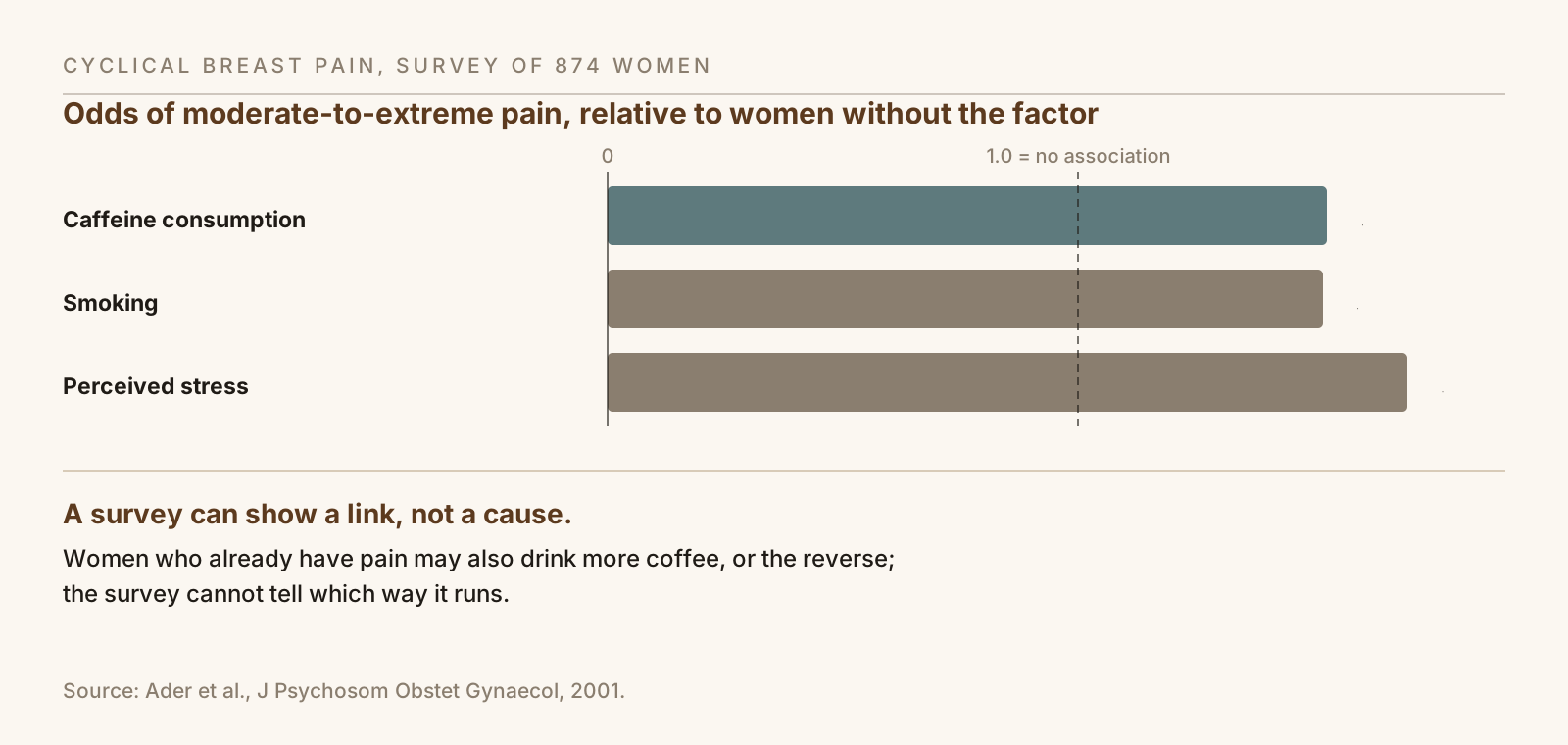
Cyclical breast pain, the kind that follows the menstrual cycle, is common. In a 2001 telephone survey of 874 women aged 18 to 44 in Virginia, 68% reported cyclical breast symptoms and 22% reported moderate to extreme discomfort. Caffeine consumption, smoking and perceived stress were each associated with that pain, with odds ratios of 1.53, 1.52 and 1.7.
A 2016 study from Istanbul compared 500 women with breast pain against 200 without it. Stressful lifestyle, caffeine consumption and smoking were again associated with pain.
The catch is the one every survey shares. It asks people what they drink and how they feel at one point in time. Someone with sore breasts might drink more coffee because they sleep badly, or less because they’re trying to feel better. Our reading is that the surveys can’t separate those possibilities, and neither paper claims they can.
The one randomized trial
The strongest design here is a 1982 randomized trial by Ernster and colleagues. They assigned 158 women who had come in with a breast concern either to a group encouraged to avoid methylxanthines (caffeine, theophylline and theobromine, found in coffee, tea, colas and chocolate) or to a group given no dietary advice.
About four months later, the avoiding group had a statistically significant reduction in clinically palpable breast findings compared with the controls. The authors added that the absolute change was minor and may be of little clinical significance. Before-and-after mammograms offered little support for the idea, and there was no link between findings at the first visit and how much caffeine women reported then.
Two things to keep in mind. The trial measured what a clinician could feel on examination, not how much pain a woman felt day to day. And it’s more than 40 years old, so I’d treat it as a lead, not an answer.
The study that reported relief
A 1989 study from Duke followed 138 women with breast pain who were counseled to cut or stop caffeine. After a year, 113 (81.9%) had substantially reduced their intake, and 61% of those women (69 of 113) reported less pain or none. The author concluded that caffeine restriction was an effective way to manage it.
That’s the sort of result that gets quoted widely, so here is why I’d hold it loosely:
- There was no comparison group. Breast pain often varies from month to month, and some of these women would likely have improved anyway.
- Pain was self-reported, and women who were told caffeine was the suspect knew they were being asked about it.
- Four in ten of those who cut back did not report improvement.
None of that means the finding is wrong. It means it can’t show that caffeine was the reason.
If you try cutting back
If you want to test it yourself, a few practical points follow from the research and from what we know about withdrawal:
- Taper instead of stopping on one day. A sudden stop can bring a headache, and that could muddy the picture. Our guide to quitting caffeine without the headache has a schedule.
- Keep a simple note. Mark pain levels across a few cycles, along with your caffeine, so you can see whether anything shifts. One month is too short to judge.
- Count the other sources. The trials grouped caffeine with related compounds in tea, cola and chocolate. Our article on caffeine in chocolate shows how much comes from places people forget.
- Change one thing at a time. If you cut caffeine, stop smoking, and start a new routine all in the same month, you won’t know which of them helped.
- Plan for the withdrawal window. Our piece on how long caffeine withdrawal lasts covers the typical range, so a headache in week one isn’t misread as a new symptom.
A brew from roasted chicory or barley has no caffeine, so it can fill the morning-cup slot while you try this. The studies didn’t test it, so I can’t tell you it will change anything. If you’re curious about what’s in one, start with what is chicory coffee. We’ve also covered a related question for hormone-sensitive symptoms, in caffeine and hot flashes.
When to ask a clinician
Breast pain is common and is often not a sign of anything serious, but it’s still worth a conversation if:
- it’s new, or it has changed in pattern
- it affects one spot or one side and doesn’t follow your cycle
- you notice a lump, skin change or discharge
- it keeps you from sleeping or from daily activities
Say how much caffeine you have, too. It’s a normal question for them to ask, and the answer helps them think it through with you.
This article is general information, not medical advice. If you have symptoms that worry you, talk to your clinician.
Sources & further reading
- Cyclical mastalgia: prevalence and associated health and behavioral factors (opens in a new tab) — Journal of Psychosomatic Obstetrics and Gynaecology, 2001 (Ader et al.)
- Factors effecting mastalgia (opens in a new tab) — Breast Care, 2016 (Eren et al.)
- Effects of caffeine-free diet on benign breast disease: a randomized trial (opens in a new tab) — Surgery, 1982 (Ernster et al.)
- Caffeine restriction as initial treatment for breast pain (opens in a new tab) — Nurse Practitioner, 1989 (Russell)
Reader conversation (4)
We read every response. Selected reader notes below.
I started keeping a cycle diary after reading about the one-month problem here. Three cycles in, the notes are more useful than my memory ever was.
Thank you for explaining why the 1989 study cannot be taken at face value. I had seen it quoted as proof before.
Thank you, Joanne. It is a useful study, just not a controlled one, so it works best as a reason to try a careful experiment.
My tenderness did not change when I cut coffee, but my sleep improved. Good reminder that it does not work for everyone.
The list of when to ask a clinician is the part I am sending to my sister.
Read this and have a question or something to add? Send us a note. With your OK, we may publish it here with an editor's follow-up. We only publish notes you've said we can.