Why does coffee send you to the bathroom? Decaf does it too, and caffeine isn't the whole story
Coffee stimulates the colon about as strongly as a meal in one small study, and decaf did too. What the studies found, where they disagree, and what a caffeine-free swap can and can't tell you.


The short answer
If a cup of coffee reliably sends you looking for a bathroom, you are not imagining it, and you are not alone. A small study that measured the colon directly found that coffee stirs it up about as much as a meal does. The odd part is that decaf appeared to do something similar, so caffeine looks like part of the story and not all of it. Nobody has a complete explanation yet.
I’m a dietitian, not your doctor, and this isn’t medical advice. This is a read of what the studies found and how far they go.
The study that measured it
In 1998, researchers at the University of Iowa put a thin pressure-sensing probe into the colons of 12 healthy volunteers and recorded muscle activity over a day. Each person received four stimuli, in random order: 240 ml of black coffee containing 150 mg of caffeine, decaffeinated coffee, water, and a 1,000-calorie meal.
- Caffeinated coffee, decaf and the meal all produced more activity than water, with more pressure waves and more contractions that travel along the colon.
- The authors reported caffeinated coffee’s effect as similar to the meal, 60% stronger than water and 23% stronger than decaf.
- The effect was greater in the upper and middle parts of the colon than in the lower end.
- Decaf’s effect was not significantly different from water or from regular coffee, and it was lower than the meal’s.
That last pair of findings is why I’d be careful about saying decaf “does the same thing.” With 12 people, the study had little power to separate decaf from either water or regular coffee. It shows decaf landing somewhere between the two, and it can’t say where.
Why it isn’t just the caffeine
A 1999 review from a gastroenterology group in Utrecht took up the same puzzle. Coffee has no calories, so the effect can’t be the energy in the cup. It also can’t be explained by the volume of liquid, the acidity, or how concentrated the drink is. The authors concluded that coffee must have pharmacological effects, and that caffeine cannot solely account for them. They also noted that in some people coffee raised activity in the lower bowel within about four minutes of drinking it.
A 2022 narrative review in Nutrients lists stimulation of colon movement among the digestive effects of coffee that “seem rather clear,” alongside stimulation of stomach acid and of bile and pancreatic secretion. One caution about that review: it was commissioned by the Institute for Scientific Information on Coffee, a coffee-industry body, though the author says it had no role in how the review was organized or written. I read it as a useful summary, not a neutral referee.
What I can’t tell you from these abstracts is which compound in coffee is responsible. That is still open, and I’d distrust any article that names one with confidence.
When the effect is wanted
The same stimulating effect has been put to use after abdominal surgery, where the gut can stall for a few days. A 2022 meta-analysis pooled four randomized trials with 312 people having colon surgery. Those who drank coffee or took caffeine afterward passed their first stool about 10 hours sooner (95% CI, 6 to 15 hours), left the hospital about a day earlier on average, and were less likely to need laxatives.
That is hospital care with a specific goal, not a lesson about your morning cup, and the trials were small. It does show the effect can be measured outside a single lab study.
If you are preparing for a bowel procedure, the question is different, and we cover it in coffee during colonoscopy prep.
Do the studies agree?
Mostly on the short-term effect, less on the longer-term question of whether coffee helps people who have trouble passing stools. A 2025 systematic review looked for exactly that. It found eight studies using coffee, tea, energy drinks, cocoa and kombucha. Four concluded caffeine may help. Four showed no improvement or a worsening. The studies were too different to combine, and only one was a randomized trial.
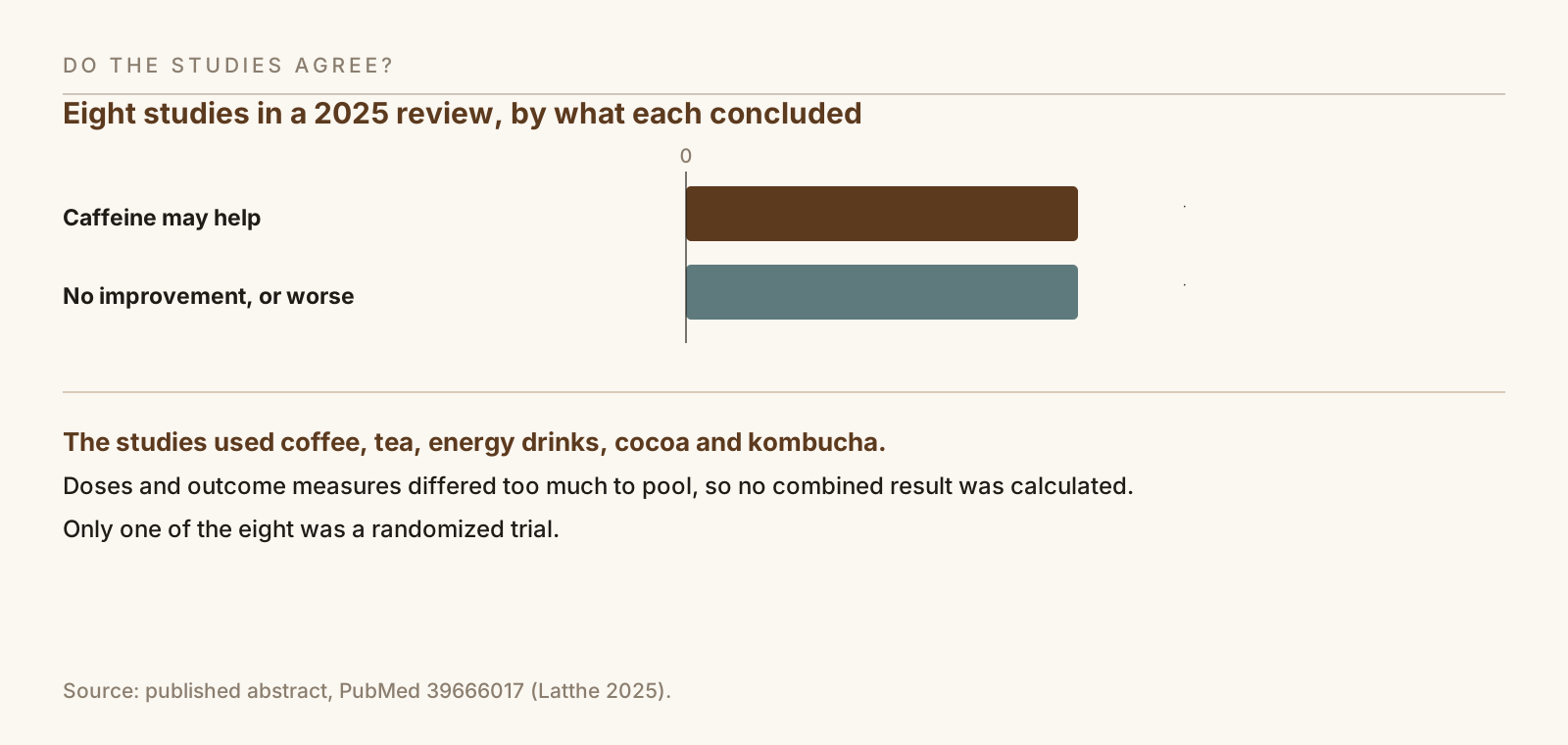
The reviewers’ conclusion was that results conflict and better trials are needed. That fits what many people notice for themselves: coffee gets some people moving and does little for others.
What none of this tells you
- I read abstracts, not full papers. Details such as exact timing, sample makeup and how results were scored are limited to what the abstracts say.
- The colon study is tiny. Twelve healthy adults, one session each, a single 240 ml serving.
- It’s not about long-term habits. Nothing here tells you whether regular coffee drinking changes your bowel habits over months.
- No data on herbal coffee. None of the studies tested roasted chicory, barley, carob or similar blends, so I can’t tell you how those behave.
- Milk, sugar and timing are untested here. What you add and when you drink it may matter, and these studies don’t address it.
If you want to test it yourself
This is a low-risk experiment for most healthy adults. If you have ongoing digestive symptoms or take medicines, check with your clinician first.
- Note your baseline for a few days. Write down what you drink and when you needed the bathroom.
- Change one thing. Swap regular coffee for decaf and leave everything else alone for a week or two. Decaf isn’t zero caffeine, as how much caffeine is in decaf explains.
- Then try a caffeine-free brew if you want a cleaner comparison. Roasted chicory, barley and carob drinks have no caffeine. They also haven’t been studied for this, so treat it as your own trial. Our explainer on what is chicory coffee covers what’s in them.
- Taper rather than stopping cold if you currently drink several cups. How to quit caffeine without the headache has a schedule.
- Compare notes. If nothing changes, caffeine probably isn’t the trigger for you, and that is useful to know.
If the effect shows up elsewhere in the body, caffeine and bladder urgency looks at the trials on that question. For another way coffee acts on the digestive system, see coffee and gallstones.
This article is general information, not medical advice. Talk to your clinician about bowel changes that are new, painful, or that worry you.

Sources & further reading
- Is coffee a colonic stimulant? (opens in a new tab) — European Journal of Gastroenterology & Hepatology, 1998 (Rao et al.)
- Coffee and gastrointestinal function: facts and fiction. A review (opens in a new tab) — Scandinavian Journal of Gastroenterology Supplement, 1999 (Boekema et al.)
- Effects of Coffee on the Gastro-Intestinal Tract: A Narrative Review and Literature Update (opens in a new tab) — Nutrients, 2022 (Nehlig)
- The Effectiveness of Caffeine in Reducing Constipation in Adults: A Systematic Review (opens in a new tab) — International Urogynecology Journal, 2025 (Latthe et al.)
- The effect of coffee/caffeine on postoperative ileus following elective colorectal surgery: a meta-analysis of randomized controlled trials (opens in a new tab) — International Journal of Colorectal Disease, 2022 (Yang et al.)
Reader conversation (4)
We read every response. Selected reader notes below.
Ten minutes after my first cup, every single morning. I had no idea decaf could do something similar. I will try the swap for a week.
Thanks for saying the colon study only had 12 people. That kind of detail usually gets left out.
Glad it helped, Marcus. A small study can still be interesting, as long as we say how small.
The four-to-four split made me laugh. My husband barely notices coffee, and I plan my mornings around it.
I like that it says nobody has tested herbal coffee for this instead of guessing. I will run my own diary.
Read this and have a question or something to add? Send us a note. With your OK, we may publish it here with an editor's follow-up. We only publish notes you've said we can.