Does coffee cause gallstones? Studies of coffee drinkers point the other way, and the decaf result is the odd one
A pooled analysis of 227,749 people found coffee drinkers were diagnosed with gallstones less often. What the cohort studies, two genetic studies and the decaf result show, and what it means if you're cutting back.


If you’ve heard that coffee is hard on the gallbladder, the research doesn’t back that up. Studies that follow coffee drinkers over time have mostly found fewer gallstone diagnoses among them, not more. One result, about decaf, doesn’t fit the pattern, and it’s worth looking at honestly.
The short answer
- A pooled analysis of six studies found coffee drinkers had a lower rate of gallstone disease, and the rate fell as cups per day rose.
- The pattern showed up in women and not in men in that analysis.
- Two genetic studies from 2022 add to the picture, and one of them points the other way on decaf, so it isn’t settled.
- None of this shows coffee prevents gallstones, and it isn’t a reason to start drinking it.
The pooled analysis
The summary we lean on is a 2015 meta-analysis in Alimentary Pharmacology & Therapeutics (opens in a new tab) by Zhang and colleagues. It combined one case-control study and five prospective cohort studies (seven cohorts among them), covering 227,749 participants and 11,477 cases of gallstone disease.
Across the prospective studies, coffee drinkers had a relative risk of 0.83 (95% range 0.76 to 0.89) compared with the lowest drinkers. A relative risk below 1.00 means fewer cases in the coffee group. The dose-response estimates were 0.89 at two cups a day, 0.81 at four and 0.75 at six.
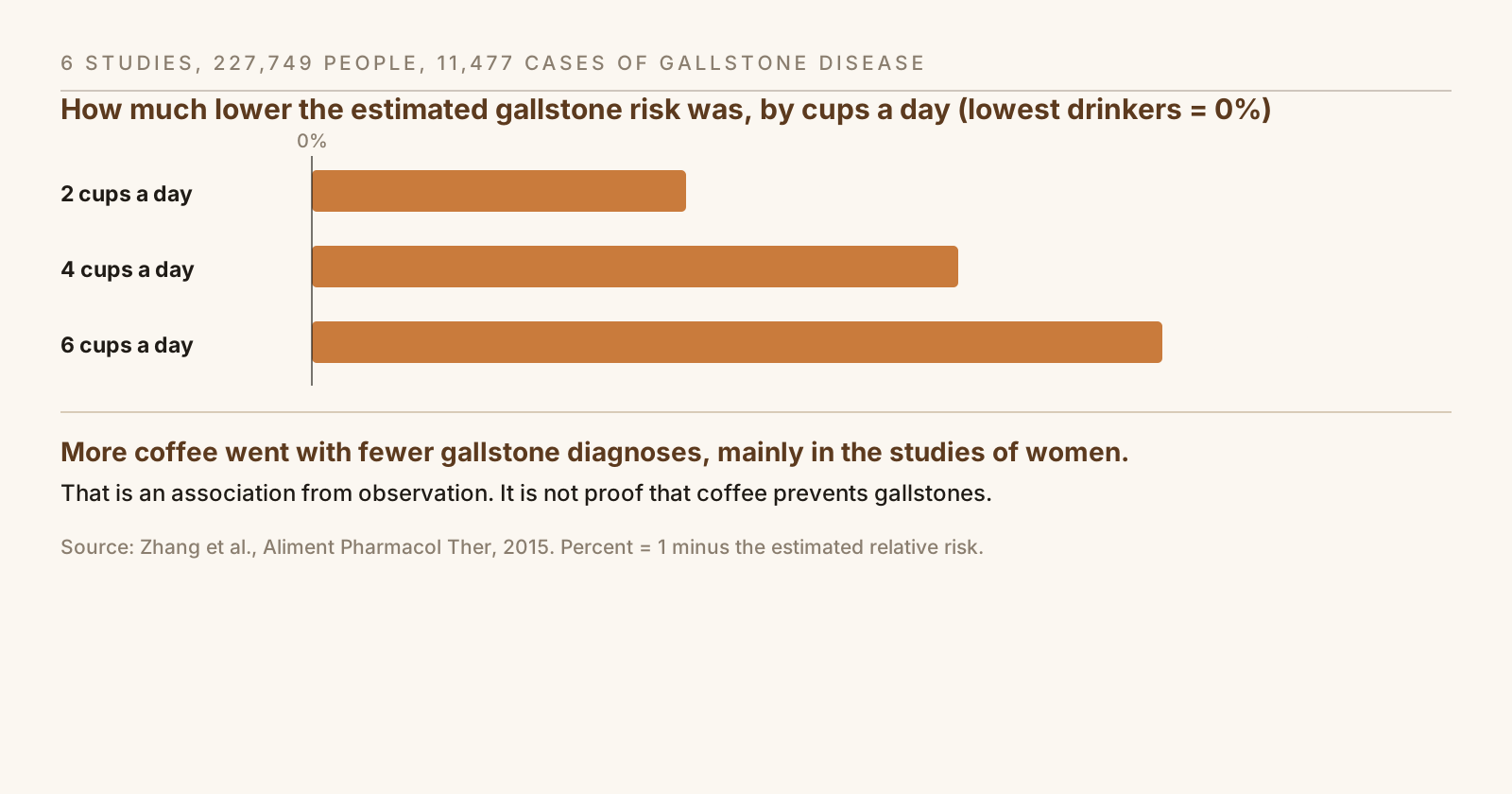
Two details temper that. The analysis saw the inverse link in women but not in men. And the single case-control study showed no association at all (odds ratio 0.99, range 0.64 to 1.53). Six cups is also a lot of caffeine for most people, and these are statistical comparisons, not a suggested dose. Our piece on caffeine and kidney stones tells a similar “large studies lean the other way” story, with the same limits.
What the genetic studies add
Ordinary studies can’t separate coffee from the people who drink it. Mendelian randomization tries to get around that by using genetic variants that nudge how much coffee someone tends to drink. Those variants are fixed at conception, so they aren’t shaped by lifestyle in the same way.
A 2022 study in Clinical Gastroenterology and Hepatology (opens in a new tab) used UK Biobank and FinnGen data, with 10,520 and 11,675 gallstone cases. Genetically predicted coffee consumption was inversely associated with gallstone disease after adjustment for body mass index and smoking (odds ratio 0.44 per 50% increase in intake, range 0.21 to 0.91). The range is wide, so the size of the effect is uncertain. The same paper found that higher body mass index, type 2 diabetes and smoking were linked to more gallstones, and its stated conclusions are about those three, not coffee.
The decaf result
A separate 2022 analysis in Frontiers in Nutrition (opens in a new tab) by Bai and colleagues did two things. Its meta-analysis of longitudinal studies again found coffee linked to lower risk (relative risk 0.86, range 0.79 to 0.93), and tea linked to slightly higher risk (1.08).
Its genetic analysis then went somewhere unexpected. Genetically predicted decaffeinated coffee intake was associated with higher gallstone risk (1.127, range 1.043 to 1.217), and the authors concluded decaf may be a causal risk factor. Genetic markers for caffeine metabolism and for tea consumption pointed toward lower risk.
We don’t know why decaf came out this way. It is a single analysis, and the abstract doesn’t offer a mechanism. One thing we can say, as our own reading and not the authors’, is that genetic proxies for decaf may be tangled up with who chooses decaf in the first place. Treat it as an open question, not a warning. If you’re comparing the two, is decaf coffee bad for you and how much caffeine is in decaf cover the basics.
What these studies can’t tell you
- They compare groups. People who drink coffee may differ in weight, diet, activity and smoking. Researchers adjust for what they measured, not everything.
- Nobody randomized people to years of coffee. We found no trial of coffee and gallstones.
- Results differ by sex and study type. The inverse link appeared in women and not men, and the one case-control study found none.
- They say nothing about herbal coffees. We found no gallstone research on chicory, dandelion or carob blends.
- Weight, diabetes and smoking carry the clearest signals. In the 2022 genetic study, those were the factors its conclusions rest on.
If you’re cutting back or quitting
This evidence shouldn’t change a decision to cut caffeine for sleep, anxiety, reflux or any other reason. It describes a pattern in people who already drank coffee and doesn’t show that stopping raises your risk.
- If you want the taste without the caffeine, herbal coffee versus decaf compares the two, and our caffeine-free coffee roundup is the place to start.
- If you’ve had gallbladder pain or gallstones, or you’ve been told you’re at risk, ask your care team about your own diet. Coffee isn’t a treatment, and nothing here replaces medical advice.
- For a similar look at another organ, see coffee and the liver.
The bottom line
Studies of coffee drinkers link more coffee to fewer gallstone diagnoses, mainly in women, though genetic studies disagree on decaf and can’t settle cause. It isn’t a reason to start drinking coffee, and if you’ve moved on from it, nothing here says you should go back.
Sources & further reading
- Systematic review with meta-analysis: coffee consumption and the risk of gallstone disease (opens in a new tab) — Zhang YP and colleagues, Alimentary Pharmacology & Therapeutics, 2015
- Obesity, Type 2 Diabetes, Lifestyle Factors, and Risk of Gallstone Disease: A Mendelian Randomization Investigation (opens in a new tab) — Yuan S and colleagues, Clinical Gastroenterology and Hepatology, 2022
- Addictive behavior and incident gallstone disease: A dose-response meta-analysis and Mendelian randomization study (opens in a new tab) — Bai Y and colleagues, Frontiers in Nutrition, 2022
Reader conversation (4)
We read every response. Selected reader notes below.
I’ve avoided coffee since my gallbladder scare, assuming it was the culprit. Good to see the research leans the other way, and good that you said it’s not proof.
Thanks, Marianne. Gallbladder symptoms are worth taking to your own care team before changing your routine, since this research can’t speak to your situation.
The decaf result surprised me. Appreciate that you didn’t invent an explanation for it.
The women-but-not-men detail is the kind of thing headlines drop. Useful to see it near the top.
I quit coffee for sleep last spring. Glad to read this isn’t a reason to go back.
Have something to add? Email us and we may include it in a future update.