What is yaupon? The caffeinated American holly behind the "black drink," and why it isn't a caffeine-free swap
Yaupon is a southeastern US holly whose roasted leaves have been brewed for centuries. It contains caffeine, and its Latin name is a colonial-era misunderstanding. What we could verify, and what we couldn't.


Most of the ingredients on this site are caffeine-free stand-ins for coffee. Yaupon is a different kind of entry: a native American plant that people have brewed for centuries precisely because it contains caffeine. If you are cutting caffeine, that matters more than the history, so we’ll start there.
The short answer
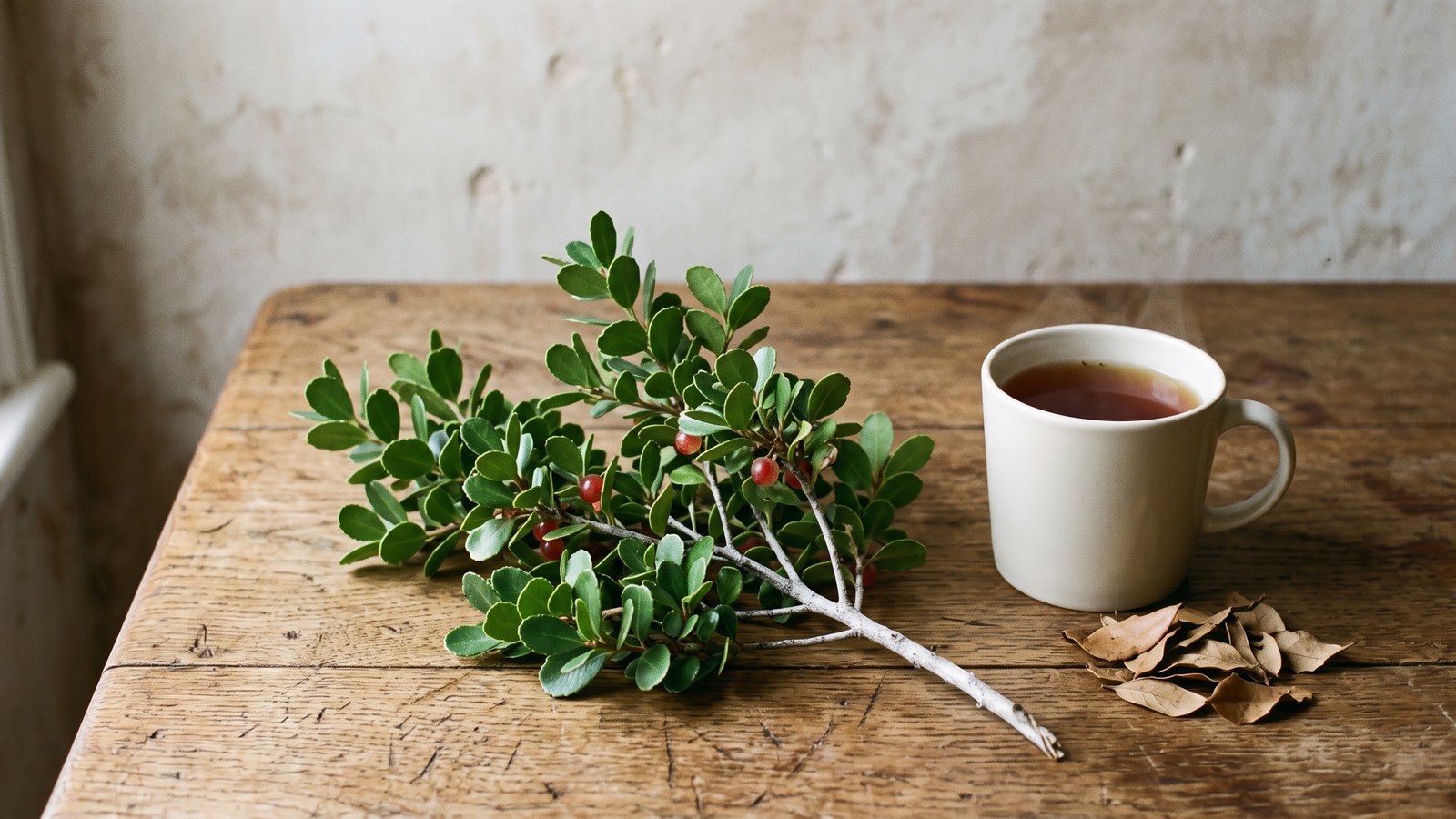
Yaupon (say “YAW-pon”) is an evergreen holly that grows along the southeastern US coast. Its leaves and twigs, usually roasted, are steeped into a dark, tea-like drink. It contains caffeine, so it is a lower-key alternative for coffee only if caffeine isn’t the thing you’re avoiding.
What yaupon actually is
Yaupon is Ilex vomitoria, a member of the holly family. The USDA plant guide describes a shrub or small tree up to about 8 meters tall with small, leathery, shallow-toothed leaves and red berries that often hang on into spring. It grows in sandy coastal soils on the Atlantic and Gulf coasts. Wikipedia gives a wider native range, from Virginia’s Eastern Shore to Florida and west to Texas and Oklahoma.
It is related to yerba mate and guayusa, two other caffeinated holly drinks. If you want that comparison, our yerba mate piece covers the better-known cousin.
The caffeine question
The sources agree yaupon contains caffeine. They disagree about how much, and we could not settle it.
- The USDA guide is plain about it. It says the leaves contain caffeine and calls yaupon the only native North American plant that does. Wikipedia’s entry says it is one of two, the other being dahoon holly (Ilex cassine), reported as having 80 percent less caffeine. Sources differ, so we’d say “one of very few.”
- The numbers don’t line up. Wikipedia’s tea article cites a leaf caffeine range of 0.0038 to 0.2288 percent by weight, against 1.01 to 1.42 percent for coffee beans. Yet the same article says yaupon has more caffeine than strong coffee, which its own figures contradict. We trust the percentages over the sentence, but we have not opened the original studies.
- There is a second compound. The same article describes a caffeine-to-theobromine ratio of about 5 to 1, cited to Crown and colleagues (2012). Cacao runs the other way, with far more theobromine than caffeine. People sometimes use this to say yaupon feels “smoother.” We found no research establishing that, so treat it as folklore.
- There is no reliable cup figure. We did not find a verified milligrams-per-cup number, and how much ends up in the cup depends on how much leaf you use and how it was roasted. A rough rule is to count it like a cup of tea or more until you know how you react. That is a caution, not a measurement.
For context on why even a modest dose can follow you into the evening, see our caffeine half-life piece.
The black drink and the name
According to the USDA guide, many Southeastern tribes, including the Alabama, Cherokee, Creek, Natchez and Seminole, brewed the leaves and shoots into a decoction called black drink. It was served socially and offered to visitors as a sign of friendly intent. It was also used ceremonially and medicinally, including as an emetic to induce vomiting and produce ceremonial purity. The guide notes that in some tribes women and boys were barred from drinking it, and that the Florida Seminoles still brew a black drink for their annual Green Corn Dance, though not always from yaupon.
That ceremonial vomiting is how the plant got its Latin name. Wikipedia says vomitoria came from early European observers who misread the ritual, and that the plant is not itself emetic. Any vomiting “likely resulted from the ceremonial context,” meaning large volumes drunk while fasting. Some scholars think the name was also used to discredit yaupon in a trade rivalry with Asian tea, which Wikipedia presents as a view, not a settled fact. We’d add that the USDA guide describes emetic use without that caveat, so the record is not entirely tidy.
One practical consequence: you may see online recipes for “ceremonial” black drink. Wikipedia notes that some Native Americans have criticized those recipes as potentially dangerous because they leave out key steps. Everyday yaupon tea is a different thing from the ceremony.
From Carolina tea to near-disappearance
Wikipedia’s account, which we haven’t verified against primary histories, runs like this:
- Spanish settlers in Florida were drinking it by 1615, and Carolina colonists widely used it by the early 1700s under names like “Carolina tea.”
- It was promoted during the Revolution as a local “liberty tea” and used as a coffee and tea substitute in the Civil War. For how other substitutes filled that role, see our wartime coffee history.
- Use then declined, partly because it became associated with poor rural people and Black Southerners. By 1928 it was reportedly in common use only on Knotts Island, North Carolina.
- Small producers in Florida, Georgia and Texas began harvesting it again in the early 2000s, and the American Yaupon Association formed in 2018.
Archaeological residue studies, cited in the same article, point to use stretching back a thousand years or more, including Cahokia beakers dated to 1050 to 1250 CE. We haven’t read those studies, so treat the dates as reported, not confirmed.
How it was prepared
The USDA guide says leaves and shoots were roasted in an earthenware container over a fire, much like coffee beans. Wikipedia adds that leaves were picked close to brewing time and lightly parched, then boiled until the liquid turned dark brown, strained and drunk hot.
Modern products are sold as loose roasted leaf, tea bags and powders. We haven’t tested any, so we can’t tell you how they taste or compare. If you try one, check the label for the roast and whether other ingredients are blended in.
Who should look elsewhere
- Anyone who needs zero caffeine, for example during pregnancy on your clinician’s advice, or if caffeine brings on palpitations or anxiety. Rooibos and roasted chicory or grain blends are genuinely caffeine-free.
- Anyone watching a daily caffeine total. Count it, and ask your clinician how much is right for you.
- Anyone tempted to forage. The berries are poisonous, according to the USDA guide, and plant identification mistakes are easy to make. Buy from a producer.
- People wanting a bitter, roasted cup. If that’s the goal, hojicha is a closer toasty match, though it also has caffeine.
The bottom line
Yaupon is a native holly with a long history as a caffeinated drink, and a Latin name that reflects a colonial misunderstanding more than any property of the plant. It is a genuine tea alternative, not a caffeine-free coffee alternative, and the caffeine figures we found are too inconsistent to quote as fact. If you want options that skip caffeine entirely, start with our roundup of caffeine-free coffee alternatives.
This article is educational, not medical advice. If you are pregnant, managing a health condition or taking medication, ask your clinician how much caffeine is right for you.
Sources & further reading
- Yaupon (Ilex vomitoria Ait.) Plant Guide (opens in a new tab) — USDA Natural Resources Conservation Service
- Yaupon tea (opens in a new tab) — Wikipedia
- Ilex vomitoria (opens in a new tab) — Wikipedia
Reader conversation (4)
We read every response. Selected reader notes below.
There’s a hedge of it behind my grandmother’s old place and nobody I knew ever brewed it. Interesting to learn it has caffeine, I’d assumed it was just a landscaping plant.
Thanks, Dale. It is a common landscaping shrub, which is also why we added the note about the berries. Buying from a producer is safer than guessing at identification.
Thank you for saying the caffeine numbers don’t add up instead of picking one. I’ve seen “gentler than coffee” on every shop page and never a source.
I tried a roasted yaupon last spring and it landed somewhere between a dark tea and a weak coffee for me. I did notice I couldn’t drink it after 3 pm, so I’d agree with counting it as caffeine.
I’m avoiding caffeine for a few months and was hoping this might be an option. Good to know before I bought a bag.
Have something to add? Email us and we may include it in a future update.