What roasting actually makes: HMF outweighs acrylamide by nearly 5,000 to one, and that isn't the story it looks like
A 2024 analysis measured HMF in coffee substitutes at thousands of times the concentration of acrylamide, in the same cups, from the same reaction. Here's what the Maillard reaction actually produces when chicory, barley or rye gets roasted, and why the bigger number isn't the scarier one.

Ten days ago, this site wrote about acrylamide — the compound with the eightfold EU benchmark gap between chicory and grain — and measured it in micrograms per cup, a number small enough that a single side order of fries carried more.
Researching that piece meant reading a 2024 Spanish analysis that measured something else in the same instant coffees and coffee substitutes: a compound called HMF, short for hydroxymethylfurfural. Its concentration wasn’t measured in micrograms per kilogram like acrylamide. It was measured in milligrams per kilogram — thousands of times the unit, on top of a number that was already bigger. Put both figures in front of a reader cold, right after they’ve just met the acrylamide number, and the obvious conclusion is that this new compound must be thousands of times more dangerous.
That conclusion would be wrong, and explaining why is worth an article on its own, because it is exactly the kind of comparison a bag of roasted chicory or barley invites and never explains.
One reaction, a family of compounds
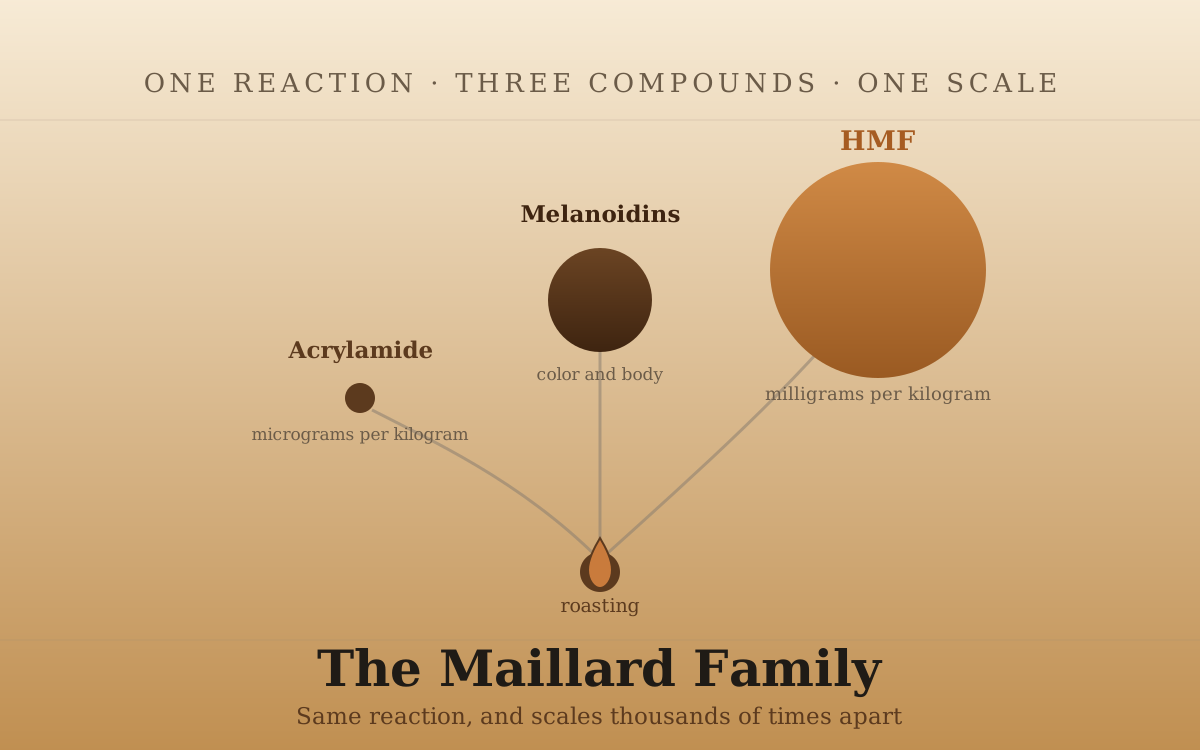
Acrylamide and HMF are not two unrelated risks that happen to show up in the same cup. They come from the same chemistry: the Maillard reaction, the browning that happens when a reducing sugar meets an amino compound under dry heat — the reaction that also produces the hundreds of aroma compounds that make a roast smell like a roast, the browning on a seared onion, and the crust on bread.
They aren’t even always separate products of the same reaction running in parallel. Kinetic modeling of coffee roasted at 200–240°C found that HMF accumulation itself feeds into the pathway that forms acrylamide — the two are chemically coupled steps in one branching reaction network, not independent siblings that happen to be born on the same tray. Roasted chicory, barley, rye, dandelion root and every other ingredient in this category run through some version of the same network the moment they hit a roaster hot enough to brown.
That framing matters more than either individual number, because it means there is no roasting process that produces the flavor of a roast and skips the chemistry family entirely. The question worth asking isn’t “does this contain Maillard byproducts” — everything roasted does — it’s what the different members of that family actually are, and whether their numbers mean what they look like they mean.
Two numbers, side by side
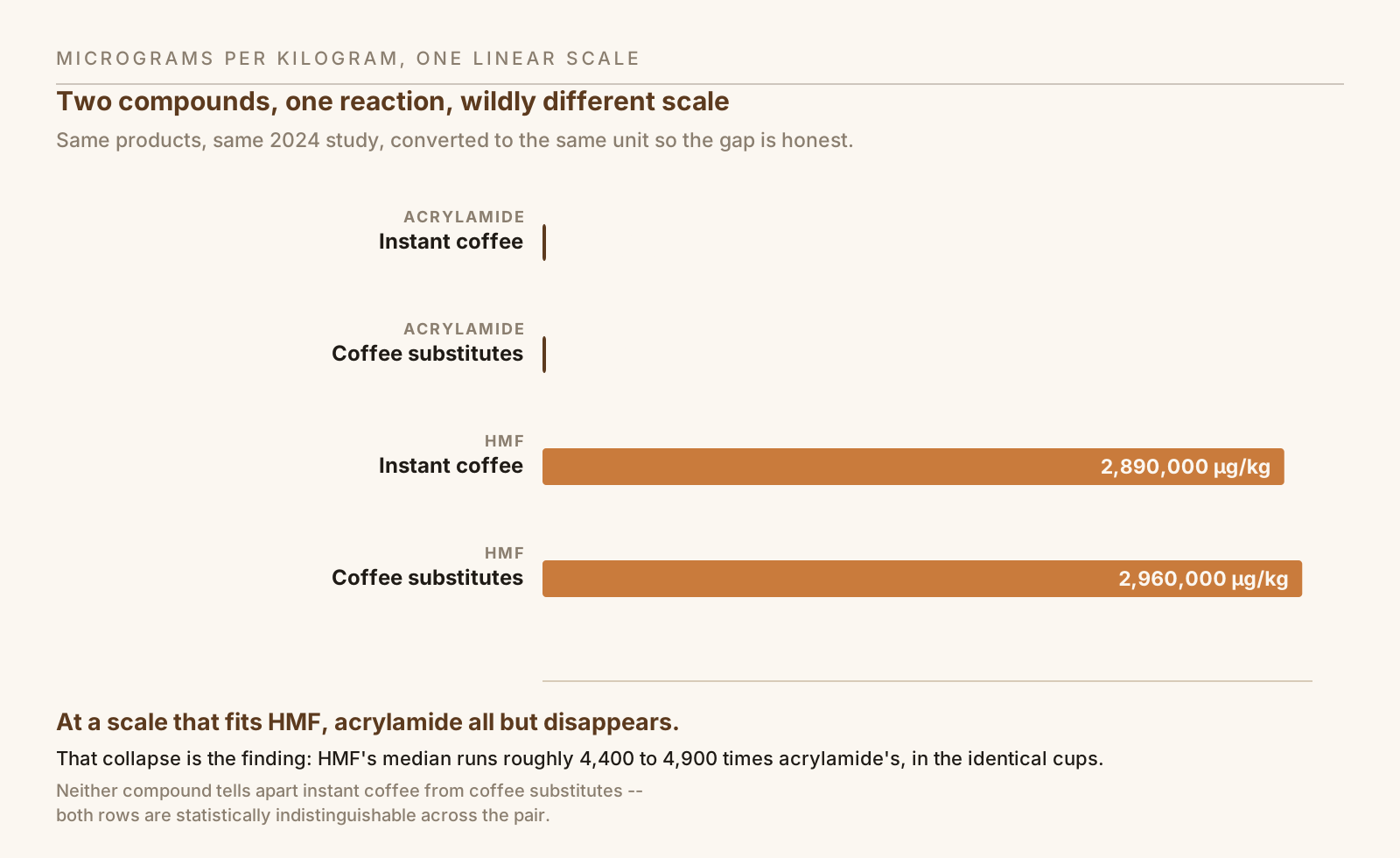
Here is the comparison, done properly — same studies, same products, converted to the same unit so the scale is honest rather than an artifact of milligrams versus micrograms.
| Compound | Instant coffee (median) | Coffee substitutes (median) | Statistically different? |
|---|---|---|---|
| Acrylamide | 589 µg/kg | 671 µg/kg | No |
| HMF | 2,890,000 µg/kg (2,890 mg/kg) | 2,960,000 µg/kg (2,960 mg/kg) | No |
Both rows come from the same 2024 retail survey of commercial instant coffees and coffee substitutes. Neither compound distinguishes the two categories — coffee substitutes aren’t the outlier for either one. But look at the two rows against each other: HMF’s median sits at roughly 4,400 to 4,900 times the acrylamide median, in the identical products. (Not “a thousandfold,” which is how the gap gets casually described — the actual multiple is closer to five thousand, and it’s worth being precise rather than rounding down a number that’s already startling.)
HMF’s range across products was wide — roughly 1,350 to 5,130 mg/kg for instant coffee and 735 to 7,130 mg/kg for substitutes, the authors note, likely reflecting how varied “coffee substitute” is as a category. Almost nothing on a real shelf is one raw material: the blends sold under names like Teeccino, Pero, Cafix and Dandy Blend mix chicory with roasted barley, rye, carob, dates, figs or nuts, and each combination brings its own sugar and amino-acid load to the same reaction. Even at HMF’s lowest measured value, it still outweighs acrylamide’s median by well over a thousand to one. This isn’t a fluke of one sample; it’s the ordinary relationship between the two compounds.
What HMF actually is, and why its story differs
HMF forms from sugars breaking down under heat and acid — no free amino acid required the way acrylamide needs asparagine, which is part of why it forms so much more readily and in such larger quantity. It shows up anywhere sugar gets heated: honey, dried fruit, caramel, balsamic vinegar, bread crust, malted grain, and every roasted coffee or coffee substitute on a shelf.
The hazard side is where the two compounds part ways. Acrylamide is classified by IARC as probably carcinogenic to humans (Group 2A), a rating built mainly on animal tumor data, with EFSA describing the human evidence itself as “limited and inconsistent.” HMF’s risk-assessment literature reaches a different, more reassuring place: a widely cited toxicology and risk-assessment review found HMF’s in vivo genotoxicity tests negative, its short-term studies for neoplastic changes negative or unreliable as evidence of carcinogenicity, and its one long-term rodent carcinogenicity study producing no tumors attributable to HMF apart from liver adenomas in female mice that the same authors call doubtfully relevant to humans. Their conclusion, stated plainly: no relevance for humans concerning carcinogenic or genotoxic effects can currently be derived.
That is a genuinely different kind of finding than “we haven’t looked yet.” It is a body of negative results, reviewed and weighed, landing on “not shown to be a human hazard at this exposure” — for a compound humans already eat in the tens of milligrams a day across an ordinary diet, with estimated daily intakes commonly cited in the 4–30 mg/person range and single dried-plum beverage servings reported as high as 350 mg. Nobody is proposing a benchmark level for HMF in EU law the way they have for acrylamide, and the absence isn’t an oversight — it reflects where the hazard evidence actually sits.
The family member that IS a genuine concern
It would be a cleaner story if every Maillard byproduct besides acrylamide turned out this mild. One doesn’t: furan.
Furan forms in the same thermal-processing conditions and travels with the same foods — including coffee, which EFSA’s own 2017 opinion names as the single largest dietary source of furan exposure for adults (jarred baby food takes that role for infants). That opinion’s conclusion is unhedged in a way HMF’s literature is not: current exposure levels to furan “indicate a health concern,” and its close relatives, the methylfurans, likely add to that exposure further.
We could not find a published survey measuring furan specifically in chicory, barley or other roasted coffee substitutes rather than coffee itself — which is worth stating plainly as a gap rather than assuming the coffee number simply transfers. Roasted substitutes go through comparable thermal processing and would be expected to generate some furan by the same chemistry, but “expected” is not “measured,” and we’d rather say that than borrow a number that was never taken from this category.
The honest shape of the family, then, isn’t “acrylamide bad, everything else fine.” It’s three compounds with three different evidence bases: acrylamide carrying a real if small classified risk, HMF carrying a much bigger number and a much weaker hazard case, and furan carrying a genuine EFSA-flagged concern with a real data gap specific to this category.
What digestion does to both — and it’s not the same thing
A concentration in a cup and what a body actually absorbs are two different measurements, and the same 2024 study measured both using simulated digestion.
For acrylamide, digestion reduced what was available for absorption — “bioaccessibility” — by up to 27.2% in instant coffee and 22.4% in coffee substitutes, regardless of whether milk was added. Less of what’s in the cup than the raw concentration implies actually becomes available to the body.
HMF moved in a way that doesn’t generalize from that pattern at all. In instant coffee, its bioaccessible fraction dropped significantly after digestion too — by roughly 26 to 48% depending on the sample. In coffee substitutes, the researchers report the opposite: HMF’s bioaccessibility rose after digestion instead of falling, likely a property of how the compound sits in a chicory- or grain-based matrix rather than a coffee one. The study reports that direction plainly but doesn’t give it a percentage, so we aren’t inventing one either. Milk didn’t change that direction either way.
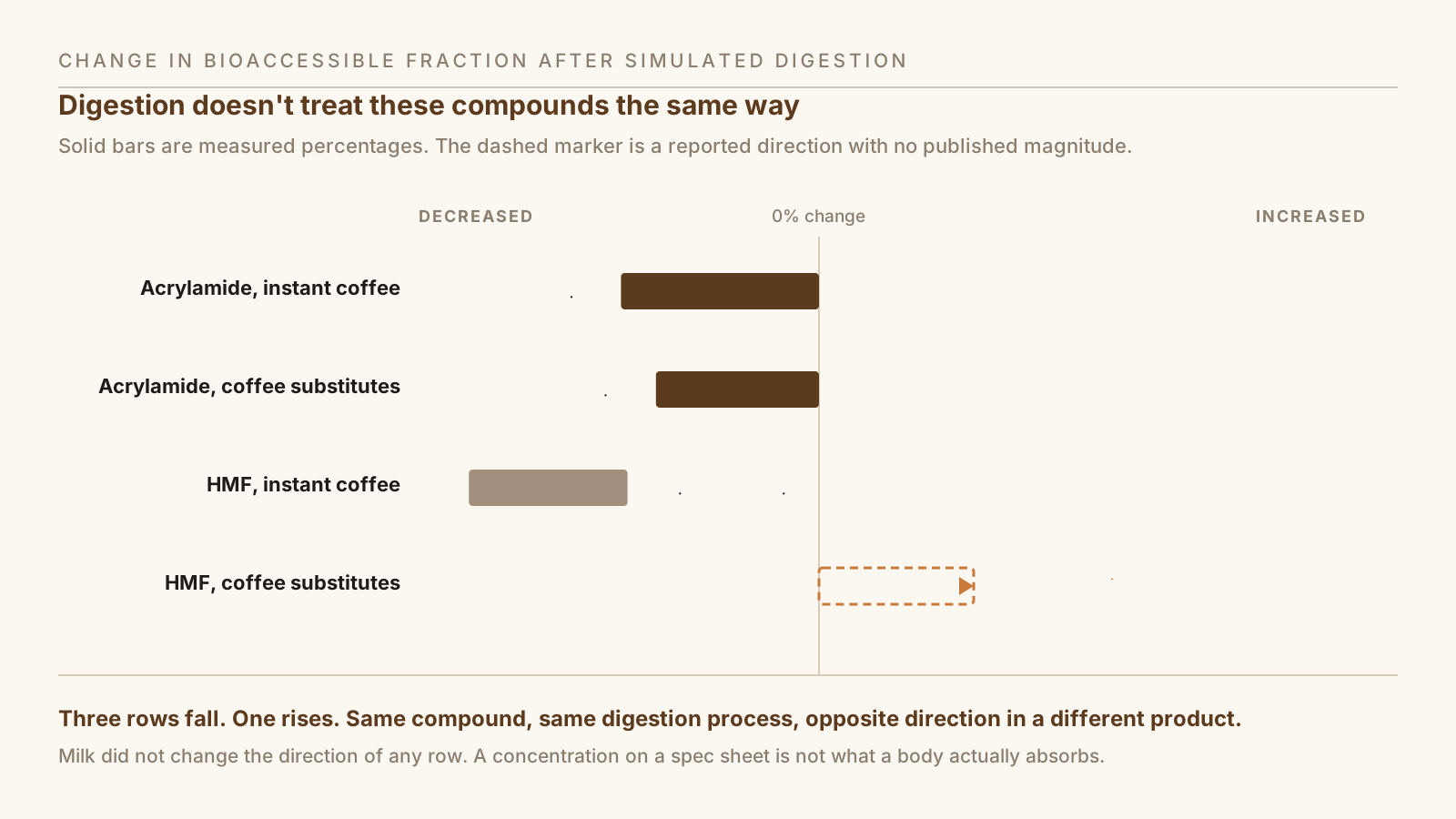
That asymmetry is the finding, not a footnote. Two compounds from the same reaction, in similar products, don’t move the same way through a simulated gut — and the same compound doesn’t move the same way across two different product categories. Nobody printing a concentration on a spec sheet is telling you what actually reaches you, and this study is one of a very small number that has bothered to check.
The positive half: melanoidins
Everything so far has been a compound somebody monitors. The Maillard reaction also produces melanoidins — the large, brown, nitrogen-containing polymers that are most of what makes a dark roast look and taste like one.
Melanoidins are responsible for a roasted beverage’s color and a meaningful share of its body and mouthfeel; they’re generally reported at somewhere between a tenth and a fifth of roasted coffee’s dry weight, and their concentration tracks roast color closely — the darker the roast, the more of them there are. They also carry measurable antioxidant activity in vitro, and reviews of their biological properties describe additional laboratory-level effects being studied in cell and animal models.
Here is where the hedge has to be exact rather than generous: in vitro antioxidant activity is a chemistry measurement, not a health outcome. It tells you a compound can neutralize free radicals in a test tube under lab conditions. It does not tell you that drinking a cup measurably changes anything in a human body, and no melanoidin research we found makes that leap responsibly. We’re stating what melanoidins do in the reaction and in a dish, not what they might do for you — and if a brand’s marketing collapses that distinction, that’s a claim to be skeptical of, not one this site is making.
What melanoidins do explain, without any hedging needed, is why nobody wants an under-roasted cup: without them, a roast has no color, thin body, and little of what people associate with the word “roasted” at all.
Why “just remove the bad one” isn’t on the table
If acrylamide, HMF and melanoidins came from separate reactions, a producer could in principle dial down the one that worries regulators and leave the rest alone. They can’t, because it’s one branching reaction, not three parallel ones.
The roast-degree research here is genuinely mixed rather than tidy, and it’s worth reporting that way instead of forcing a clean rule. Our earlier piece on acrylamide found — in barley- and rye-specific studies — that acrylamide rises with roasting and then falls with continued heat, an inverted U, so a very dark roast in that research sometimes carried less than a medium one. HMF’s relationship with roast degree, in coffee-specific literature, tends to run the other way: it’s reported climbing with roasting energy, higher in darker batches. And a 2019 study looking specifically at strategies for cutting acrylamide during coffee roasting found what its authors call an antagonistic effect — turning down acrylamide can turn up furan-family compounds, HMF included, in the same batch. None of this coffee research has been repeated on chicory or grain substitutes specifically, so treat the direction as a reasonable expectation for this category rather than a measured fact about it.
Put together: there is no dial that lowers everything in this family at once. The real levers producers actually have are raw-material choice (chicory is more asparagine-rich than grain, which is why the older piece found chicory’s acrylamide benchmark set eight times higher) and roast profile — and a profile tuned to suppress one compound can raise another. That’s a genuinely different, more useful fact than “roasting is risky,” and it’s the reason no coffee-substitute brand we’re aware of publishes a single number claiming to have solved this. There isn’t one number to solve.
Does any of this change what you drink?
For nearly everyone, no. Here’s what the numbers above are actually worth.
The scale gap is not a danger gap. HMF outweighing acrylamide by thousands to one in the same cup tells you about reaction chemistry, not about relative risk. Read the hazard evidence for each compound on its own terms rather than by its concentration.
“More Maillard byproducts” isn’t a reason to prefer coffee over a substitute, or the other way around. The 2024 survey found the two categories statistically indistinguishable for both acrylamide and HMF. This isn’t a switching argument in either direction.
If you want a genuinely unresolved question to watch, it’s furan, not HMF — because EFSA’s own conclusion on furan is unhedged, and because nobody has published a substitute-specific number to know whether this category tracks coffee’s or differs from it.
Don’t read “in vitro antioxidant activity” as a health claim, from this site or anyone else’s marketing. It describes real chemistry. It does not describe a proven benefit to a person drinking the cup.
A roast profile is a trade-off, not a fix. If a product markets itself as engineered to be lower in any one compound in this family, ask what else that process likely raised — because on the evidence here, something usually did.
The bottom line
Acrylamide and HMF come out of the same reaction, in the same roasted cup, at concentrations thousands of times apart — and the bigger number is the milder hazard, not the scarier one. Furan, the family’s third member, is the one with an actual unhedged concern attached to it by EFSA, and it’s also the one this category has never measured for itself. Melanoidins, the reaction’s other major product, give a dark roast its color and body and carry real laboratory-level antioxidant activity that has not been shown to be a health benefit in the cup.
None of that adds up to a reason to worry about a roasted chicory or barley coffee, and none of it adds up to a reason to declare it clean, either. What it argues for is reading a concentration next to its own hazard evidence rather than next to a different compound’s, and being honest that a roast profile moves this whole family together, not one member at a time.
This article describes what the Maillard reaction produces during roasting, not what any beverage does to a body. Nothing here is medical advice, and no coffee or coffee alternative has been shown to improve or worsen any health outcome on this basis. If you have a specific dietary concern, that’s a conversation for a clinician, not a website.
Sources & further reading
- Acrylamide and HMF occurrence and bioaccessibility in instant coffee and coffee substitutes. A study on isolated and milk-combined beverages (opens in a new tab) — Delgado-Andrade, Morales & Mesías, Food Research International, 2024
- Commission Regulation (EU) 2017/2158 establishing mitigation measures and benchmark levels for the reduction of the presence of acrylamide in food (opens in a new tab) — EUR-Lex
- Acrylamide (opens in a new tab) — European Food Safety Authority
- Toxicology and risk assessment of 5-Hydroxymethylfurfural in food (opens in a new tab) — Abraham, Gürtler, Berg, Heinemeyer, Lampen & Appel, Molecular Nutrition & Food Research, 2011
- 5-Hydroxymethylfurfural (HMF) levels in honey and other food products: effects on bees and human health (opens in a new tab) — Shapla, Solayman, Alam, Khalil & Gan, Chemistry Central Journal, 2018
- Risks for public health related to the presence of furan and methylfurans in food (opens in a new tab) — EFSA Panel on Contaminants in the Food Chain, EFSA Journal, 2017
- Melanoidins Produced by the Maillard Reaction: Structure and Biological Activity (opens in a new tab) — Wang, Qian & Yao, Food Chemistry, 2011
- Potential Antagonistic Effects of Acrylamide Mitigation during Coffee Roasting on Furfuryl Alcohol, Furan and 5-Hydroxymethylfurfural (opens in a new tab) — Lachenmeier, Schwarz, Teipel, Hegmanns, Kuballa, Walch & Breitling-Utzmann, Toxics, 2019
- 5-Hydroxymethylfurfural accumulation plays a critical role on acrylamide formation in coffee during roasting as confirmed by multiresponse kinetic modelling (opens in a new tab) — Hamzalıoğlu & Gökmen, Food Chemistry, 2020
Reader conversation (5)
We read every response. Selected reader notes below.
Food chemistry grad student here. I want to flag that the Hamzalıoğlu and Gökmen paper is a bigger deal than one paragraph gives it credit for — if HMF accumulation is genuinely upstream of acrylamide formation in the same kinetic pathway, that’s not just “two compounds from one reaction,” that’s “two compounds where one feeds the other.” Worth a follow-up on its own if anyone’s ever run that specific pathway on chicory rather than coffee.
Agreed, and I kept that section shorter than the finding deserves because the kinetic modeling in that paper is coffee-bean-specific and I didn’t want to imply it had been repeated on chicory or grain when it hasn’t. But you’re right that “one feeds the other” is the more precise and more interesting claim than “one reaction, two products,” and if anyone reading this has a lead on a chicory-specific kinetic study, I would genuinely like to see it.
I had the exact wrong reaction you predicted in the intro — saw “milligrams versus micrograms” in a different write-up of this same study last month and assumed HMF must be the scarier number. Glad someone finally laid out why that instinct is backwards. Would still like to know the actual answer to “should I care about furan” though, since that’s the one part of this piece that doesn’t end in a shrug.
Honest answer: we don’t fully know for this specific category yet, and I didn’t want to paper over that. EFSA’s furan conclusion is about food broadly with coffee as the named major adult source — nobody has published a substitute-specific number to say whether chicory or barley tracks that or sits somewhere else. If that survey exists, I haven’t found it, and I’d rather say that plainly than borrow coffee’s number and imply it’s been measured here.
The melanoidin section is doing something a lot of brand copy doesn’t: saying “antioxidant activity” and “health benefit” are not the same sentence. I roast my own chicory at home and have absolutely seen marketing that blurs exactly that line for coffee. Appreciate seeing it stated plainly instead of implied through a vague “packed with antioxidants” line.
Genuine question, not a gotcha: if a darker roast lowers acrylamide but raises HMF, and HMF is the much milder hazard, doesn’t that mean darker is just straightforwardly the better choice here? Feels like the piece stops short of saying that even though the numbers seem to point that way.
That’s a fair reading of the two hazard profiles on their own, and if I only had to weigh acrylamide against HMF I might land close to where you did. Where I stopped short is the furan finding — the antagonistic-effects study found that strategies aimed at cutting acrylamide during roasting can raise furan-family compounds too, and furan is the one member of this family EFSA has actually flagged as a concern in food generally. I don’t have a substitute-specific furan number to weigh against the acrylamide/HMF trade-off, so “darker is better” would be borrowing confidence from a comparison I can only make for two of the three compounds, not all three.
Following on from the mugicha research your acrylamide piece cited — is there a Japanese-language source on HMF in roasted barley tea specifically? Most of what I can find locally treats it as a flavor compound rather than anything worth measuring for safety, which now makes more sense after reading this.
Have something to add? Email us and we may include it in a future update.