What is Kentucky coffee tree coffee? The pioneer-era brew a 2004 lab test still won't recommend
Kentucky coffee tree seeds were roasted into a coffee substitute on the American frontier — it's the reason the tree carries the name at all. The seeds are also toxic raw, roasting is supposed to fix that, and the one university team that actually tested the process in a lab came away unwilling to vouch for it. Here's the honest version: the history, the chemistry, what it tastes like, and why this is one coffee alternative we're not telling you to try at home.

Most of the plants in this category earned the word “coffee” in their name because someone, somewhere, roasted and brewed them as a substitute for the real thing. Kentucky coffee tree is the most literal version of that story anywhere on this site — its common name isn’t a marketing flourish or a rough flavor comparison, it’s a direct record of what settlers on the American frontier actually did with its seeds. It’s also the one ingredient we’ve covered where the researchers who tested it most carefully ended up telling people not to drink it.
That combination — a name earned honestly, and a modern lab test that still won’t sign off — makes it worth a longer look than most obscure roasted seeds get. Here’s the honest version: what it is, where the name comes from, what the actual toxicity research says, and why this is one coffee alternative we’re describing rather than recommending.
What Kentucky coffee tree coffee is
Gymnocladus dioicus, commonly called the Kentucky coffee tree, is a large deciduous legume native to the central United States and parts of southern Ontario — related botanically to beans and peas, not to coffee at all. It produces thick, leathery, dark brown seed pods roughly 6 to 10 inches long, each holding several large, extremely hard, dark grey-brown seeds about the size of a big marble.
Historically, those seeds were dried, roasted, cracked, and ground into a powder brewed much like ground coffee — the same basic process behind chicory, acorn, and ramón seed: no bean, no caffeine, just a hard plant material roasted dark enough to develop coffee-adjacent flavor compounds. What sets this one apart from the rest of that family is a genuine safety catch sitting in the middle of the story, which is most of what this article is about.
Why it’s called a coffee tree at all
According to a University of Kentucky Cooperative Extension history of the species, the “coffeetree” name traces to the late 1700s, when both Native American communities and early European settlers brewed a hot beverage from the tree’s roasted seeds. The name stuck for a reason that had less to do with the drink’s quality and more to do with real estate: land developers later promoted “Kentucky coffee tree” specifically to lure settlers westward, advertising that a tree grew there whose beans could be roasted into something like coffee, at a time when real coffee was expensive and hard to get anywhere away from a coastal port.
It’s a naming story with a financial motive baked into it — which, as you’ll see below, may explain why the beverage got a more flattering reputation in the historical record than a modern lab test actually supports.
A pioneer story, thinner in the record than the legend
The popular version of this story is confident: Kentucky, Tennessee, and Ohio Valley pioneers, cut off from imported coffee, roasted and brewed the tree’s seeds as a matter of course, especially during the Revolutionary War and other periods when trade with Europe broke down. Garden centers, extension offices, and plant-guide sites repeat some version of that account routinely.
The North Carolina Botanical Garden’s own review of the evidence is more careful. It describes “repeated claims that Kentucky and Tennessee pioneers made a coffee substitute from the seeds,” while noting plainly that “documentation remains uncertain.” That’s a meaningfully different claim than “pioneers definitely drank this all the time” — it’s closer to “this story has been repeated often enough that it’s probably rooted in something real, but nobody has nailed down how common the practice actually was, or how satisfied anyone really was with the results.”
That gap between the confident garden-center version and the more hedged botanical-garden version is worth naming on its own, separate from the safety question below. This is a genuinely different lineage from the European wartime chicory and acorn story that accounts for most of the roasted substitutes on this site — an American frontier-era practice, tangled up with land promotion, rather than a rationing-driven one — but it’s also a story that’s been told more confidently than the record actually supports.
The cytisine problem, and what a 2004 lab test actually found
Here’s the part that separates this ingredient from nearly everything else covered in this category.
Kentucky coffee tree seeds and pulp are toxic raw. The toxin has long been attributed to an alkaloid called cytisine — the same broad family of compound found in some other legumes — though, notably, Spaeth and Thieret’s 2004 paper in the journal SIDA, the most direct piece of research we found on this exact question, states that “the presence of this compound has never been confirmed” specifically in Kentucky coffee tree seeds. In other words: the textbook explanation for the toxicity is a reasonable working theory, not a settled, chemically confirmed fact.
What is better established is that the toxin — whatever its precise identity — is heat-labile, meaning heat breaks it down, and that properly roasted (“parched”) seeds are not toxic in the way raw ones are. That’s the whole premise behind the historical practice: roast it hard enough, and whatever makes the raw seed dangerous gets destroyed.
So the researchers built a real experiment to test that premise. They roasted batches of seeds at 300°F (150°C) for 2.0, 2.5, 3.0, and 3.5 hours, then had twenty people smell and taste the resulting brew. Their conclusion, in their own words: “we do not recommend the ‘coffee’ until more is known about the poisonous compounds in the seeds.” A separate source, the plant blog Awkward Botany, frames the practical risk a little differently — noting that the cytisine content is thought to be low enough that “chewing one or two [seeds] would not be expected to produce toxic effects,” and that the bigger everyday hazard is mechanical: the seeds are hard enough to potentially crack a tooth. Both things can be true at once: probably low-risk in small amounts, and still an open scientific question that the people who study it directly aren’t willing to close.
We’re treating that the way we’d want a source to treat it for us: not as a poison warning, and not as a green light either. It’s an honest “we don’t fully know,” from the researchers closest to the question, and we’re passing that along without rounding it up or down.
How it was roasted — and why lids matter
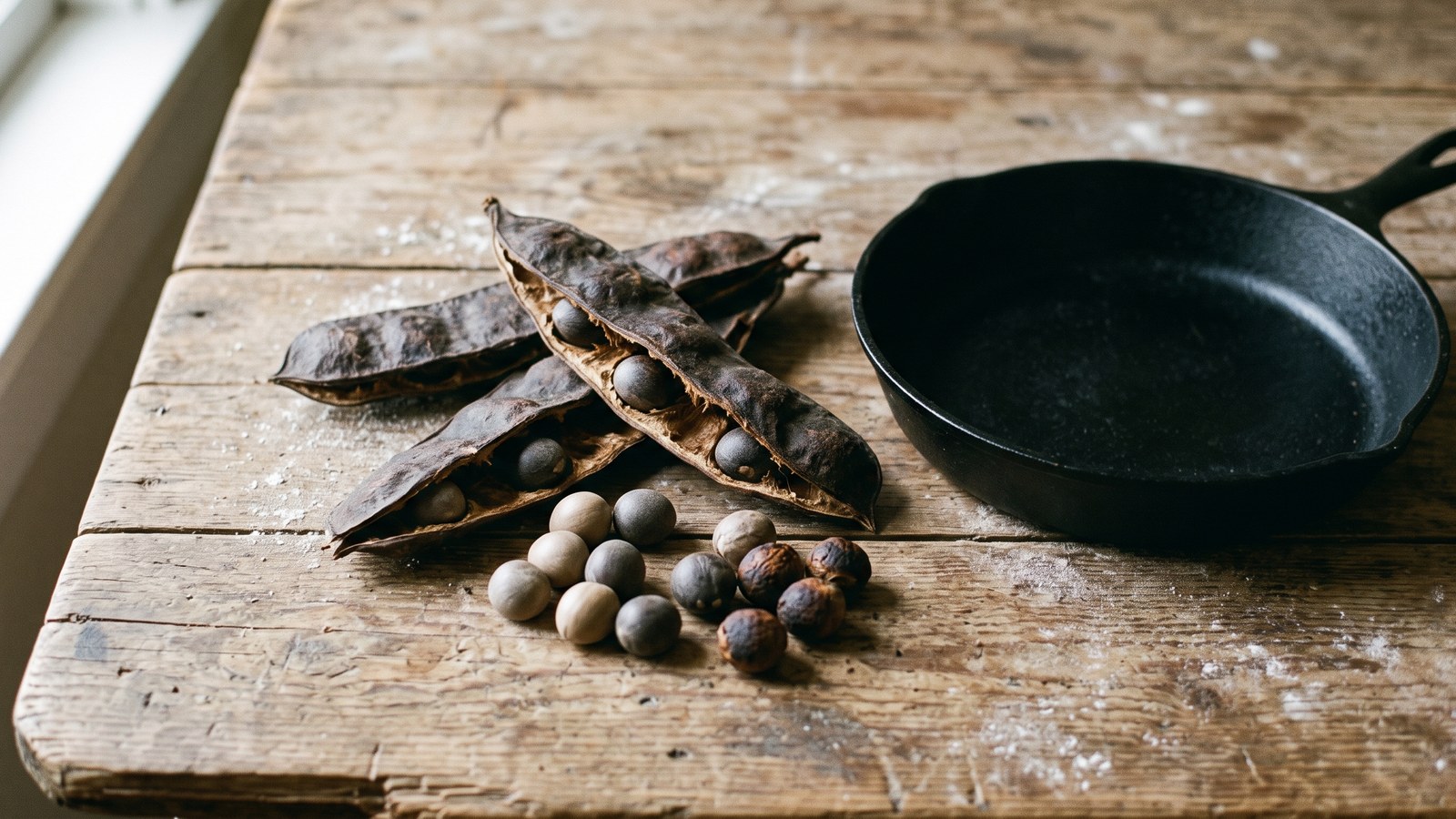
The Spaeth and Thieret study is unusually specific about the mechanics, and it’s worth walking through because it explains a detail nearly every home-roasting writeup repeats: use a lid.
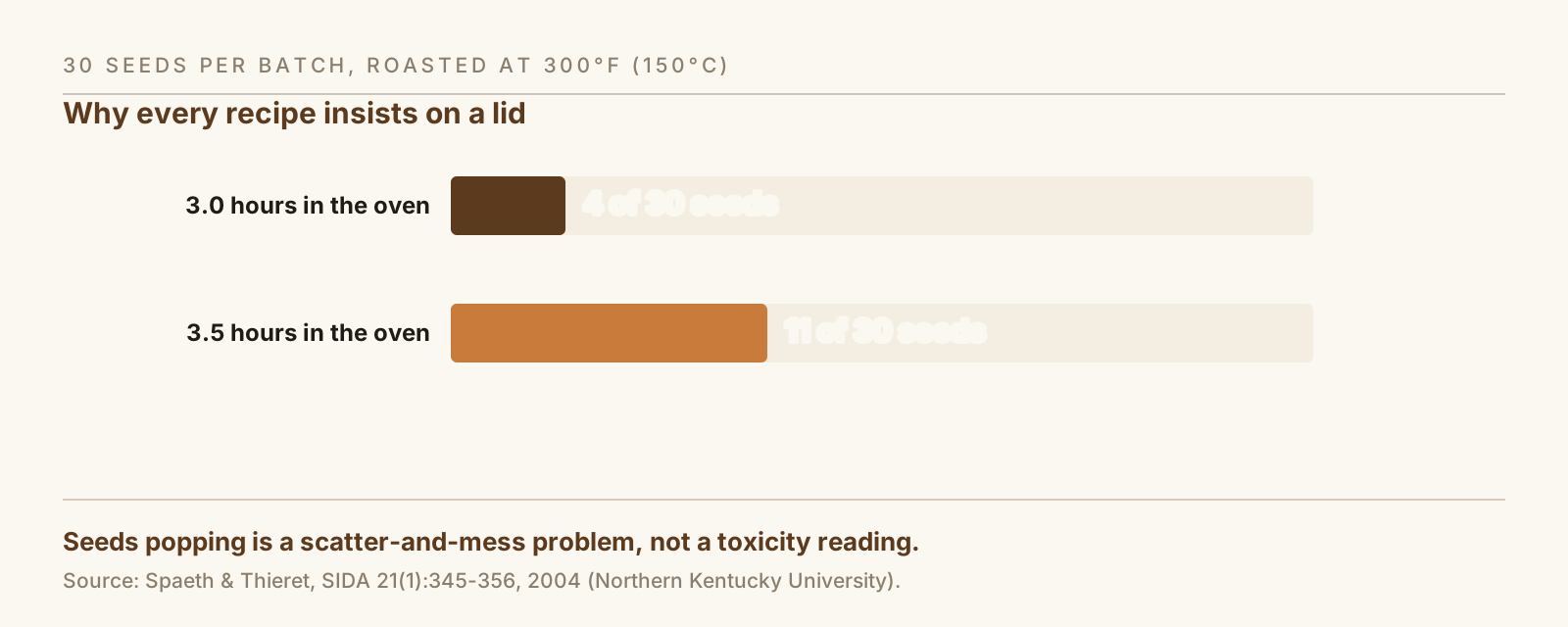
Thirty seeds were roasted per batch. As the oven ran, the room reportedly filled with an aroma the researchers compared to peanut butter — and by the three-hour mark, four of the thirty seeds had burst open; by three and a half hours, eleven had. That’s a genuine, arithmetic reason recipe writers insist on roasting these in a covered pan: an uncovered batch of Kentucky coffee tree seeds will, with real regularity, pop and scatter as the interior pressure builds.
After roasting, the rock-hard seeds still need to be manually cracked — a nutcracker is the tool of choice in the home-roasting accounts we found — before being ground into a coarse powder in a coffee or spice grinder. One home writeup describes soaking the seeds for an hour or two after collecting the pods, to loosen them, then drying and roasting at a similar 300°F for three-plus hours. Every account we found agrees the resulting grounds turn mud-thick and can clog a standard coffee filter, which is as much a practical description of “why this never became a commercial product” as anything else in the record.
What it actually tastes like
Even setting the safety question aside for a moment, the taste reviews don’t exactly build a case for trying this.
In the 2004 study, twenty participants smelled and tasted the brewed result. Responses ranged from “horrible” and “really bad” to, at the more generous end, “like coffee with a touch of chocolate” — and the researchers specifically noted that “no one claimed to enjoy the taste or the experience,” with an “overpowering and persistent aftertaste” that everyone agreed on. When the brew was sweetened, four of the twenty tasters upgraded their verdict to somewhere between “acceptable” and “still rather unpleasant.”
A separate, more recent home-roasting account is a little kinder, describing the brewed cup as “very earthy and rich and somewhat similar to strong black coffee” for one taster, while others in the same writeup landed on “tea-like,” “chocolaty,” “fruity,” or, less charitably, “akin to mud.” Cream reportedly helps some drinkers get through a cup.
Put those two accounts together and the pattern is consistent even where the specific words differ: nobody describes this as a pleasant, easy drink. The 2004 researchers’ own summary line is the fairest one available — “KCT ‘coffee’ is not destined for supermarket shelves” — and every source since has essentially agreed with them.
Caffeine, and who should skip this one entirely
Caffeine: none, structurally. Gymnocladus dioicus is a legume, not a coffee plant, and produces no caffeine at all — so, like every other roasted-seed or roasted-root substitute on this site, there’s no decaffeination process involved and nothing to trace. If a completely caffeine-free cup is the whole point for you, that part of the story is genuinely settled.
Everything else here calls for real caution, not curiosity. Given the primary research team’s own stated reluctance to recommend the finished drink, and given that raw seeds and pod pulp are toxic, we’d treat this one differently from the rest of the roasted-plant family covered on this site:
- Pregnant or breastfeeding readers, and anyone preparing food for children, should treat this as off the table entirely. There’s no dosing guidance, no established safety margin, and no reason to take on an unresolved toxicity question for a drink that even its own researchers won’t vouch for.
- Foragers should never assume “roasted enough” without real verification. The 2004 study used a controlled oven temperature and timed intervals specifically because home methods vary — and even that careful, methodical version of the process ended in a non-recommendation.
- If you’re generally curious about wild or foraged coffee substitutes, this is a case where reading the history is the safer and, frankly, more interesting way to engage with it than brewing a cup.
Where to find it today
You will not find Kentucky coffee tree coffee on a store shelf. Every source we found describes the same practical outcome: even in the eras when it was genuinely tried, “the beverage was no substitute for coffee, and the early settlers quickly dropped it as soon as the real thing became available,” according to the University of Kentucky’s own history of the tree. No commercial product exists today, and given the open safety question above, that’s not a gap we’d encourage anyone to fill by foraging their own pods.
If what actually draws you to this story is the roasted, caffeine-free, coffee-adjacent idea — rather than specifically wanting to track down and process toxic tree pods — the established roasted-botanical brands deliver that same basic experience without any of the risk or the guesswork. Teeccino (opens in a new tab)’s French Roast, for instance, builds a roasted, caffeine-free cup out of chicory, carob, barley, dates, and almonds — a very different set of plants, but the same basic promise of “roasted, brewed, no bean, no caffeine” without a single unresolved toxicology question attached to it. It’s one brand among several in that lane, not a replacement for what this article is actually about, just the honest, safer version of the same general idea.
Does it work as a coffee alternative?
As a practical, everyday coffee replacement: no, and we’d stop well short of suggesting anyone try to make it one. Nothing in the record — not the pioneer accounts, not the 2004 lab test, not the more recent home-roasting writeups — describes a drink that’s pleasant enough or established-safe enough to recommend, and the one research team that actually built a controlled experiment around it came away unwilling to give it their endorsement.
As a genuinely interesting piece of American plant history: absolutely. Few ingredients in this category carry a name that’s this literal, or a modern research paper willing to be this candid about what it doesn’t yet know. If you want the roasted-seed, caffeine-free character that made pioneers reach for this tree in the first place, that experience is easy to get elsewhere, from ingredients with a much better-understood safety profile — acorn coffee and ramón seed coffee both scratch a similar foraged, historical itch without the same open question hanging over them.
The bottom line
Kentucky coffee tree earned its name honestly: 18th-century settlers really did roast and brew its seeds as a coffee substitute, and land promoters leaned on that story to help sell the frontier. But the raw seeds and pulp are toxic, roasting is supposed to neutralize that, and the most careful modern test of the actual process — a 2004 university study that roasted seeds for hours and asked twenty people to taste the result — ended with the researchers themselves declining to recommend it, on a beverage that most tasters didn’t even enjoy. That’s a rarer verdict than we reach for most ingredients on this site, and we’re passing it along exactly as we found it: a genuinely fascinating piece of coffee-alternative history, and one we’re not telling anyone to go recreate in their own kitchen.
This article describes the history and available research on Kentucky coffee tree, not a recommendation to forage, roast, or consume its seeds. Nothing here is medical advice. If you have a specific safety question about a wild plant, that’s a conversation for a toxicologist or your regional poison control center, not a website.
Sources & further reading
- Kentucky Coffee-tree: Look but Don't Drink (opens in a new tab) — North Carolina Botanical Garden
- Notes on 'coffee' from the Kentucky coffeetree (Gymnocladus dioicus, Fabaceae) (opens in a new tab) — Spaeth & Thieret, SIDA 21(1):345-356, 2004
- Tea Time: Kentucky Coffeetree (opens in a new tab) — Awkward Botany
- Kentucky Coffeetree: The State Tree of Kentucky (FOR-8) (opens in a new tab) — University of Kentucky Cooperative Extension
Reader conversation (4)
We read every response. Selected reader notes below.
Grew up two miles from a stand of these and every local knows the “coffee tree” name but almost nobody knows why, or that anyone actually tried drinking it. Appreciate that this didn’t just repeat the garden-center version of the story uncritically.
Foraging forums treat the roasting-neutralizes-it claim as settled fact and pass it around like a known recipe. Genuinely surprised to learn the researchers who actually tested it in a lab still wouldn’t vouch for it in 2004. That’s a meaningfully different message than what gets repeated online.
That gap was the whole reason this got a full article instead of a footnote — most “roast it and it’s fine” folk claims don’t have an actual controlled study behind them either way, and this one does, and the study itself is the hedge. Worth reading the source paper directly if you come across the confident version of this claim anywhere else.
My grandfather told a story about his own grandfather drinking this during a coffee shortage, and I always assumed it was one of those exaggerated family legends. Nice to see the “documentation remains uncertain” framing instead of either dismissing it outright or repeating it as settled history — it’s probably both true and thinner than the way it gets told.
The seeds-popping chart is a nice touch — I always assumed the “use a lid” advice in foraging writeups was just generic kitchen caution, didn’t realize there was an actual measured rate behind it.
Have something to add? Email us and we may include it in a future update.