Is karkade Egypt's automatic caffeine-free pour? I checked room by room
Hassan Ibrahim in Cairo asked whether Egyptian hibiscus tea is poured for guests the way Moroccan mint tea is, or asked-for like Turkish sage tea. The honest answer depends on which room you're standing in.

Hassan Ibrahim left a comment from Cairo on last week’s Turkey, Balkans and North Africa piece that I flagged immediately as its own article rather than a reply. His point: that piece scoped North Africa to Morocco alone and said nothing about Egypt, where karkade — hibiscus tea — is caffeine-free and genuinely offered to guests. His honest hedge was the interesting part: he wasn’t sure himself whether it’s poured automatically, the way Moroccan mint tea is, or named and requested, the way Turkish sage tea is. He asked me to find out rather than guess.
The question I left open
The Turkey/Balkans/North Africa piece was upfront about why Egypt wasn’t in it: “I didn’t find comparably solid sourcing for Algeria, Tunisia or Egypt’s restaurant conventions specifically, so I’m not extending this to the whole region on the strength of one country’s evidence.” That was the honest limit of what I had at the time, not a judgment that Egypt doesn’t matter. Hassan’s comment is exactly the kind of correction that piece was built to invite.
So: does karkade clear the bar Moroccan mint tea cleared — poured for you the moment you sit down, no request required — or does it sit in Turkey’s tier, real and ordinary but something you have to name? I went looking for an answer specific to Egypt, and what I found doesn’t collapse into one clean yes or no. It splits by where you are.
Hotels: a genuine, unasked win
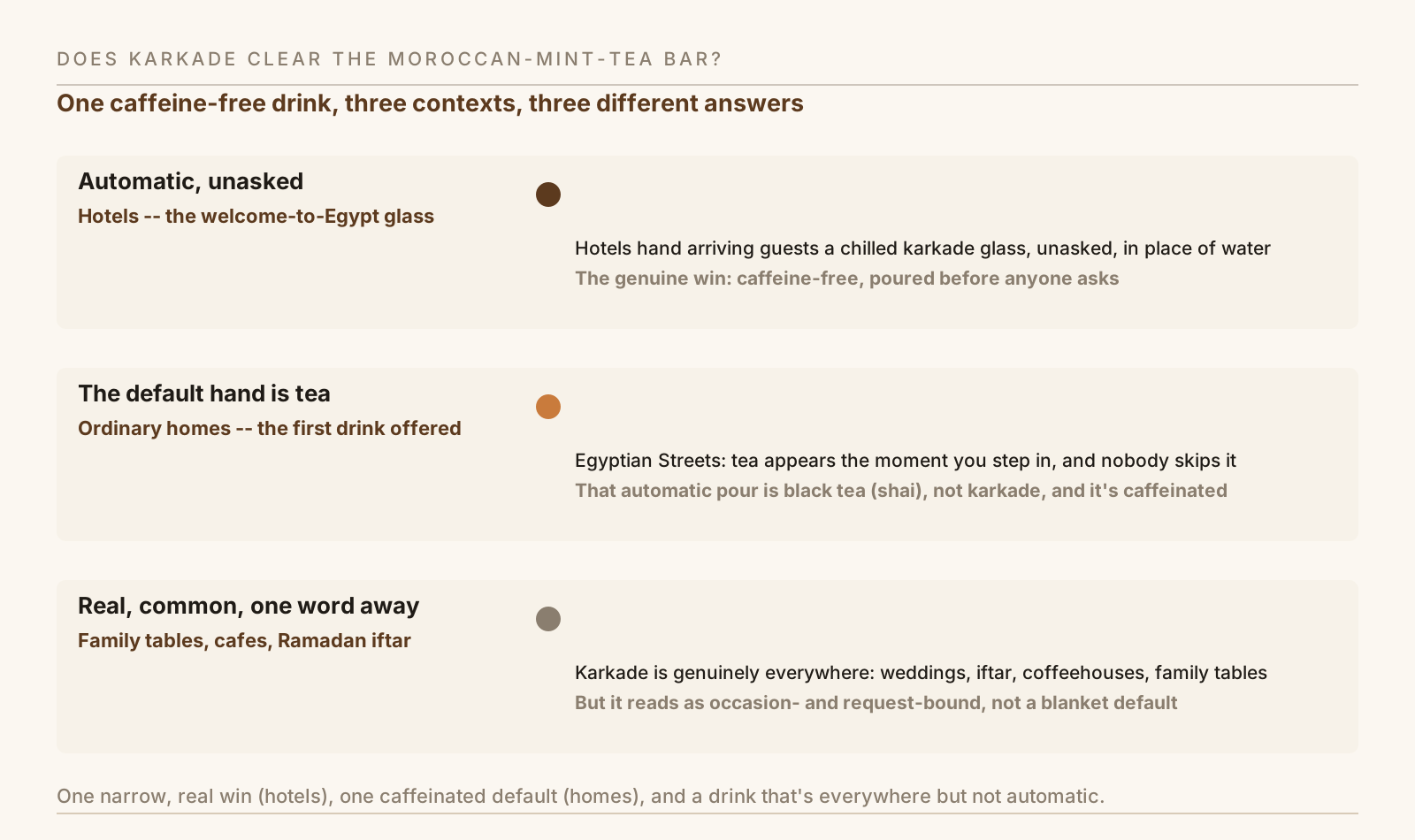
Start with the strongest, cleanest case, because it’s a real one. Multiple hotel and travel accounts describe the same specific ritual: a chilled glass of karkade handed to arriving guests as a “welcome to Egypt” gesture, offered in place of the water or lemonade a hotel elsewhere might hand out at check-in. Nobody asks for it. It shows up because you walked in.
That’s a genuine match for the mechanism Morocco’s mint tea earns in the earlier piece — a caffeine-free drink that arrives before you’ve said a word. It’s narrower than Morocco’s version, though, in an important way: Morocco’s automatic pour is a household and cafe custom, something that happens across ordinary daily life, not a specific hospitality-industry ritual. Egypt’s hotel-welcome karkade is real and unasked, but it’s scoped to exactly one kind of arrival. That distinction matters for the next section, because it’s also where the tidy version of this story stops working.
Homes: the default hand is tea
Here’s the part that complicates Hassan’s hoped-for clean win, and I want to be straightforward about it rather than round past it. The single best-sourced account I found of what actually happens when a guest arrives at an ordinary Egyptian home is Egyptian Streets — a Cairo-based publication doing its own cultural reporting, not a generic wellness or travel-tips blog — and it doesn’t describe karkade as the automatic pour. It describes tea:
“The act of drinking tea, however, has graduated from a pleasant evening ritual, to a core element of Egyptian hospitality. Egyptians will offer several cups to loved ones in one sitting, and serve it after any meal offered to a guest.”
That’s shai — black tea, caffeinated, sweetened generously — and the piece is unambiguous that it’s the default: it appears “the second you step into an Egyptian home,” and turning it down is considered mildly rude. The article’s own reporting mentions karkade exactly once, in a photo caption, with no claim that it’s what shows up for a random guest.
I found one other source — a general food-and-drink blog, not a local publication — that flatly calls karkade “the default welcome drink” while, in the same piece, also describing tea as something that “appears the second you step into an Egyptian home… nobody skips this step.” Those two claims sit awkwardly next to each other in a single article, and I’m not going to resolve the tension by picking whichever line supports the tidier story. Between a Cairo-based cultural outlet that treats tea as the hospitality drink and a generic blog asserting both things at once, I trust the more specific, more locally grounded account. So: if you’re a guest in an ordinary Egyptian home and a drink appears before you ask for one, the best available evidence says to expect tea, not karkade — and that default pour has caffeine in it.
Everywhere else: real, common, and named
None of that makes karkade a minor or hard-to-find drink — the opposite is true. Wikipedia’s entry on karkadeh, and every account I checked, describes it as genuinely everywhere: served hot in cooler months and cold the rest of the year, poured at weddings “symbolizing joy and prosperity,” central to Ramadan iftar tables as a way to break the fast, sold as street tea bags, and kept as an overnight-soaked family ritual in plenty of households. Egyptian Streets’ own history piece on karkade — the one whose photo caption is the sole karkade mention in the tea-culture article above — ties it to coffeehouse leisure time and family dinner tables as well as festive occasions.
What I couldn’t confirm, in any of that, is the specific claim Hassan’s comment was checking: that it shows up unasked the way mint tea does in Morocco, for any guest, in any ordinary setting. The honest shape of the evidence is closer to this: karkade is abundant, beloved, and available on request or at an occasion — a wedding, an iftar table, a coffeehouse order — rather than a blanket household default. That’s a real and useful answer. It’s just not the same answer as Morocco’s.
Where this leaves the map
Laid next to the original three tiers and last week’s Turkey and Morocco findings: Korea’s boricha is the cleanest case, poured before you ask in almost any restaurant setting. Italy’s caffè d’orzo is an ordinary named menu order. Turkey’s sage and linden teas are real and named but sit next to a caffeinated free pour. Morocco’s mint tea is the automatic household default — and it has caffeine in it, which was the twist of that whole piece.
Egypt adds something genuinely new to that map rather than repeating a tier: a context-dependent answer. In one specific setting — a hotel welcoming an arriving guest — karkade matches Morocco’s mechanism almost exactly: unasked, caffeine-free, poured on arrival. In the far more common setting of an ordinary home, the best evidence points the other way: the automatic pour is tea, and it’s caffeinated. Everywhere in between — cafes, family tables, festive occasions — karkade is real, common, and available, but you’re naming it rather than receiving it unbidden.
I don’t think that’s a disappointing answer. It’s a more precise one than “yes, Egypt has an automatic caffeine-free pour too,” which is the version I might have written if I’d stopped after finding the hotel accounts.
What this actually changes about the plan
- Checking into a hotel in Egypt? You may well be handed a chilled glass of karkade at the desk. Drink it — it’s a genuine caffeine-free welcome, and among the most reliable unasked pours in this whole regional series.
- Visiting someone’s home? Don’t assume the first glass that appears is caffeine-free. The best-sourced account says to expect tea. If you want karkade specifically, ask for it by name — it’s a completely ordinary request, not an unusual one, given how common the drink is.
- At a cafe, a family meal, or during Ramadan? Order it directly. It’s on offer widely enough that asking for karkade needs no explanation, the same way asking for adaçayı in a Turkish tea garden doesn’t.
- Traveling anywhere in the region and don’t want to rely on any single custom? This is exactly the case the packing piece is built for — a tea-bag herbal coffee or a single-serve instant sachet turns any hot-water station into your order regardless of local custom. A bagged herbal coffee like Teeccino’s French Roast (opens in a new tab) is a fine version of that backup at home; for the road, the format matters more than the brand, so lean on whichever caffeine-free instant or sachet already travels well in your bag.
The bottom line
Hassan asked a fair, specific, checkable question, and hedged it honestly himself rather than asserting an answer he wasn’t sure of. The answer I found back is just as specific: karkade genuinely clears the automatic-pour bar in one real context — the hotel welcome glass — and doesn’t clear it, on the best sourcing I could find, in the more everyday context of an ordinary home, where tea is the drink that shows up before you ask.
That’s not a letdown. It’s a more useful map than a flat “yes, it’s automatic” would have been, because it tells you which room you’re standing in matters. Hassan, thank you for pointing me at a country instead of letting me leave it blank — and if anyone reading this has been served karkade unasked somewhere I haven’t accounted for, the comments are exactly where I want to hear it.
Sources & further reading
- Drinking Tea Like An Egyptian (opens in a new tab) — Egyptian Streets
- Ruby Red: How Karkade Became a Signature Egyptian Tea (opens in a new tab) — Egyptian Streets
- Karkadeh (opens in a new tab) — Wikipedia
- Karkade - the refreshing red tea of Egypt (opens in a new tab) — Inside-Egypt
- Egyptian Drinks and Beverages: From Karkade to Ahwa Explained (opens in a new tab) — Amazing Food & Drink
Reader conversation (5)
We read every response. Selected reader notes below.
This is exactly the split I couldn’t articulate myself when I left that comment — I knew both things were true (hotels do it unasked, my own grandmother’s house runs on tea) but hadn’t put them side by side as two different answers to the same question. The Egyptian Streets quote is the right one to lean on. Thank you for actually checking instead of taking my half-formed comment at face value.
That’s the best outcome I could hope for from a follow-up piece — the reader who asked the question recognizing the answer as more accurate than his own starting guess. Thank you for flagging Egypt in the first place; this piece doesn’t exist without your comment.
Can confirm the home version from my own family. Tea is what my mother pours the instant anyone sits down, full stop — karkade comes out for Ramadan, for a wedding, or if you specifically ask because you know she keeps a jar of it. I’d never really separated those into “automatic” versus “on request” before, but reading it laid out that way, it’s obviously correct.
Worked hotel front-of-house in Cairo and Hurghada for six years before moving to Qatar, and the welcome-karkade ritual is very real and very consistent across properties — it’s basically standard operating procedure at check-in, chilled, in a small glass, no one asks. Good to see that specific detail get the credit it deserves instead of being generalized into “Egyptians drink hibiscus tea,” which undersells how deliberate that hotel gesture actually is.
That’s a useful confirmation from the inside — “standard operating procedure” is a stronger claim than anything my sourcing let me make, and it’s good to hear it holds across more than one property. Appreciate you adding the detail rather than just agreeing in general terms.
Isn’t the “generic blog contradicts itself” bit a little harsh? Plenty of travel writing simplifies for a general audience without meaning to mislead anyone.
Fair, and I don’t think the blog was trying to mislead anyone — simplifying for a general audience is exactly what happened. My problem wasn’t the simplification, it was that the piece asserted two different “the default drink is X” claims in the same article without noticing the contradiction, which makes it hard to use as a source for the specific question I was checking. A Cairo-based publication doing its own cultural reporting is simply better sourcing for that particular claim, not a moral judgment on the other piece.
Interesting to read this next to the Morocco section from last week’s piece — our mint tea doesn’t have Egypt’s hotel/home split, it’s just automatic everywhere, cafes and homes alike. Neither of us gets off easy on the caffeine question though: yours is caffeinated at home, mine’s caffeinated basically everywhere. Louiza and karkade are both the “you have to ask” caffeine-free option in our respective countries, which I didn’t expect going in.
Have something to add? Email us and we may include it in a future update.