Does coffee block thyroid medication? Yes — and herbal coffee may not fix it
Coffee measurably lowers how much levothyroxine your body absorbs when the two are taken together, and waiting an hour erases the effect completely. The popular explanation for why is wrong, and the honest answer for herbal coffee drinkers isn't the relief they're hoping for.

Someone in a hypothyroidism forum asks a version of this question every few weeks, usually right after they’ve made a change they were proud of: I switched from coffee to a caffeine-free herbal blend for other reasons — does that mean my thyroid medication timing problem is solved too?
I understand why that seems like a reasonable guess. It probably isn’t, and the reason why is more interesting than the question itself.
The short answer
Coffee taken at the same time as levothyroxine measurably lowers how much of the hormone your body absorbs. This is not folk wisdom — it’s a documented, statistically significant finding, replicated in both diagnosed patients and healthy volunteers, in a study designed specifically to test it.
But the reason is not caffeine, and it is not what most articles about this tell you. That has two consequences worth knowing before you change anything:
- The fix is timing, and it’s already generous. Waiting one hour before your coffee — any coffee — appears to erase the effect entirely.
- Switching to a caffeine-free herbal coffee is not a verified escape route. Nobody has run this exact study on chicory or roasted-grain coffee, and the ingredients involved have their own reasons for caution.
What the study actually found
The paper that settles this is Benvenga and colleagues’ 2008 study in Thyroid, and it’s worth walking through because the numbers are more specific — and more reassuring about the fix — than the one-line summaries floating around.
The researchers had noticed a pattern in referred patients: people on levothyroxine whose thyroid levels wouldn’t normalize, who turned out to be taking their pill with coffee or espresso to help swallow it. They tested this directly in eight patients and, separately, nine healthy volunteers, giving each person 200 micrograms of oral T4 under three conditions: with water alone, with espresso instead of water, and with water followed by espresso exactly one hour later.
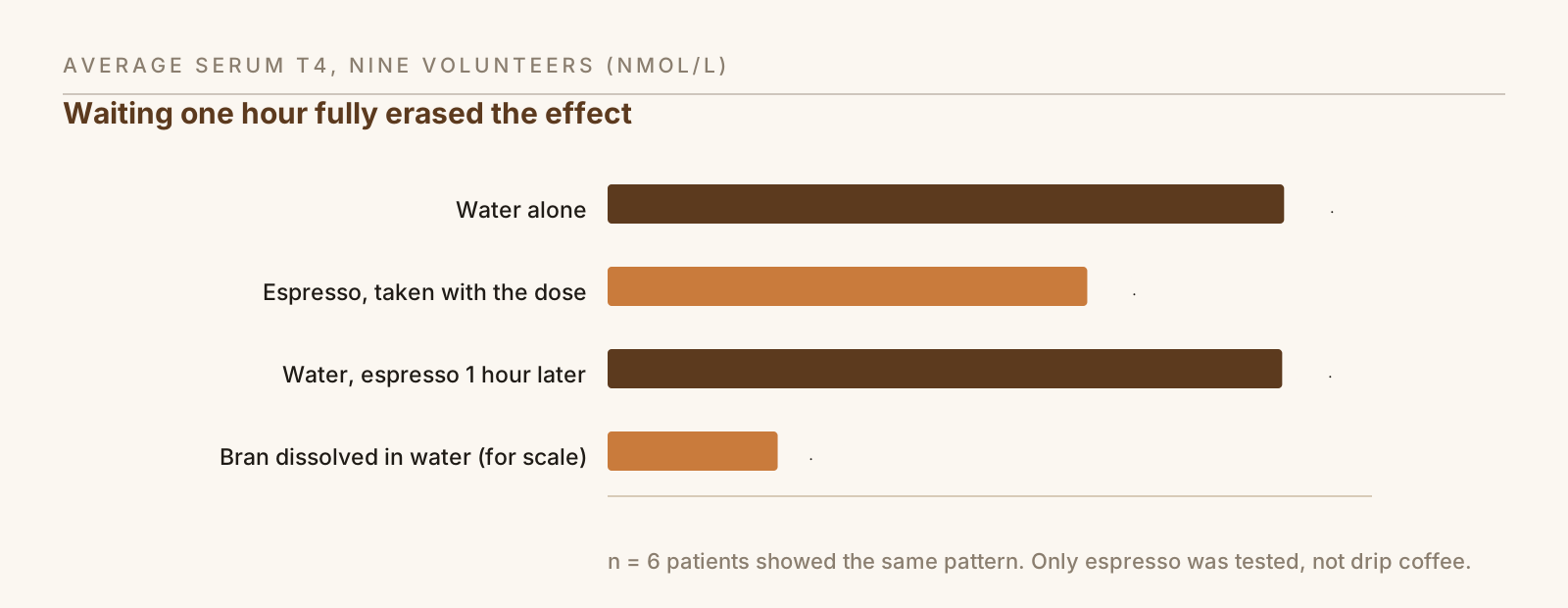
Taking levothyroxine with espresso significantly lowered both average serum T4 (p<0.001) and peak serum T4 (p<0.05) compared with water alone — roughly a 30 percent drop in the average measure, consistent across both the patient group and the volunteer group. Waiting one hour before the espresso produced numbers statistically indistinguishable from water alone, in both groups.
One honest asterisk: the area-under-the-curve measure — arguably the single best summary of how much hormone actually got into circulation over time — was also lower with espresso, but the researchers report this difference did not reach statistical significance. Two of three measures moved clearly; the most comprehensive one moved in the same direction without clearing the bar. That’s a real study reporting a real result, including the part of it that’s less clean than the headline.
The mechanism a lot of blogs get wrong
Here’s where checking the primary paper paid off, because several popular health sites summarize this finding with a mechanism the study itself explicitly rules out.
The commonly repeated explanation is that caffeine speeds up gastric emptying, or that coffee’s acidity changes stomach pH enough to interfere with the pill dissolving properly. The physician commentary published alongside the original study says the opposite, in plain language: “Coffee does not change the gastric pH, nor does it impair gastric emptying and intestinal transit in normal volunteers.”
What the researchers propose instead, based on their own in vitro work, is more direct: espresso appears to chemically sequester the T4 molecule itself, tying it up so intestinal cells can’t take it up efficiently, rather than doing anything to the stomach environment around it. In a lab test that combined espresso with a known concentration of T4 in solution, less T4 could be recovered afterward — a binding effect, not a digestive one.
This distinction isn’t trivia. If the mechanism were about caffeine and gastric speed, a genuinely caffeine-free drink would sidestep it completely. If the mechanism is binding by compounds that also show up in other roasted plant material, that’s a different, less comfortable question — which is exactly the one herbal coffee drinkers are actually asking.
One more honest limit worth naming: the human testing here used espresso specifically, not drip coffee, and the study’s own commentary flags that different coffees and roasting methods affect the gut lining differently. The precise 30 percent figure is an espresso number. The general caution reasonably extends further; the specific percentage may not.
Does switching to herbal coffee fix it?
This is the part I most want to get right, because it’s exactly the spot where a site about coffee alternatives is tempted to oversell a caffeine-free swap as a clean fix.
Nobody has run the Benvenga study on chicory, dandelion root, or roasted-grain coffee. I looked. There is no published trial testing levothyroxine absorption against a chicory-based brew the way there is for espresso. Anyone telling you a herbal coffee is safe with your thyroid medication is going beyond what’s actually been measured — in either direction.
What we can reason from is composition, and it points toward caution rather than reassurance:
- Chicory root and dandelion root — the base of most herbal “coffee” blends — are concentrated sources of inulin, a soluble fiber. Dietary fiber is already on the list of things known to interfere with levothyroxine absorption, and it was on that list before espresso was ever studied.
- In the very same Benvenga study, bran dissolved in water reduced absorption far more than espresso did — down to roughly a quarter of the water-alone baseline in the chart above. That’s not a chicory result, but it’s a direct demonstration that a fiber-based interference can be larger than coffee’s, not smaller.
- A separate, independent study gives some reassurance about scale, though: Chiu and Sherman (1998) tested two common fiber supplements against levothyroxine directly and found a much smaller effect than bran’s — absorption fell from 89 percent to 86 percent with calcium polycarbophil, and to 80 percent with psyllium.
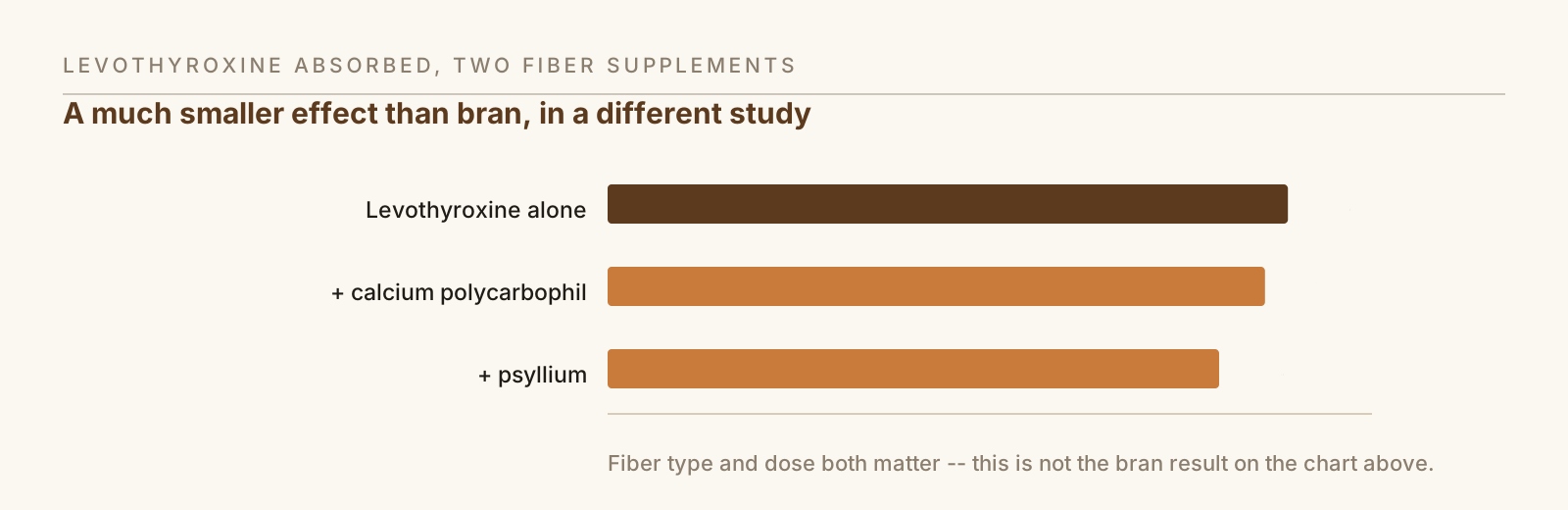
So the honest range runs from “modest, like psyllium” to “substantial, like bran” — and chicory and dandelion root haven’t been placed on that scale by anyone yet. Drug-interaction checkers such as Drugs.com already list a moderate interaction between levothyroxine and inulin supplements specifically; I couldn’t get past a paywall to the primary study behind that rating to see its size or mechanism, so I’d treat it as corroborating rather than load-bearing — but it’s one more data point pointing the same direction, not the opposite one.
Brands built on roasted chicory and dandelion root — Teeccino’s French Roast (opens in a new tab) among them, alongside blends like Dandy Blend that lean even more heavily on chicory and dandelion root together — are all in the same unstudied position. That’s not a knock on any specific brand; it’s the absence of evidence in both directions, for the whole category. We’ve looked at chicory’s fiber content from a different angle in does chicory coffee raise blood sugar and its tolerance issues in chicory coffee and IBS — inulin has real, documented effects on the gut. Whether it meaningfully changes thyroid hormone absorption specifically is a genuine open question, not a settled “no.”
The practical upshot is simple, even if the science isn’t fully mapped: don’t assume a caffeine-free swap solved a medication-timing problem it was never tested against. Apply the same one-hour rule to herbal coffee that the research supports for real coffee, until someone actually runs the study.
The one real workaround, and who it’s for
There is one genuinely good-news finding in this literature, and it’s worth knowing if the standard timing window is the thing making your mornings miserable.
A 2022 study examined a liquid oral levothyroxine solution and found it was bioequivalent whether participants took it five minutes before coffee or under fasting conditions — no meaningful difference across 48 hours of blood sampling. The Endocrine Society’s summary (opens in a new tab) frames this as real dosing flexibility for patients who’ve found the standard waiting period burdensome.
That’s a meaningful option, and worth a conversation with your prescriber if timing has been a genuine barrier to consistent dosing. It is not, however, a finding about tablets in general, and it isn’t a reason to change your own formulation without medical guidance — some levothyroxine tablets and gel capsules have their own, different timing rules on the label, and Mayo Clinic’s standard guidance (opens in a new tab) is still to take it on an empty stomach and wait 30 to 60 minutes before food or coffee unless your specific prescription says otherwise.
Who this actually matters for
If your thyroid levels have been stable for years on a consistent routine, this article is more interesting than urgent — consistency, not any single beverage choice, is what your prescriber is actually optimizing for.
This matters more directly if you:
- Have recently started levothyroxine and are still establishing a routine — this is the window where an unrecognized interaction does the most damage, because nobody’s looking for it yet.
- Take your pill with coffee, herbal coffee, or breakfast as a matter of habit, especially if your TSH hasn’t been landing where your prescriber expects.
- Recently switched from coffee to a caffeine-free herbal blend for other reasons and assumed, reasonably but incorrectly, that it also solved a medication-timing question nobody had actually tested.
- Are on a fiber-heavy diet or a fiber supplement for unrelated reasons — the interactions here compound, they don’t replace each other.
One thing that isn’t optional: if your thyroid levels seem off despite what looks like the right dose, that’s a conversation with your prescriber and a blood test, not a beverage swap. This article describes a real, documented interaction; it is not a substitute for monitoring your own levels with the person managing your prescription.
What I actually tell people
When someone asks me directly what to change, the list is short:
- Take the pill with water, not with anything else, coffee or herbal coffee included — this is the cheapest, best-evidenced move available and it costs nothing.
- Wait the full window your prescriber gave you before your first cup of anything. The research supports one hour as sufficient for coffee specifically; if you haven’t been given a number, ask rather than guessing.
- Don’t assume the caffeine-free swap solved this. It may have helped your sleep, your anxiety, or your afternoon crash — genuinely good reasons, covered elsewhere on this site. It has not been shown to solve this.
- If the timing window is genuinely unworkable for your life, ask your prescriber about a liquid formulation rather than quietly ignoring the instructions. That’s a real option with real evidence behind it, not a compromise.
- Keep fiber supplements, calcium, and iron on their own separate schedule too — this is one absorption interaction among several, covered from a different angle in our piece on iron and coffee and the four mineral traps on a plant-based plate. None of them are unique to thyroid medication, and none of them are solved by the same trick twice.
The bottom line
Coffee lowers levothyroxine absorption when the two are taken together — a real, statistically significant, twice-replicated finding, with a clean fix: wait an hour. The popular explanation for why (gastric pH, faster stomach emptying) doesn’t match what the original researchers actually found, which points instead to direct chemical binding.
That distinction matters for anyone who switched to a caffeine-free herbal coffee assuming they’d sidestepped the problem. Chicory and dandelion root are fiber sources, and fiber is independently documented to interfere with the same medication, sometimes more than coffee does. Nobody has tested the herbal blends directly — which means the honest answer is caution, not clearance, until somebody does.
This article is educational and is not medical advice. If your thyroid levels aren’t where you and your prescriber expect them to be, that’s a conversation and a blood test, not something to troubleshoot with a beverage change alone.
Sources & further reading
- Altered Intestinal Absorption of L-Thyroxine Caused by Coffee (Benvenga, Bartolone, Pappalardo, et al.) (opens in a new tab) — Thyroid, 2008
- Effects of Pharmacological Fiber Supplements on Levothyroxine Absorption (Chiu & Sherman) (opens in a new tab) — Thyroid, 1998
- Drinking coffee does not hinder the absorption of liquid thyroid medication (opens in a new tab) — The Endocrine Society, 2022
- Levothyroxine (oral route) — dosing and administration (opens in a new tab) — Mayo Clinic
- Chromium picolinate / inulin and Levothyroxine interaction check (opens in a new tab) — Drugs.com Interactions Checker
Reader conversation (5)
We read every response. Selected reader notes below.
I’ve been hypothyroid for eleven years and my endocrinologist told me the one-hour rule back when I was diagnosed, but nobody ever told me why, and I never thought to ask. The espresso-sequestering-the-hormone explanation actually makes it click in a way “just wait an hour” never did. I follow the rule anyway, but I follow it better when I understand it.
This is exactly the article I needed six months ago. I switched to Teeccino specifically because I read it was “gentler,” assumed that meant gentler on everything including my Synthroid timing, and never once thought to question it. Genuinely unnerving to learn that was never tested in either direction.
That reaction is exactly why I didn’t want to soften the “nobody has tested this” line — it’s an uncomfortable thing to tell people who made a switch in good faith, but “untested” and “fine” aren’t the same word, and conflating them is how this kind of gap gets papered over. The one-hour rule costs you nothing to keep applying regardless of what’s in the cup.
Appreciate the callout on the gastric-pH explanation, because that’s the one I’d absorbed from about four different sites without ever seeing a source attached to it. Good reminder to actually check what a study says before repeating the tidy version of it.
Question: does this apply the same way to NDT (desiccated thyroid) or just synthetic levothyroxine? My prescriber has me on Armour and I’ve never seen the coffee-timing advice specifically tied to it.
Good question, and I don’t have a direct answer — the Benvenga study tested synthetic L-T4 specifically, and I couldn’t find an equivalent trial for desiccated thyroid extract. NDT still delivers T4 (alongside T3), so I’d apply the same empty-stomach, one-hour caution as a sensible default rather than assume it’s exempt, but that’s an inference on my part, not a finding. Worth asking your prescriber directly since NDT dosing already gets individualized more than synthetic T4 typically does.
The bran comparison landed harder for me than the espresso numbers did, honestly. I’d never have guessed a fiber source could out-block coffee that dramatically. Rethinking my breakfast oatmeal-plus-pill routine after reading this, not just the coffee.
Have something to add? Email us and we may include it in a future update.