Does your antibiotic make coffee hit harder? Some quinolones slowed caffeine clearance in small trials, and one by a lot
Small volunteer studies found that certain quinolone antibiotics slow how fast the body clears caffeine, from no change with ofloxacin to a big drop with enoxacin. What that means for your cup, and what to ask your pharmacist.


You picked up a prescription, and the label doesn’t say a word about coffee. Yet researchers have been testing caffeine alongside antibiotics for decades, because caffeine makes a handy probe for how the liver is working. We read the abstracts to see what that work says for a normal morning cup.
The short answer
- In small studies of healthy volunteers, some quinolone antibiotics slowed how fast the body clears caffeine. Others didn’t.
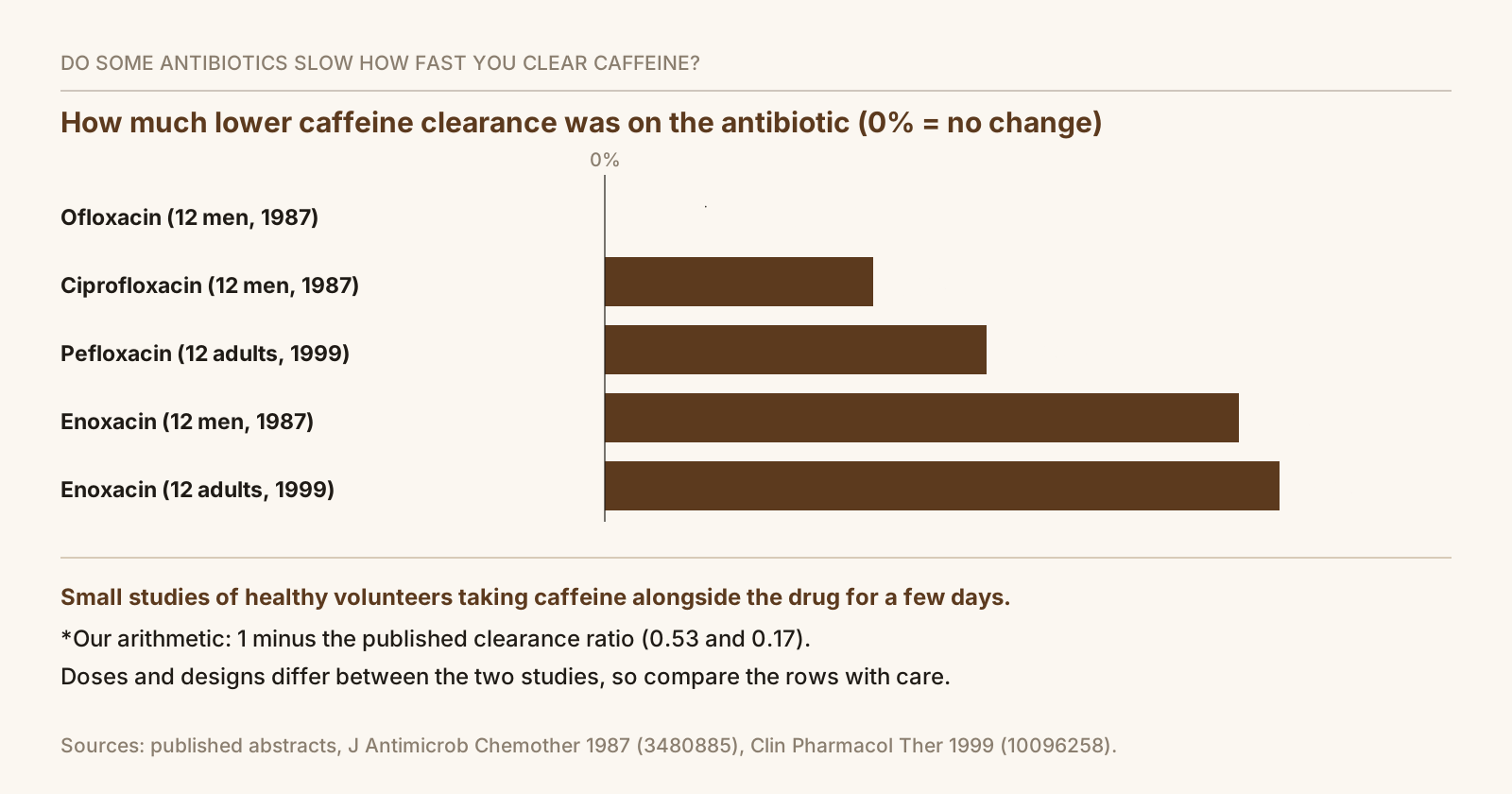
- The size of the effect varied a lot: none noticeable with ofloxacin, about a third lower clearance with ciprofloxacin, and more than three-quarters lower with enoxacin.
- Slower clearance means caffeine stays around longer, much like a longer half-life.
- These studies measured blood levels, not how people felt, and we read abstracts only.
- Your pharmacist can tell you whether your specific drug is one of them.
What the trials measured
The liver breaks caffeine down with an enzyme called CYP1A2. A drug that slows that enzyme can leave caffeine in the blood longer. That’s the mechanism the authors describe, and it’s the same idea behind how long caffeine stays in your system.
In a 1987 study in the Journal of Antimicrobial Chemotherapy (opens in a new tab), 12 healthy men took a single dose of caffeine (220 to 230 mg) before and during treatment with three quinolones. Ofloxacin changed nothing noticeable. Ciprofloxacin lengthened caffeine’s half-life by 15% and cut total clearance by 33%. Enoxacin prolonged the half-life by as much as 260%, raised peak caffeine by 41% and cut clearance by 78%.
A 1999 study in Clinical Pharmacology and Therapeutics (opens in a new tab) gave 12 young volunteers caffeine daily (183 mg) with pefloxacin or enoxacin. The ratios of caffeine clearance with versus without the drug were 0.53 for pefloxacin and 0.17 for enoxacin, which the authors described as a 2-fold and a 6-fold decrease.
A 1992 review (opens in a new tab) reported that several quinolones reduce clearance of the related compound theophylline, that lomefloxacin has no effect on theophylline or caffeine clearance, and that ciprofloxacin reduces caffeine clearance by about a third. That matches the 1987 numbers.
What the studies can’t tell you
Blood levels aren’t symptoms. None of the abstracts report whether people felt jittery or slept worse. A one-third drop in clearance doesn’t translate neatly into a one-third stronger cup, and we haven’t seen a study that tests that.
Small, short, healthy groups. Twelve volunteers per study, men only in the 1987 work, taking the drug for days. They tell us nothing about older adults or people taking several medicines.
Dose and design differ. One study used a single caffeine dose, the other daily dosing. That’s why the two enoxacin rows in our chart don’t match, and why we’d compare rows only loosely.
Weight matters. A 2003 study (opens in a new tab) of 12 men and 12 women found apparent sex differences in the ciprofloxacin interaction, but they disappeared once the numbers were adjusted for body weight.
No look at herbal drinks. The research is about caffeine. We found nothing on chicory, carob or other caffeine-free drinks and these drugs, and nothing in these abstracts suggests an interaction from the caffeine side.
If you’re on a course
None of this is a study result about what to do, so treat it as common sense:
- Ask your pharmacist. Say the name of your antibiotic and ask whether it’s known to affect caffeine. They can look up your exact drug, which an abstract can’t.
- Don’t stop the prescription. Finish it as directed, and tell your prescriber if something feels off.
- Go lighter for the duration. If you notice more jitters or poorer sleep, cut the second cup or move your last one earlier. See our taper guide if you’d rather step down gradually.
- Try a caffeine-free swap for a week or two. A roasted-grain or chicory drink keeps the ritual. Our guide to caffeine-free alternatives lists options, and it’s worth reading each label for caffeine.
- Know it’s not the only medicine story. We cover other prescriptions in our pieces on antidepressants, birth control and thyroid medication timing.
The bottom line
Small studies found that ciprofloxacin and especially enoxacin slow caffeine clearance, while ofloxacin didn’t. Nobody we found has shown how that feels in a real morning, so the practical step is the cheap one: ask your pharmacist about your drug, and go easy on coffee while you take it.

Sources & further reading
- Decrease of caffeine elimination in man during co-administration of 4-quinolones (opens in a new tab) — Journal of Antimicrobial Chemotherapy, 1987
- Interaction of pefloxacin and enoxacin with the human cytochrome P450 enzyme CYP1A2 (opens in a new tab) — Clinical Pharmacology and Therapeutics, 1999
- Interaction between quinolones and caffeine (opens in a new tab) — Drugs, 1987
- The effects of quinolones on xanthine pharmacokinetics (opens in a new tab) — American Journal of Medicine, 1992
- Influence of sex on the pharmacokinetic interaction of fleroxacin and ciprofloxacin with caffeine (opens in a new tab) — Clinical Pharmacokinetics, 2003
Reader conversation (4)
We read every response. Selected reader notes below.
I was on cipro last winter and my usual two cups felt like four. Nobody told me, so I just assumed I was run down. A line on the pharmacy sheet would help.
That’s a plausible match for the 1987 numbers, Marcy, though the studies measured blood levels, not how people felt. Your pharmacist is the right person to ask about your own drug.
Good to see the chart start from zero. The two enoxacin bars not matching made me trust it more, not less.
I switched to a roasted chicory drink for the ten days of my prescription and didn’t miss the jitters. Might not be for everyone, but it was an easy swap.
Wish there were studies on how people actually felt. Blood levels are useful, but I’d like to know whether a normal person notices.
Same here, Jeff. We didn’t find one, so we said so in the piece.
Read this and have a question or something to add? Send us a note. With your OK, we may publish it here with an editor's follow-up. We only publish notes you've said we can.