Does coffee make you sweat more? One heat trial says yes, others found little, and the effect looks small
In a 2024 trial of 12 men cycling in 35 °C heat, 5 mg per kilogram of caffeine raised sweat rate by 21%. A trial of ballet dancers found no change. What the studies show about coffee, sweat and body temperature.

A hot cup, a damp hairline, a sticky back of the neck by the time you finish it. If your coffee seems to make you sweat, you’re not imagining a pattern so much as noticing one that has a few possible causes. We read the abstracts of five studies to see how much of it is caffeine.
The short answer
- In a 2024 trial of 12 men cycling in 35 °C heat, caffeine raised whole-body sweat rate by 21% compared with placebo.
- A 2011 study of 13 men found sweating started sooner and was heavier on a run in mild conditions after caffeine.
- A study of nine ballet dancers found no change in sweat rate at 400 mg.
- A 2025 meta-analysis found a small rise in peak core temperature with caffeine, but no overall effect of supplements on sweat rate.
- Every trial here is small, short and about exercise. None looks at an ordinary morning cup.
What the heat trials found
The clearest result is from a 2024 crossover trial (opens in a new tab). Twelve healthy men who were used to caffeine but not used to heat cycled to exhaustion at 35 °C and 40% humidity. They did it twice, 60 minutes after either 5 mg per kilogram of caffeine or a placebo, and neither they nor the researchers knew which was which.
Time to exhaustion didn’t change, 28.5 minutes with caffeine and 29.9 with placebo. But the body’s heat handling did. Compared with placebo, caffeine raised heat production by 7.9%, whole-body sweat rate by 21% and evaporative heat transfer by 16.5%. It lowered estimated skin blood flow by 14.1%. Core temperature was 0.6% higher, and the men rated the heat as less comfortable. The authors concluded that caffeine increased the thermal strain of participants.
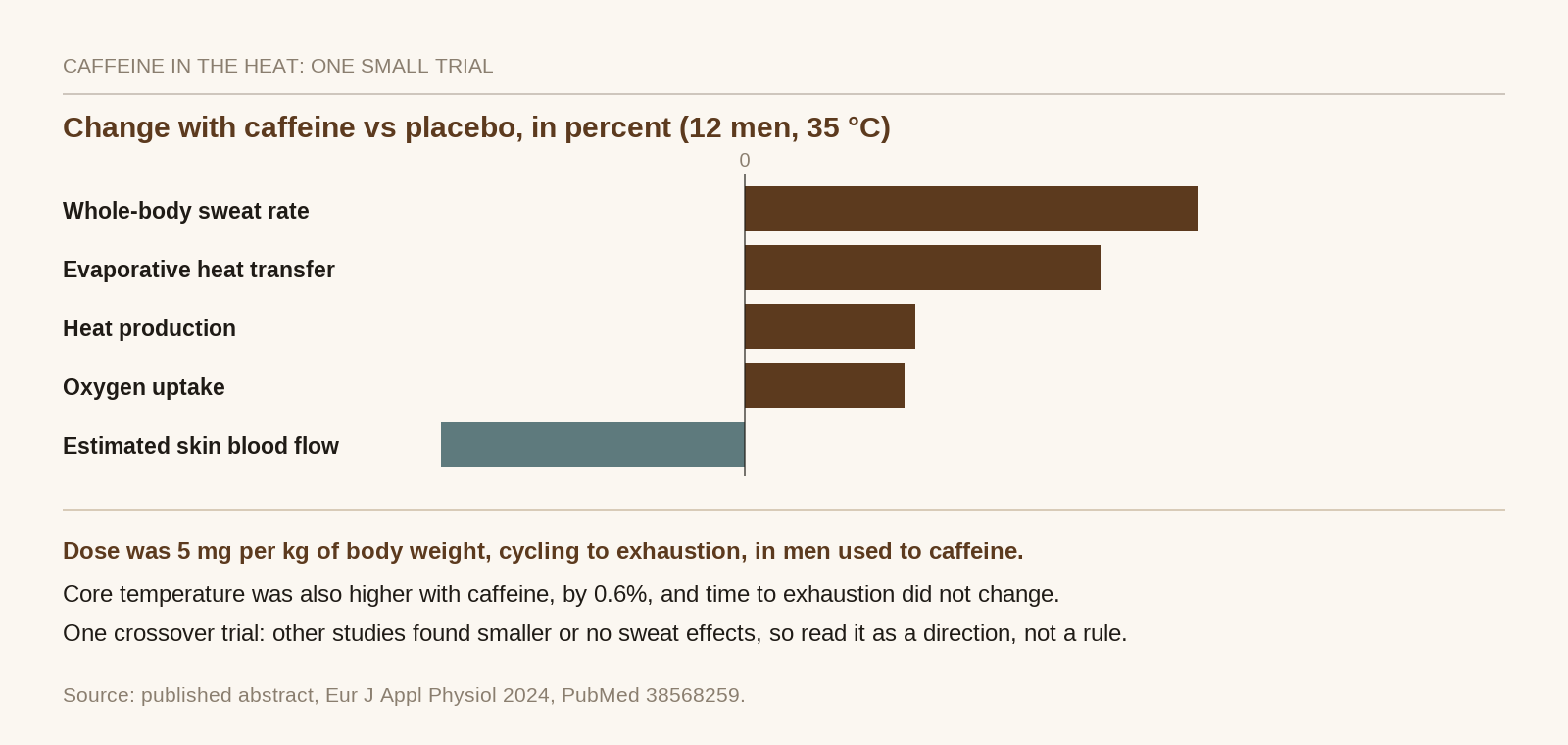
For a feel for 5 mg per kilogram: for a 70 kg (154 lb) person that is 350 mg. That is our arithmetic, not a figure from the abstract, and it is well above one cup. Cups vary a lot, as our caffeine half-life guide explains.
A 2011 study (opens in a new tab) used a lower dose, 3 mg per kilogram, with 13 trained men running for 30 minutes in mild conditions, about 24 °C. After caffeine, body temperature was higher before and after the run. Sweating started sooner, and local sweat volume and the number of active sweat glands were higher. The authors called it increased sweating sensitivity.
Where the studies disagree
Not everyone found an effect. In a 2018 trial (opens in a new tab), nine professional ballet dancers took 400 mg of caffeine, or placebo, an hour before a five-hour session. Sweat rate and blood pressure did not differ. That is a very small group and a very different setting, and it shows how easily one study can point a different way.
A 2020 factorial experiment (opens in a new tab) put 35 fit adults through a walk with a weighted backpack, with and without heat and with and without caffeine. Both heat and caffeine raised core temperature and heart rate. But the effect of caffeine was small, at most 0.17 °C and 6.6 beats per minute. The two did not make each other worse.
The widest view is a 2025 meta-analysis (opens in a new tab) of 124 articles on dietary supplements in hot conditions. Across all supplement types, there was no overall effect on whole-body or local sweat rate. For peak core temperature, caffeine had a small positive effect, from 30 comparisons. The authors suggested caffeine may pose the greatest risk in the heat of the supplements they looked at, because of that temperature effect.
Our reading, and it’s ours, not the authors’: caffeine seems to nudge body heat up a little, and sweat rises in some trials but not reliably.
What the studies can’t tell you
They’re about exercise. Every trial here involved running, cycling, walking under load or a long dance session. We found none on sitting at a desk with a cup.
Doses ran high. The trials used 3 to 6 mg per kilogram, or a flat 400 mg. That is more than a typical single cup.
The groups were small and mostly male. Twelve, thirteen and nine people, and the two biggest-effect studies used only men.
We read abstracts only. We can’t tell you how the researchers handled things like room temperature, hydration or recent caffeine intake beyond what the abstracts say.
A hot drink sweats on its own. None of the studies compared coffee with other hot drinks, so they can’t separate the caffeine from the heat of the cup.
No herbal evidence. We found nothing on chicory, carob, barley or mushroom blends and sweating.
If coffee makes you sweat
None of this tells you what to do, so treat it as ordinary practical sense.
- Run a simple test. Try the same drink iced for a week, or a smaller serving. If the sweating drops, heat or dose may be doing more than the caffeine.
- Be careful with caffeine before hard exercise in hot weather. The trials here suggest it adds to the load and did not help performance in the heat. Our piece on caffeine and exercise performance covers the wider picture.
- Keep drinking water. Coffee counts toward fluids, as we cover in does coffee dehydrate you.
- Notice what comes with it. Sweating plus a pounding pulse is worth a look at caffeine and heart palpitations.
- Try a swap if you want to. A roasted-grain or chicory drink keeps the ritual. Our guide to caffeine-free alternatives lists options, and it’s worth reading each label for caffeine.
- See a doctor if the sweating is new, drenching, happens at night, or comes with other changes you can’t explain.
The bottom line
Caffeine can raise body temperature a little, and in some heat trials it raised sweat rate too, by 21% in the most striking one. A trial of ballet dancers found nothing, and the pooled evidence on sweat is flat. If coffee makes you sweat, a smaller or cooler cup is a cheap experiment. If the sweating is new or heavy, that is a conversation for your doctor.

Sources & further reading
- Caffeine ingestion compromises thermoregulation and does not improve cycling time to exhaustion in the heat amongst males (opens in a new tab) — European Journal of Applied Physiology, 2024
- Caffeine and heat have additive but not interactive effects on physiologic strain: A factorial experiment (opens in a new tab) — Journal of Thermal Biology, 2020
- Caffeine increases sweating sensitivity via changes in sudomotor activity during physical loading (opens in a new tab) — Journal of Medicinal Food, 2011
- Acute Caffeine Supplementation Does Not Change Sweat Rate and Blood Pressure in Ballet Dancers: A Double-Blind and Placebo-Controlled Study (opens in a new tab) — Journal of Dance Medicine and Science, 2018
- The effect of dietary supplements on core temperature and sweating responses in hot environmental conditions: a meta-analysis and meta-regression (opens in a new tab) — American Journal of Physiology: Regulatory, Integrative and Comparative Physiology, 2025
Reader conversation (4)
We read every response. Selected reader notes below.
I run in the summer here and noticed I felt hotter on mornings I had a big coffee first. Good to see someone actually looked at the heat studies.
Thanks, Dana. The trials used fairly high doses, so a single cup is a different question, but the direction fits what you noticed. Nobody has tested your exact routine, so a week of trying it both ways is a fair experiment.
The ballet dancer study being in there is what I appreciate. Easy to cherry-pick the one that makes a tidy headline.
For me it is the hot mug more than the coffee. I get the same damp forehead with hot tea. Glad you mentioned the cup temperature.
I switched to a roasted chicory drink in the afternoons and still get warm from the hot drink itself. Iced helps more than anything.
Read this and have a question or something to add? Send us a note. With your OK, we may publish it here with an editor's follow-up. We only publish notes you've said we can.