Does caffeine cause heart palpitations? What happens when researchers actually hand people coffee, instead of just asking them
A randomized trial that gave people real coffee on some days and none on others found measurably more extra heartbeats on the coffee days. A 386,000-person study of habitual drinkers found the opposite: less arrhythmia risk, not more. Both are real, and the gap between them is the actual answer.

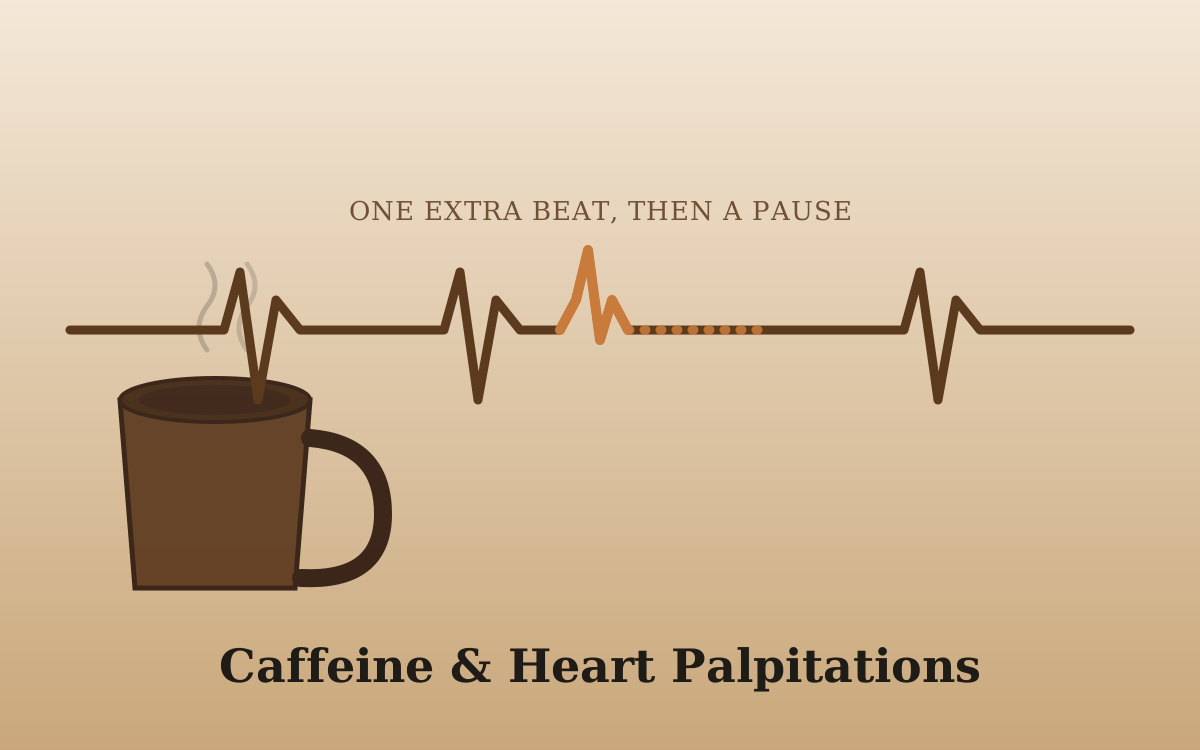
You felt it mid-sip: a flutter, a thud, a beat that seemed to skip and land wrong. Your hand goes to your chest. You google “does caffeine cause heart palpitations” while your pulse is still doing something you can feel. It’s one of the more unsettling sensations a drink can produce, and it sends a lot of people straight to quitting caffeine cold, sometimes for years, on the strength of a single scary afternoon.
Here’s what’s actually been measured. A research team gave 100 healthy adults real coffee on some days and had them avoid it entirely on others, then counted every extra heartbeat with a wearable heart monitor. Coffee days did produce more of one specific kind of extra beat. A separate study following over 386,000 people for years found the opposite pattern for arrhythmia risk overall — more coffee, less risk. Both are real findings from real research. The reason they don’t contradict each other is the actual, useful answer here.
The short answer
Caffeine can plausibly cause one specific, common, generally harmless type of extra heartbeat to happen more often — a randomized trial found exactly that. It does not have good evidence of causing the dangerous rhythm problems people are usually actually afraid of, like atrial fibrillation; the largest population studies point toward neutral-to-protective, not toward risk. The flutter you felt might genuinely be caffeine. It’s very unlikely to be caffeine causing something dangerous.
That’s not a dodge — it’s what happens when you take three different, well-designed studies and read them against each other instead of picking whichever one confirms what you already suspected.
What a palpitation actually is
“Palpitation” is a symptom, not a diagnosis — it just means you noticed your own heartbeat in a way you usually don’t. Most of the time, according to Cleveland Clinic’s overview of premature ventricular contractions (opens in a new tab), that sensation traces back to an extra beat that starts from the wrong place in the heart. Two common versions get shortened to acronyms in the research:
- PVCs (premature ventricular contractions) — an extra beat that originates in the lower chambers (the ventricles).
- PACs (premature atrial contractions) — the same basic idea, but starting in the upper chambers (the atria).
Both are strikingly common. Cleveland Clinic notes PVCs show up in the majority of people monitored continuously for 24 hours, most of whom never notice a thing. When they are felt, people describe a flutter, a skipped beat, or a hard thump as the heart’s next beat compensates. In someone without underlying heart disease, both are generally considered benign — annoying, sometimes alarming in the moment, rarely dangerous. That background matters, because it’s the difference between “caffeine can trigger a sensation” and “caffeine can hurt your heart,” and those are not the same claim.
The trial that actually gave people coffee
Most research on coffee and health just asks people what they already drink and tracks them for years. That design can’t fully separate coffee’s effect from everything else about a coffee drinker’s life. The CRAVE trial (opens in a new tab), published in the New England Journal of Medicine in 2023, did something rarer: it randomly assigned 100 healthy adults to drink coffee on some days and avoid all caffeine on others, alternating over two weeks, while a continuous heart monitor and a wearable tracker recorded what actually happened.
The results are more specific than a single verdict:
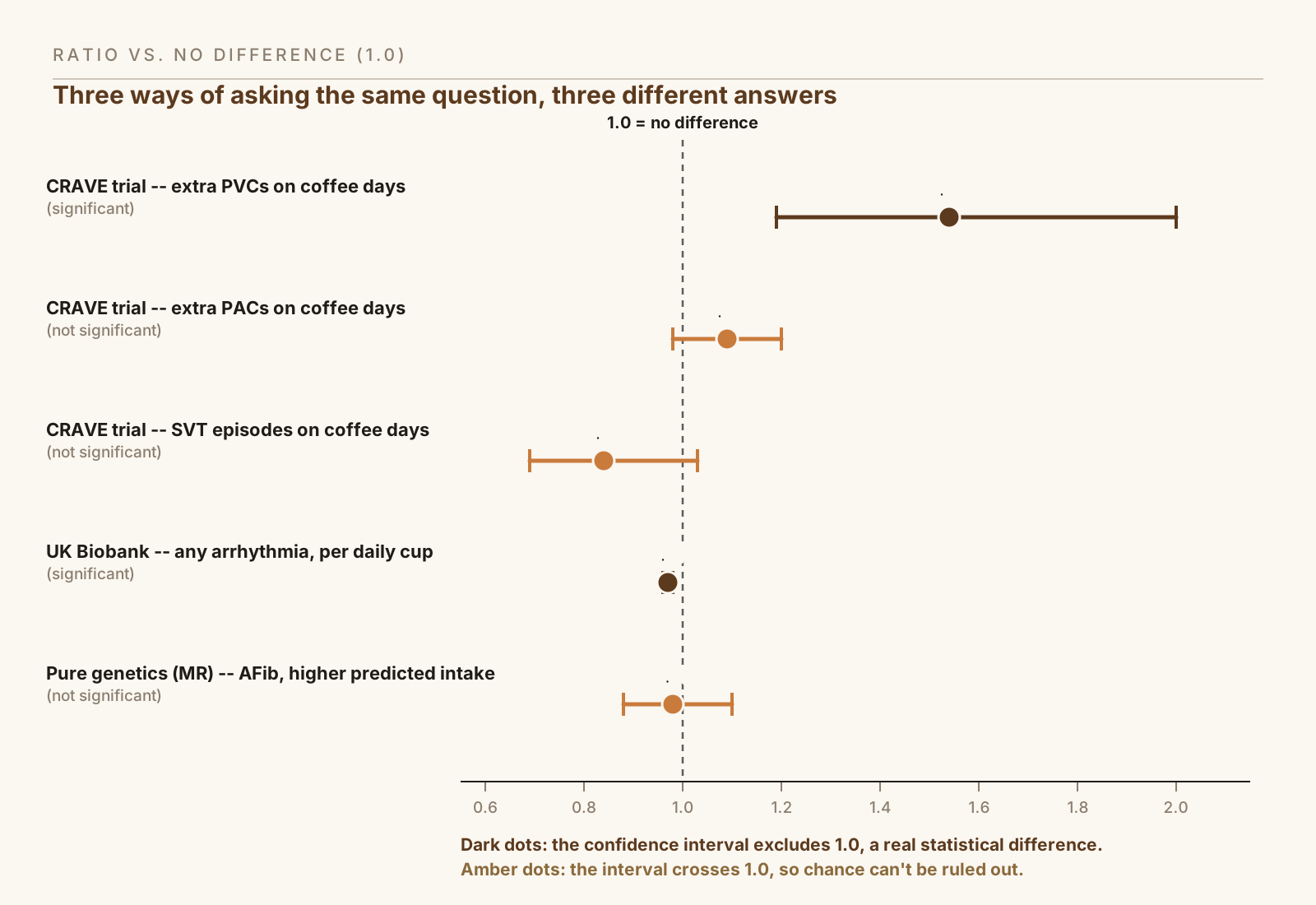
- PVCs rose on coffee days — a statistically significant 54% relative increase compared with no-coffee days.
- PACs did not rise significantly — coffee days and caffeine-free days produced a statistically similar number.
- Short bursts of rapid heart rate (SVT episodes) trended lower on coffee days, though not significantly so.
- Coffee days also came with about 36 fewer minutes of sleep and roughly 1,000 more steps than caffeine-free days, and slower caffeine metabolizers felt the sleep disruption more than fast ones — a genetic difference we’ve written about before in why caffeine wrecks your afternoon.
That PVC finding is the most solid piece of causal evidence anyone has that caffeine can provoke extra heartbeats — it isn’t an association pulled from a questionnaire, it’s a measured difference between coffee days and non-coffee days in the same people. It’s also worth sitting with the size of the study: 100 people is enough to catch a real, common effect like a rise in PVCs, but too small to say much about rare, serious events like a diagnosed arrhythmia. For that, you need a much bigger dataset.
The 386,000-person picture
Zoom out from a two-week trial of 100 people to a study that followed 386,258 UK Biobank participants for an average of 4.5 years, and the story changes shape. Published in JAMA Internal Medicine in 2021, the analysis tracked habitual coffee drinking against who actually went on to develop a diagnosed arrhythmia — atrial fibrillation, supraventricular tachycardia, and related conditions, the kind that show up in a medical chart rather than just on a home monitor for two weeks.
The finding ran opposite to the fear: each additional cup of coffee someone habitually drank was associated with a 3% lower risk of developing an arrhythmia (hazard ratio 0.97, meaning less risk, not more). This is observational data — it shows association, not proof that coffee itself is protective — but the direction is consistent with several other large cohort analyses of coffee and cardiovascular outcomes, and it flatly does not support the idea that habitual coffee drinking drives people toward dangerous heart rhythms over time.
When it’s just genetics, not a cup in your hand
There’s a third, quieter kind of study that sidesteps the biggest weakness of both a trial and a cohort study: it doesn’t ask anyone what they drink at all. Mendelian randomization studies use the genetic variants that predict how much coffee someone tends to drink as a stand-in for their actual intake, which strips out a lot of the lifestyle and personality differences that make coffee drinkers and non-drinkers hard to compare fairly.
A 2019 Mendelian randomization study in Nutrition, Metabolism and Cardiovascular Diseases, drawing on data from the Atrial Fibrillation Consortium covering more than 588,000 people, found no significant association between genetically predicted coffee consumption and atrial fibrillation risk in either direction (odds ratio 0.98, 95% CI 0.88–1.10). Not protective, not harmful — a null result. The UK Biobank study above ran its own internal genetic sub-analysis too, and it didn’t undercut the protective pattern seen in the reported-behavior data.
Read plainly, the genetics say: whatever is driving the cohort studies’ protective association, it isn’t obviously just “caffeine metabolism, at the population level, prevents AFib.” It’s more honest to call this an open, reassuring-but-unresolved question than a settled mechanism.
Reconciling three findings that all sound right
Put the three pieces next to each other and the apparent contradiction resolves into something coherent:
- A small randomized trial found real coffee causes more of a common, usually harmless extra heartbeat (PVCs) — the strongest causal evidence available, from the smallest, shortest study.
- A huge cohort of habitual drinkers found lower rates of the arrhythmias that actually get diagnosed and treated, atrial fibrillation among them — reassuring, but observational.
- Pure genetics found no link to atrial fibrillation either way — the cleanest design for ruling out confounding, and it comes back a shrug.
These aren’t measuring the same thing. PVCs are a sensation-level, largely benign event that a trial can catch in two weeks. Atrial fibrillation is a clinical diagnosis with real health consequences that takes years of follow-up in tens of thousands of people to see clearly. It’s entirely consistent for caffeine to nudge the harmless, common thing upward in the short term while having no detectable effect — or even a favorable one — on the serious, rare thing over the long term. The mistake is treating “my heart did something weird after coffee” and “coffee causes heart disease” as the same claim. The evidence says they aren’t.
Who should actually pay attention
- People who notice a real, repeatable pattern. If your palpitations reliably show up after coffee and settle down without it, that’s meaningful personal data, even if the population studies read as reassuring — you’re not obligated to match the average.
- Anyone with new, frequent, or worsening palpitations, especially alongside chest pain, dizziness, fainting, or shortness of breath. That’s a conversation with a clinician, not a caffeine-elimination experiment. Cleveland Clinic also flags electrolyte imbalances, alcohol, stress, and thyroid or existing heart conditions as other common palpitation triggers worth ruling out.
- People with a diagnosed arrhythmia or supraventricular tachycardia, who are the specific group the CRAVE researchers said shouldn’t necessarily be told to avoid coffee outright based on this evidence — but who should absolutely make that call with their own cardiologist, not a population average.
- Everyone else who’s felt one flutter and spiraled into fear. The data genuinely doesn’t support that reaction. A skipped beat after a strong coffee is common, usually harmless, and not a sign your heart is in danger.
What to do if your heart flutters after coffee
If you want to test your own response rather than guess, the CRAVE trial’s own design is a reasonable template in miniature: note your intake and how you feel across a few caffeinated and a few caffeine-free days, rather than judging from one bad afternoon. A cheap wrist heart-rate monitor or even just paying attention gives you better personal data than any study average.
If you find a real pattern and want to cut back without giving up the ritual, dose and timing usually do more than total elimination — front-load your caffeine earlier in the day, the same lever we walk through for the caffeine-sensitive in the best coffee alternative for anxiety. Decaf is a partial step, not a full one: it still carries a few milligrams per cup, worth knowing if you’re highly sensitive, an angle we cover in is decaf coffee bad for you. For a full removal of the variable, genuinely caffeine-free roasted alternatives — chicory, dandelion, and barley-based blends — carry no caffeine at all, so there’s nothing left for a sensitive heart to react to. Teeccino’s French Roast is one option built around roasted chicory, carob, barley, dates, and almonds — worth knowing it contains both barley (gluten) and almonds (tree nuts), while the brand’s Dandelion Dark Roast is gluten-free if that’s the constraint. Pero and other roasted-grain blends work on the same principle. None of them will cause a palpitation, and none of them prove anything about your particular heart — they’re just a way to keep the mug in your hand while you find out. The wider field of options, including brands with real caffeine if that’s what you’re actually after, is in the best caffeine-free coffee alternatives.
A flutter after your coffee is real, it’s common, and — for the vast majority of people whose hearts are otherwise healthy — it isn’t a warning sign. It’s your heart doing something it does on its own fairly often, just at a moment you happened to be paying attention.
This article is educational and not medical advice. New, frequent, or worsening palpitations — especially with chest pain, dizziness, fainting, or shortness of breath — deserve a clinician’s evaluation, not a home judgment call.
Sources & further reading
- Acute Effects of Coffee Consumption on Health among Ambulatory Adults (opens in a new tab) — New England Journal of Medicine (Marcus et al., the CRAVE trial, 2023)
- Coffee Consumption and Incident Tachyarrhythmias: Reported Behavior, Mendelian Randomization, and Their Interactions (opens in a new tab) — JAMA Internal Medicine (Kim et al., UK Biobank cohort, 2021)
- No association between coffee consumption and risk of atrial fibrillation: A Mendelian randomization study (opens in a new tab) — Nutrition, Metabolism and Cardiovascular Diseases (Yuan & Larsson, 2019)
- Premature Ventricular Contractions (PVCs) (opens in a new tab) — Cleveland Clinic
Reader conversation (5)
We read every response. Selected reader notes below.
I quit coffee for almost three years after one bad flutter at my desk sent me to urgent care. Everything came back normal and the doctor basically said “sounds like a PVC, don’t worry about it” but I never trusted a cup again after that. This is the first thing I’ve read that actually explains what probably happened instead of just telling me not to worry.
That’s such a common story, and I don’t think “don’t worry about it” from a rushed ER visit actually does much for the part of you that felt your own heart do something wrong. Glad the trial data gave you an actual mechanism instead of just reassurance with nothing behind it.
Skeptical of the UK Biobank number here — “coffee drinkers have less arrhythmia” sounds a lot like the classic healthy-user bias, where people who can still handle a normal daily routine including their coffee are just generally healthier people to begin with.
That’s a completely reasonable read, and it’s exactly the gap the genetics study is there to probe — using genetic variants sidesteps a lot of “who chooses to drink coffee” confounding, since your genes aren’t shaped by your current health. It came back null rather than protective, which to me reads as “the cohort finding probably isn’t pure biology” more than it reads as “the cohort finding is fake.” I tried to flag that tension rather than resolve it in the piece, because I don’t think it’s actually resolved yet.
Diagnosed with paroxysmal AFib two years ago and my cardiologist has never told me to cut out coffee, which used to genuinely surprise me given how much “heart health” content online treats caffeine like poison. This is the first article that explained why that’s not actually contradictory advice.
The forest plot made this click in a way the paragraphs alone wouldn’t have for me — seeing the UK Biobank line be that tiny and tight next to the wide swingy CRAVE lines makes the “different study, different question” point obvious at a glance.
Get the occasional thump after a strong second cup, always right around the same time, never with any other symptoms. Sounds exactly like the PVC pattern described here. Going to try pushing that second cup earlier instead of giving it up completely, which is honestly all I wanted someone to tell me was a reasonable option.
Have something to add? Email us and we may include it in a future update.