Coffee on a GLP-1 like Ozempic: what actually interacts, and why switching to decaf misses the point
There is no drug interaction between coffee and injectable semaglutide — but there is a real, label-level one with the oral tablet, and a separate question about comfort on a stomach that is emptying slowly. A dietitian's read on what the FDA labels actually say, why the compound causing most of coffee's gut effects is not caffeine, and where the obvious swap has a catch of its own.

I want to start by narrowing this question, because it arrives as one question and it is actually three, and the three have completely different answers. Two of them are about comfort. One of them is written into a drug label and is the only part of this article that is genuinely non-negotiable.
I should also say plainly what this piece is not. Nothing here is medical advice, nothing here treats or prevents anything, and every version of “should I change something?” ends the same way: ask the person who prescribed it. What I can do is tell you what the labels actually say and what the primary literature actually found, because a remarkable amount of what is written about coffee and these drugs is neither.
The short answer
- If you take the injection (Ozempic, Wegovy, Mounjaro, Zepbound), there is no known drug interaction with coffee. The Ozempic label says to inject “once weekly at any time of the day, with or without meals.” Coffee does not enter into it.
- If you take the tablet (Rybelsus, oral semaglutide), there is a real interaction, and it is on the label. Coffee inside your morning dosing window reduces how much drug you absorb. This one matters.
- Separately from both, these medications slow the stomach down, and coffee is a gastric irritant for a lot of people. Stacked, they can produce discomfort neither causes alone. That is a tolerability question, and it is the one most people are actually asking.
And then the finding that reorganised this article for me: the part of coffee that stimulates gastric acid is not the caffeine. Which means the standard advice — switch to decaf — is aimed at the wrong molecule.
Three different questions in one
When someone asks “can I drink coffee on Ozempic,” they usually mean one of these:
- Will it stop the drug working? — Only relevant for the tablet.
- Will it hurt me? — Not in the pharmacological sense. There is no known interaction.
- Why does my coffee suddenly feel terrible? — This is nearly always the real question, and it has the most interesting answer.
Let me take them in that order, because the first one is short and absolute.
The tablet: a real, label-level interaction
Oral semaglutide is absorbed very poorly and very fussily. To get any of it into you, the tablet has to be taken essentially alone. The RYBELSUS prescribing information (opens in a new tab) is unusually specific about this, and I am going to quote it exactly rather than paraphrase:
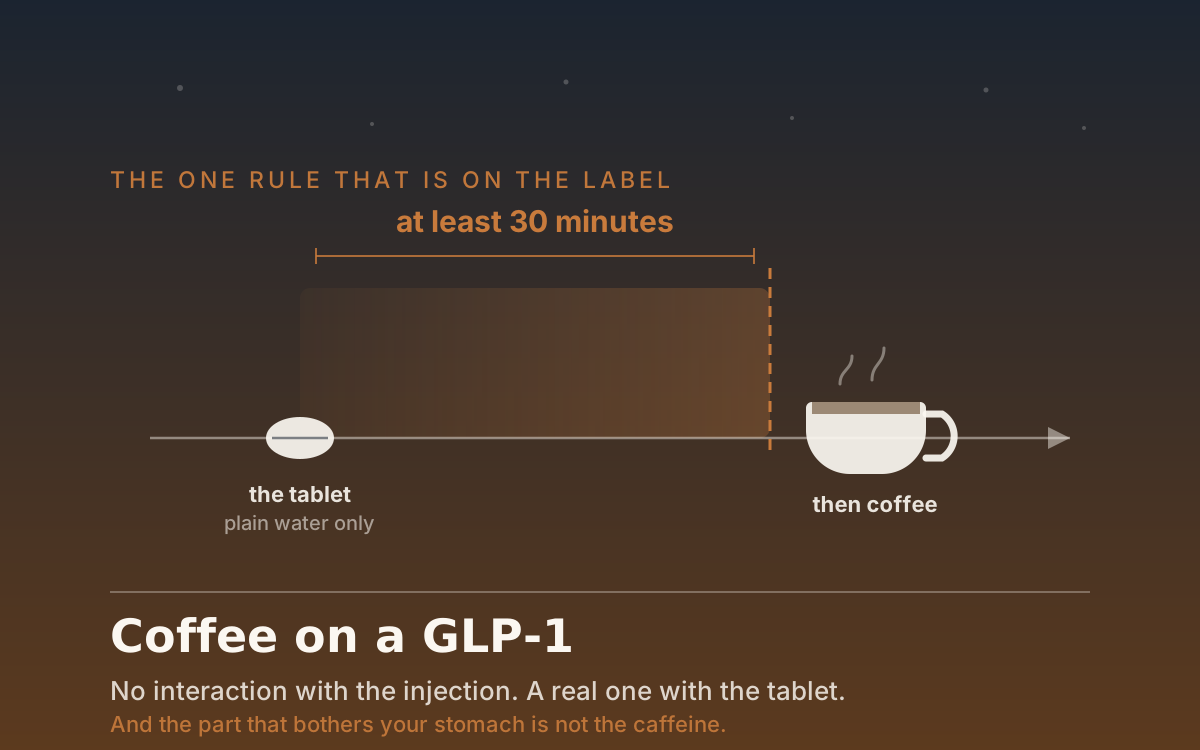
“Instruct patients to take RYBELSUS at least 30 minutes before the first food, beverage, or other oral medications of the day with no more than 4 ounces of plain water only. Waiting less than 30 minutes, or taking RYBELSUS with food, beverages (other than plain water) or other oral medications will lessen the effect of RYBELSUS by decreasing its absorption.”
Read that again with a coffee drinker in mind. Coffee is a beverage other than plain water. It is also, for a very large number of people, the very first thing that enters their body in the morning — which is exactly the slot the label reserves.
So if you are on the tablet, this is not a wellness question and there is no hedging in it. The morning coffee is not banned; it needs to move to the other side of a thirty-minute wall. That is the whole intervention. It costs you half an hour, not the cup.
Two practical notes. The label caps the water at four ounces, so this is not “take it with a big glass of water” either. And “more than 30 minutes” is not a problem for the drug — the label notes that waiting longer increases absorption — so erring late is safer than erring early.
The injection: no interaction, with or without meals
For the once-weekly injectables, the picture is much simpler, and I think it is under-communicated. The Ozempic label (opens in a new tab) directs administration “once weekly at any time of the day, with or without meals.” Its drug-interactions section flags a concern in the other direction — that because semaglutide delays gastric emptying, it “may impact absorption of concomitantly administered oral medications.” That is about your other pills. It is not about your breakfast, and it is not about coffee.
I want to be clear about the shape of this, because it is easy to over-read. No known interaction does not mean no effect on how you feel. It means the coffee is not doing anything to the drug and the drug is not doing anything to the coffee. What is left is your stomach, which is where the rest of this article lives.
The comfort question, and the numbers behind it
Here is why so many people notice their coffee changing.
These medications work partly by slowing gastric emptying — food and liquid sit in the stomach longer. That is not a side effect, it is close to the mechanism. And the gastrointestinal consequences are common enough to be the headline adverse events in the trials. From the placebo-controlled data in the Ozempic label:
| Adverse reaction | Placebo | 0.5 mg | 1 mg |
|---|---|---|---|
| Nausea | 6.1% | 15.8% | 20.3% |
| Vomiting | 2.3% | 5.0% | 9.2% |
| Diarrhea | 1.9% | 8.5% | 8.8% |
| Abdominal pain | 4.6% | 7.3% | 5.7% |
| Constipation | 1.5% | 5.0% | 3.1% |
| Dyspepsia | 1.9% | 3.5% | 2.7% |
| Gastroesophageal reflux disease | 0% | 1.9% | 1.5% |
Taken together, gastrointestinal adverse reactions occurred in 15.3% of placebo patients, 32.7% at 0.5 mg, and 36.4% at 1 mg. Roughly one in three people on the drug, against one in seven on placebo.
Now put coffee on top of that. Coffee is a well-documented stimulant of gastric acid secretion — that part has been settled since the 1970s. On a stomach that is emptying normally, a stimulated acid response is unremarkable; most people drink coffee daily for decades without noticing. On a stomach that is holding its contents substantially longer, the same acid load has more time and less exit. You do not need a drug interaction to explain the discomfort. Two ordinary effects arriving at the same organ is enough.
That framing matters because it changes what the fix looks like. If nothing is interacting, then nothing has to be eliminated on principle. You are managing a dose and a timing, the same way you would manage anything else that is fine in small amounts and unpleasant in large ones.
The part everyone gets wrong: it isn’t the caffeine
This is the section I would keep if I had to cut the rest.
Almost every article you will find on this topic advises cutting caffeine, or switching to decaf, on the theory that caffeine is the irritant. That theory was tested directly in 1975, and it did not survive.
Cohen and Booth, publishing in the New England Journal of Medicine (opens in a new tab), compared caffeine, regular coffee and decaffeinated coffee head-to-head for gastric acid secretion in normal subjects, on a cup-equivalent basis. The maximal acid responses:
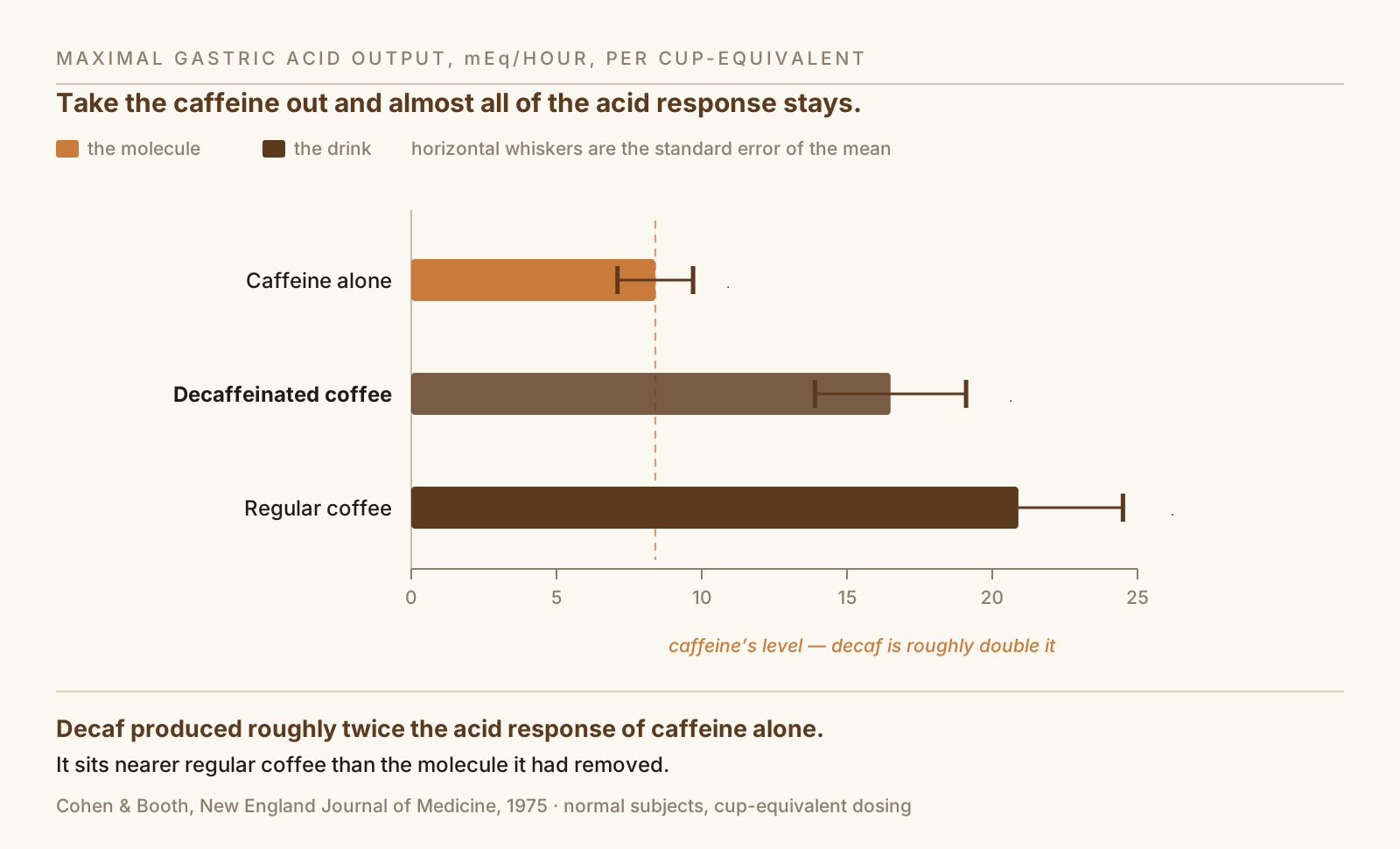
- Caffeine alone: 8.4 ± 1.3 mEq per hour
- Decaffeinated coffee: 16.5 ± 2.6
- Regular coffee: 20.9 ± 3.6
Decaf produced roughly twice the acid response of caffeine, and landed much closer to regular coffee than to the molecule everyone blames. The authors’ own conclusion is worth quoting, because it is unusually blunt for 1975: “these data suggest that clinical recommendations based upon the known gastrointestinal effects of caffeine may bear little relation to the actual observed actions of coffee or decaffeinated coffee.”
Fifty years on, the recommendations they were complaining about are still the ones circulating.
The practical consequence is specific. If acid is what is bothering you, decaf is a small intervention, not a real one — you are removing the component that contributes least. Moving off coffee entirely is a genuinely different action, because it removes the roasted-coffee matrix that the acid response actually tracks. That is not an argument that you should; it is an argument that if you do, you should know which of the two changes you are making.
Long-time readers will recognise the shape. We found the same thing when we looked at whether coffee blocks iron absorption — the culprit was polyphenols, not caffeine, and so switching to decaf did not fix that either. Caffeine is the most famous thing in coffee. It is very often not the thing doing the work.
On reflux, the research contradicts itself
I had planned a confident paragraph here about coffee relaxing the lower esophageal sphincter — the valve at the top of the stomach — because that claim is everywhere, and it pairs so neatly with delayed gastric emptying that it almost writes itself. Then I opened the two primary papers and they disagree.
Cohen and Booth, in the same 1975 study, reported that sphincter pressure “showed minimal changes in response to caffeine, but was significantly increased by both regular and decaffeinated coffee.” Increased. Higher pressure at that valve would be protective against reflux, not permissive of it.
Five years later, Thomas and colleagues in Gastroenterology (opens in a new tab) found the opposite. In 20 healthy volunteers and 16 patients with reflux esophagitis, coffee decreased sphincter pressure — from 19.4 to 13.7 mmHg at pH 4.5, and from 18.7 to 16.0 mmHg at pH 7.0, with larger reductions in the reflux patients. Notably, the effect appeared at both pH levels, so acidity alone does not explain it either.
Two well-conducted studies, opposite directions, both still cited. I am not going to adjudicate that here, and I am certainly not going to pick whichever one makes my article tidier. What I will say is the honest version: the reflux mechanism is unsettled, so if you get reflux on a GLP-1 and coffee makes it worse, trust your own experience over any mechanism story — including a mechanism story you read in a well-referenced article. Your oesophagus has more data on you than the literature does.
The trade-off nobody mentions: constipation
Look back at the adverse-event table. Constipation shows up at 5.0% and 3.1% against 1.5% on placebo. It is a real and reasonably common effect, and it points the opposite way from everything above.
Because coffee, whatever else it does, gets the colon moving. Rao and colleagues, in European Journal of Gastroenterology & Hepatology (opens in a new tab), ran ambulatory colonic manometry on 12 healthy subjects and compared caffeinated coffee, decaffeinated coffee, water and a 1,000 kcal meal. Caffeinated coffee stimulated colonic motor activity with a magnitude “similar to a meal, 60% stronger than water and 23% stronger than decaffeinated coffee.”
Two caveats before anyone builds a plan on that. The 23% figure is the authors’ summary, but the results section is more careful: decaffeinated coffee’s effects “were not significantly different from those of water or caffeinated coffee.” So even here — third time in this article — caffeine is not cleanly established as the active ingredient. And twelve healthy subjects is a small study.
Still, the practical point stands and it is one I rarely see acknowledged: if constipation is your dominant symptom, quitting coffee may cost you something. The morning cup is doing a job. Someone whose problem is nausea and someone whose problem is constipation are being given the same advice on the internet, and they should not be.
The dehydration claim is the weakest one
You will read that you must cut coffee on a GLP-1 because it dehydrates you and these drugs already risk dehydration. The second half of that is true. The link between them is not.
The dehydration concern on these labels is specific and it is not about beverages. Ozempic’s acute kidney injury section attributes the reported events to patients who “had experienced nausea, vomiting, diarrhea, or dehydration” — that is fluid lost through the gastrointestinal side effects. The patient-facing medication guide’s instruction is correspondingly simple: “It is important for you to drink fluids to help reduce your chance of dehydration.”
Coffee is a fluid. As we covered when we looked at whether coffee dehydrates you, habitual coffee consumption does not produce a meaningful net fluid deficit; the mild diuretic effect does not outrun the water the drink delivers. Cutting coffee to prevent dehydration solves a problem that is not the problem. If you are losing fluid to vomiting or diarrhea, that is a call to your prescriber, not a change to your mug.
When coffee simply stops tasting good
There is one more version of this question, and it is not about the stomach at all: people on these medications quite often report that coffee has simply stopped appealing to them.
I want to handle this carefully, because the confident mechanistic explanations circulating — GLP-1 drugs make bitter compounds taste stronger, and so on — are running well ahead of what has actually been measured.
What has been measured: at ENDO 2024, Jensterle Sever and colleagues reported (opens in a new tab) a proof-of-concept randomised trial in 30 women with obesity, given semaglutide 1 mg or placebo for 16 weeks, with taste-strip testing, functional MRI of the response to sweet stimuli, and tongue-tissue gene expression. They found changes in taste perception, in taste-bud gene expression, and in brain reward response. It is a real, well-designed study and it is genuine evidence that these drugs can change taste.
It is also thirty women, sixteen weeks, and focused on sweet taste. Bitter was not the object of study and coffee was not tested. So the honest statement is narrow: taste changes on GLP-1 receptor agonists are documented, food and drink aversions including coffee are very widely self-reported, and the specific claim that these drugs amplify coffee’s bitterness is not something I can point you to a study for. I would rather leave that gap visible than fill it.
Practically, none of the uncertainty changes what to do. If coffee has stopped tasting like something you want, that is sufficient information. You do not need a receptor-level explanation to stop drinking something you no longer enjoy.
It may ease on its own
This is the most useful thing I can offer anyone in dose escalation right now, and it is the reason I would not make a permanent decision in week three.
A 2024 review in the Journal of Clinical Endocrinology & Metabolism (opens in a new tab) examined how much these drugs actually delay gastric emptying, and found that for long-acting GLP-1 receptor agonists, regression analysis showed “a significant reduction over time in the prolongation of gastric emptying half-times” — tachyphylaxis, the effect wearing down with continued exposure. The same pattern did not appear for short-acting agents, and interindividual variation throughout this literature is large.
That lines up with something in the Ozempic label itself: “the majority of reports of nausea, vomiting, and/or diarrhea occurred during dose escalation.”
So a reasonable reading — and I would put this to your prescriber rather than acting on it alone — is that the window in which coffee feels worst may be a window rather than a new baseline. Which argues for pausing rather than quitting. Those are different decisions with different emotional weights, and a lot of people make the heavier one because nobody told them the lighter one was available.
The obvious swap has a catch of its own
Here is where I am supposed to tell you to switch to a caffeine-free coffee alternative. I am going to tell you something more useful, which is where that plan can backfire.
The most coffee-like caffeine-free drinks — the roasted-root herbal coffees — are built largely on chicory, and chicory root is one of the richest dietary sources of inulin. Inulin is a fermentable fiber and a well-characterised FODMAP. It is not absorbed in the small intestine; it travels to the colon and gets fermented there, and the by-product of fermentation is gas.
For most people, at a cup or two, that is unremarkable or even desirable. For someone whose stomach is already emptying slowly, who is already nauseated, already bloated, or already dealing with the gastrointestinal side effects in that table, adding a fermentable fiber is not an obviously good idea, and I am not going to pretend otherwise because the swap makes a tidier story. We went through this in detail when we looked at chicory coffee and IBS, and the FODMAP caution there applies with more force here, not less.
So the honest map, on the specific axis of how much fermentable fiber am I adding:
| Option | Inulin load | Worth knowing |
|---|---|---|
| Rooibos | Negligible | Naturally caffeine-free, low tannin, gentlest starting point — but not remotely coffee-like |
| Roasted barley (orzo, mugicha) | Low | Genuinely roasty and coffee-adjacent. Contains gluten — not an option in coeliac disease |
| Carob-forward blends | Low to moderate | Naturally sweet, closer to cocoa than coffee |
| Chicory / dandelion herbal coffee | High | The most coffee-like category, and the one with a real reason to start small |
Among the chicory-based herbal roasts, Teeccino (opens in a new tab) is the one we have found comes closest to a coffee-shaped cup, and the range is wide enough that you can pick a lighter or darker roast. It is also, unavoidably, chicory-based, which puts it squarely in that bottom row — so the same caution applies to it as to every other product in the category. Dandy Blend and Crio Bru sit in adjacent territory; we compared several of them in our herbal coffee roundup and our Teeccino vs Dandy Blend head-to-head if you want the flavour comparisons rather than the fiber question.
The move I would actually suggest is boring: start at half strength. Half the grounds, or half a cup. Inulin tolerance varies enormously between people and it is dose-dependent, so a half-strength trial tells you what you need to know at a fraction of the cost of finding out the hard way.
What I actually suggest
In rough order of how much they matter:
- If you are on the tablet, fix the timing first. Thirty minutes, four ounces of plain water, nothing else — coffee after. This is the only item on this list that comes from a label rather than from judgement.
- Tell your prescriber that coffee has become a problem. It is ordinary tolerability information and it may affect how they pace your escalation. It is also the answer to every question this article cannot answer.
- Do not eliminate first — move it, shrink it, and pad it. Later in the day rather than on an empty stomach, smaller volume, and with food rather than before it. Most people find the discomfort is dose-and-timing shaped.
- If you do experiment, understand that decaf and no-coffee are different experiments. Per Cohen and Booth, decaf changes less than people expect.
- Check which symptom you are actually solving. Nausea and constipation point in opposite directions, and coffee helps one of them.
- If you try an herbal coffee, start at half strength, especially a chicory-based one.
- Reassess after your dose stabilises, rather than deciding in the middle of escalation.
Everything in that list is reversible, which is the property I care most about in advice given to someone who is already changing a lot at once.
The bottom line
There is no interaction between coffee and the injectable GLP-1s. There is a firm, label-level one with the oral tablet, and it is solved by a thirty-minute gap rather than by giving anything up. What is left — the reason most people are asking — is that a drug which deliberately slows your stomach and a drink which stimulates gastric acid can add up to something neither does alone.
And the standard advice for that is aimed at the wrong target. Caffeine is not the part of coffee doing most of this work — not for acid secretion, probably not for colonic motility, and not for iron absorption either. That is a real reason a non-coffee drink is a different intervention from decaf, and it is a much better reason than the ones usually given.
If you land on a caffeine-free cup and it helps you keep a morning ritual you were about to lose, that is a genuinely good outcome. Just go in knowing that the most coffee-like options in that category carry a fermentable fiber your gut may have opinions about right now, and that half a cup is a cheaper way to find out than a full one.
None of this is a substitute for the person who prescribed your medication. Bring them the symptom. Bring them the timing question. They have the rest of your chart, which is the part I do not have.
Sources & further reading
- Gastric acid secretion and lower-esophageal-sphincter pressure in response to coffee and caffeine (Cohen & Booth) (opens in a new tab) — New England Journal of Medicine, 1975
- Inhibitory effect of coffee on lower esophageal sphincter pressure (Thomas, Steinbaugh, Fromkes, Mekhjian & Caldwell) (opens in a new tab) — Gastroenterology, 1980
- Is coffee a colonic stimulant? (Rao et al.) (opens in a new tab) — European Journal of Gastroenterology & Hepatology, 1998
- RYBELSUS (semaglutide) tablets — Prescribing Information (opens in a new tab) — US Food and Drug Administration
- OZEMPIC (semaglutide) injection — Prescribing Information (opens in a new tab) — US Food and Drug Administration
- Clinical Consequences of Delayed Gastric Emptying With GLP-1 Receptor Agonists and Tirzepatide (opens in a new tab) — Journal of Clinical Endocrinology & Metabolism, 2024
- GLP-1 has the power to change taste sensitivity in women with obesity (Jensterle Sever et al., ENDO 2024) (opens in a new tab) — Endocrine Society