Quitting caffeine before finals? The study says stress wrecked students' sleep, not the extra coffee — so time the taper around it
In a German study of university students, caffeine intake rose during exams but didn't predict who slept badly; perceived stress did. That changes the question from 'quit now or never' to 'when does a taper cost least' — and the answer is usually not exam week.

Finals are the one stretch of the year when every reason to quit caffeine and every reason not to show up together. You’re jittery, sleeping badly, and drinking more coffee than usual. You’re also about to need your brain to work on a schedule somebody else set.
Short version: probably don’t go cold turkey during exam week, and don’t assume the coffee is the whole sleep problem either. Here’s what one study actually found, and how to fit a taper around it.
The short answer
Hold off on quitting outright until your last exam is done. If you want to cut back now, do it slowly and start from the calmest week you’ve got. If you’re quitting for good, pick a window with no exams in it. That’s a scheduling decision, not a judgment about willpower.
The reasoning comes from two bodies of research that point in different directions, and both matter.
What the exam-period study actually found
A team at the University of Regensburg surveyed university students in Germany before, during and after an exam period, tracking sleep with the Pittsburgh Sleep Quality Index alongside self-reported alcohol, caffeine and nicotine use and a perceived-stress questionnaire. The analysis covered 142 students.
Two results stand out:
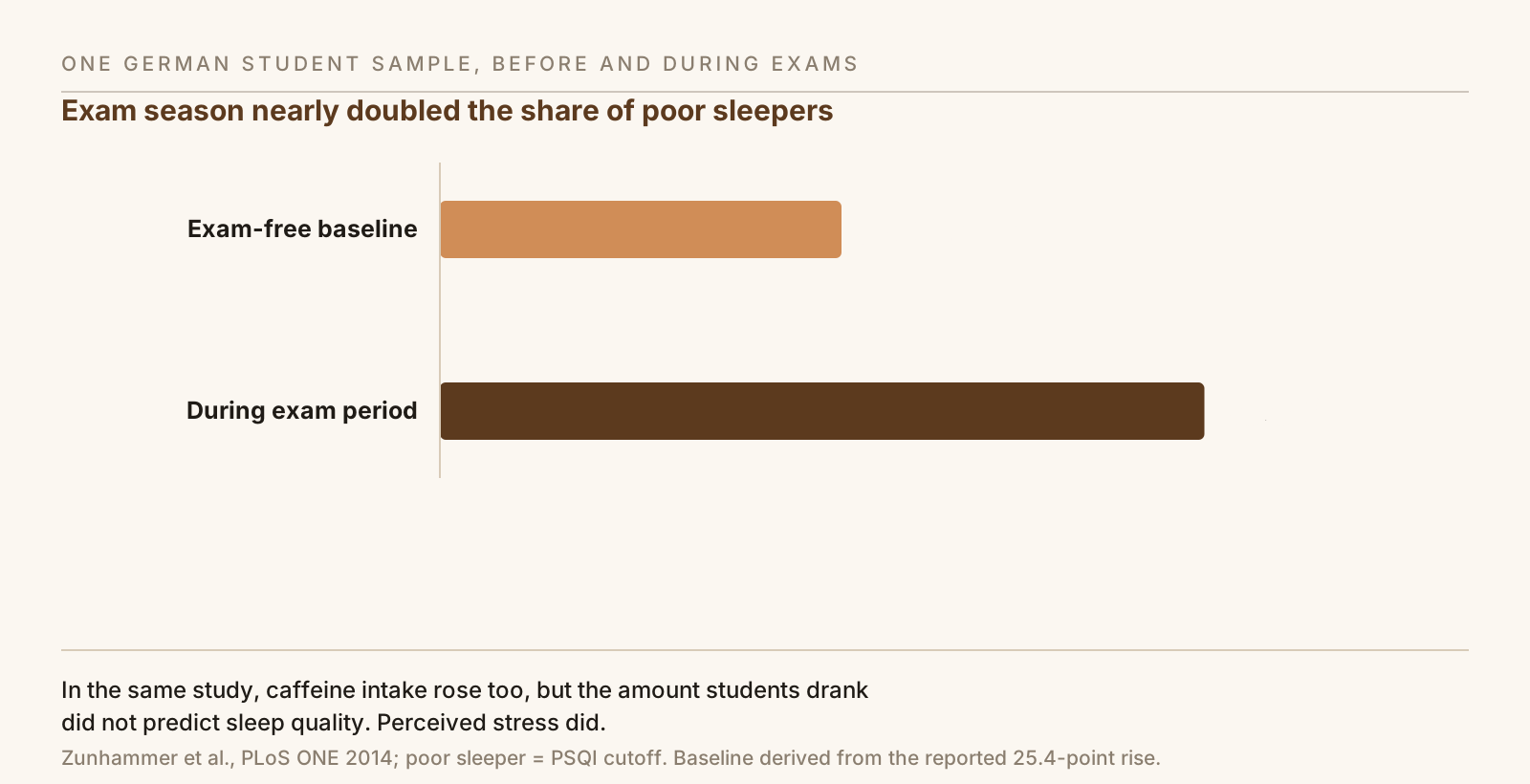
- Sleep got worse, and students spent about half an hour less in bed on average. The share classed as poor sleepers rose by 25.4 percentage points, to 53.3%.
- Caffeine use went up too, but how much students drank didn’t significantly predict how badly they slept. The two factors that did were perceived stress and, more weakly, nicotine.
This is one self-report survey of students in rural Bavaria, asked about caffeine over the previous week and sleep over the previous month, and the authors note that kind of design has limits. It doesn’t show caffeine is harmless for sleep. Other research on caffeine and sleep architecture points the other way. What it does suggest is narrower and more useful: if the stress doesn’t change, dropping the coffee alone may not give you your sleep back.
Why finals week is the wrong week to go cold
Now the other side. A widely cited review of the caffeine-withdrawal literature (Juliano and Griffiths, covering 57 experimental studies) found that in experimental studies about half of people developed a headache, and about 13% had clinically significant distress or impairment. Symptoms typically began 12 to 24 hours after the last dose, peaked around 20 to 51 hours and lasted 2 to 9 days. The validated symptom list included fatigue, reduced alertness, drowsiness, depressed mood, difficulty concentrating, irritability and feeling foggy. Higher daily doses tended to mean more symptoms, though stopping doses as low as about 100 mg a day produced them in some studies.
Read that list as a student: reduced alertness, poor concentration and irritability, peaking a day or two after you stop. If your last cup is Monday night, the worst of it can land on Wednesday morning’s exam. You’d be swapping a stress-and-sleep problem for a stress-sleep-and-withdrawal problem.
Most people won’t get the worst case. But an exam gives you no room to find out which person you are. For the longer version of the timeline, see how long caffeine withdrawal lasts.
Where a taper fits in a semester
The shape doesn’t change from what’s in how to quit caffeine without the headache: cut by roughly a quarter to a third every few days, rather than stopping all at once. What changes is the start date.
- Best: the first weeks of a term. Syllabus week, before the first midterm, has the most slack. A three-week taper finishes before the pressure builds.
- Acceptable: right after your last exam. Winter and summer breaks are good windows, because you can sleep through a rough day. Expect the first two or three days to be the bumpy ones.
- Risky: anywhere inside the two weeks before an exam. If you have to start, cut only the latest cup of the day first. That’s the smallest change with the clearest upside for falling asleep.
That latest-cup move is the same math as in why caffeine wrecks your afternoon. With an average half-life of about 5 hours (it varies a lot by person), a cup at 8 p.m. still leaves roughly half its caffeine in your system at 1 a.m. Moving your last cup to early afternoon costs you little in the morning and is the change most likely to give sleep back.
If you’re already in it: the exam-week rules
Sometimes the taper is off the table: it’s week 14 and you’re already at four cups a day. Then the goal is to stop things getting worse, not to quit.
- Hold your dose steady. No big jumps up for an all-nighter. A sudden increase makes the later drop bigger.
- Set a cutoff time. Early afternoon is a reasonable default; adjust if you know you’re a fast or slow metabolizer.
- Protect the sleep you can. In the study, students got about half an hour less in bed during exams, and poor sleep climbed. A short nap beats a fourth cup. The caffeine nap explains how a cup followed by 20 minutes can work if you time it.
- Plan the quit for after. Put a start date in your calendar for the week after your last exam. Having a date makes it easier to keep your dose steady now.
What to drink at 1 a.m. instead
Late-night studying is partly a ritual: a warm cup, something to hold, a reason to sit still. A roasted chicory or grain-based herbal coffee can keep that. It won’t keep you alert, because it has no caffeine, so treat it as a replacement for the ritual, not the boost.
Teeccino’s French Roast (opens in a new tab) is one option; it contains barley and almonds, so it isn’t gluten-free or nut-free. Pero and other roasted-grain blends work on the same principle. Dorm realities matter here too: these brew like coffee, so you need a kettle, a French press or a drip machine, and a few minutes. If you only have a hot-water dispenser, instant options are easier. More in the best caffeine-free coffee alternatives.
The bottom line
Stress, more than caffeine, was what tracked with worse sleep in the one exam-season study we looked at, and withdrawal symptoms are exactly the ones you don’t want during a test. So put the quit on the calendar for after your last exam, hold your dose steady until then, and move your last cup earlier. Do that and you haven’t given up on quitting. You’ve only picked a better week.
This article is educational, not medical advice. If you take medication or have a health condition, talk to your doctor or campus health service before changing how much caffeine you have.
Sources & further reading
- Sleep quality during exam stress: the role of alcohol, caffeine and nicotine (opens in a new tab) — Zunhammer, Eichhammer & Busch, PLoS ONE, 2014
- A critical review of caffeine withdrawal: empirical validation of symptoms and signs, incidence, severity, and associated features (opens in a new tab) — Juliano & Griffiths, Psychopharmacology, 2004
- Caffeine (opens in a new tab) — NCBI Bookshelf
Reader conversation (5)
We read every response. Selected reader notes below.
I tried to quit the week before my orgo midterm last year and it was a disaster. Day two was the headache and I could not hold a mechanism in my head. Moving it to winter break worked fine. The “put it on the calendar for after” advice is boring and correct.
Boring and correct is the goal here. Thanks for the real-world timeline, day two lines up with the peak window in the research.
The finding that the amount of coffee didn’t predict sleep but stress did is uncomfortable for me. I’ve blamed the 9 p.m. cup for years. Going to try moving it to 2 p.m. and see if anything changes.
Useful that you pointed out it’s one self-report survey. Most articles on this would have presented it as proof in one direction or the other. I’d still love to see a version with sleep trackers instead of questionnaires.
Same here. Questionnaires can only tell you so much, and the authors flag the mismatch between the one-week caffeine window and the one-month sleep window themselves.
Dorm tip from my daughter: a cheap electric kettle plus a small French press is all it takes for the herbal stuff. The hot-water-dispenser problem is real though, instant is the only thing that works in her building.
Setting a start date for after the last exam helped me more than I expected. Knowing the plan existed made it easier to just keep my usual two cups during the crunch instead of panic-drinking.
Have something to add? Email us and we may include it in a future update.