Caffeine-free coffee alternatives for camping and backpacking: what actually works without a kitchen
Every instant-coffee-alternative roundup assumes a counter, a mug, and a tap. Backcountry camping removes all three. We checked what each maker's own directions actually say about hot water, cold water, and steep time — and found only one widely sold option that skips the stove entirely.


Our instant coffee alternatives ranking judged everything on dissolve quality and flavor, on the assumption you’re standing at a kitchen counter with a kettle, a mug, and a tap. That assumption holds for a hotel room or an office break room. It falls apart the moment you’re three miles up a trail with a stove you’re trying not to use, or car-camping with a cooler and no outlet in sight. Camping and backpacking add a constraint the indoor guides never have to solve for: sometimes there’s no reliable way to heat water at all, and every ounce and every dish you don’t have to wash matters.
So this is a narrower question than “what’s the best instant.” It’s: what actually works when the kitchen is gone?
The real question isn’t caffeine-free — it’s no kitchen
Every product in this piece is already caffeine-free or close to it — that part isn’t the hard filter for a camping trip. The hard filter is equipment. A roasted-grain instant that needs “very hot, not boiling” water and a spoon is trivial to make at a campsite with a stove and a kettle. It’s a real obstacle if your stove broke, if you’re rationing fuel, or if you deliberately packed light and didn’t bring one.
We went back to the source for six formats — three instants, one tea bag, and grounds you’d brew or cold-steep — and read each maker’s own preparation directions rather than assuming “instant” means “add any water.” The differences turned out to be bigger than we expected.
Three scenarios, three different answers
Not every camping trip has the same constraints, so the right pick depends on which one you’re on:
- Car camping with a stove or kettle. You have hot water on demand. Every format in this piece works, and the deciding factor is just taste — see our full instant ranking or, if you packed a compact dripper, our French press and pour-over guide.
- Backcountry backpacking, minimal or no stove. This is the scenario the rest of this piece is really written for — what works when heating water is expensive (fuel weight, time) or off the table.
- Flying to the trailhead. You’re not just packing for the trail, you’re packing through airport security first. We cover that in detail in staying caffeine-free while traveling; the short version reappears below.
The cold-water test: what each maker’s own directions say
We checked the preparation instructions each brand publishes for itself — not marketing copy, the actual “how to make this” text — for four instant and tea-bag products people commonly reach for as a coffee substitute on a trip.
Cafix instant grain beverage: “Stir one or more teaspoons of Cafix Crystals into a 6 oz. cup of very hot (not boiling) water.” No cold-water method appears anywhere in the manufacturer’s own directions.
Pero instant natural beverage: “Place one heaping teaspoon into one cup of very hot (not boiling) water or warm milk and stir… Pero can also be enjoyed cold, over ice.” Read that carefully — it’s mixed hot, then served cold. That’s a different thing from dissolving cold.
Teeccino Miraculous Mushrooms Adapt & Protect Instant: the product page’s own instructions read, “Add 1½ tsp to a cup or glass. Add 8 oz of hot or warm water & blend with an electric frother or whisk. Enjoy hot or pour over ice.” This one’s honest about needing more than a spoon — a frother or whisk is part of the stated method, on top of needing warm water in the first place.
Dandy Blend, individual serving packets: “The powder is soluble in any type of liquid at any temperature. No steeping or brewing.” That’s the one unhedged claim in the group. Dandy Blend was already the dissolve leader in our broader instant ranking; this is the same solubility showing up as a genuine cold-water, no-heat-source use case, and the brand sells it in individual travel sticks explicitly for that.
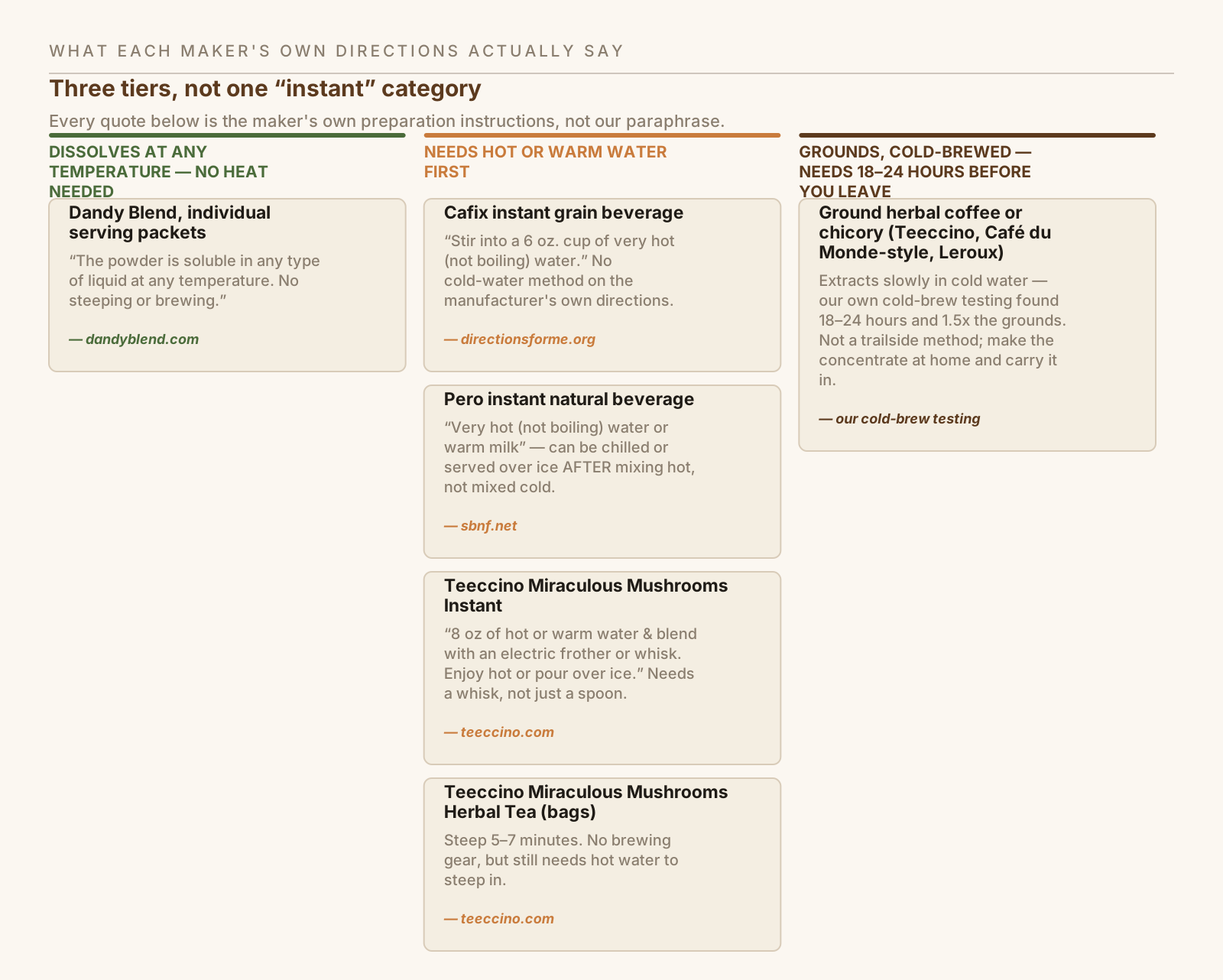
The honest reading of that chart: “instant” is doing a lot of work as a category name. Three of the four instants and the tea bags all assume access to hot or warm water. Only one is documented to skip that step.
Tea bags: no gear, but still no cold-water shortcut
Tea bags solve a different problem than instants do. There’s no scooping, no measuring, no wet spoon to rinse, and nothing to spill in a pack. Teeccino’s Miraculous Mushrooms Adapt & Protect Herbal Tea steeps for “5–7 minutes for a strong rich flavor,” per the product page, in 25 individually wrapped bags at 6 grams each — light, and genuinely no equipment beyond a cup and hot water.
Two honest caveats worth knowing before you pack it for a group trip. First, water temperature isn’t specified on the product page — you still need something hotter than ambient to get a real steep, so this doesn’t solve the no-heat-source problem the way Dandy Blend does. Second, and more importantly for shared camp food: the tea bags are “produced on machinery that also processes almonds,” and the blend itself contains barley, so it is not gluten-free. If anyone in your group is managing a tree-nut allergy or celiac disease, that’s a real constraint, not a formality — check it the way you’d check any packaged trail food before a group trip.
Grounds and cold brew: the 18-to-24-hour trap
If you already carry loose ground herbal coffee or chicory — Teeccino’s roasts, a plain roasted chicory like Leroux or a Café du Monde-style blend — there’s a real hot-water method: treat it like camp coffee. Boil water, pour it over the grounds in a pot or a compact French press, let it sit, and either press or strain through a fine mesh or a clean bandana. It’s slower than an instant, but it needs nothing you wouldn’t already carry if you brought loose grounds in the first place. Our French press and pour-over guide covers the technique for a packable dripper if you want something more controlled than a strain-and-pour.
What doesn’t work is treating those same grounds as a cold-brew option on the trail. We tested this directly for our cold-brew coffee alternative guide: roasted herbal coffee grounds need roughly 1.5 times the usual dose and an 18-to-24-hour steep before they taste like more than weak brown water, because the carob and chicory that give Teeccino its body extract slowly in cold conditions. Eighteen hours is not a lunch break — it’s not a trailside method at all. The version that actually works is prep-ahead: make the concentrate in your fridge before you leave, carry it in a bottle or a flask, and dilute it with trail water as you go, exactly the way backpackers already do with real coffee cold-brew concentrate.
Packing it: weight, security, and the water-safety line
A few practical notes that apply regardless of which format you pick:
- Single-serve beats a jar. Dandy Blend’s travel packets and Teeccino’s individually wrapped tea bags are both pre-portioned — no wet spoon reaching into a shared tub, no jar to protect from getting crushed in a pack. If you’re backpacking rather than car camping, that’s worth more than it sounds.
- Flying to the trailhead means airport security. As we cover in staying caffeine-free while traveling, dry tea bags and sealed single-serve sachets go through security without issue, but a large tub of loose powder can draw extra screening. Pack individual packets rather than decanting a jar into a bag.
- A cold-dissolve powder doesn’t purify water — that’s a separate job. If you’re filling a bottle from a stream or lake, the CDC’s guidance is to treat water you’re unsure of before drinking it: a rolling boil for 1 minute (3 minutes above 6,500 feet elevation) kills viruses, bacteria, and parasites including Giardia and Cryptosporidium, and it notes plainly that water from a clear mountain stream is “generally not” safe untreated. If you’re already boiling water for a hot cup, that step does double duty. If you’re using something like Dandy Blend that dissolves cold, treat or filter the water first and add the powder after — the powder doesn’t make untreated water any safer, and it doesn’t make it any less safe either. It’s just not a substitute for treatment.
What to buy, by trip type
- Car camping, stove or kettle available: anything in this piece works — pick on taste. Start with our instant ranking or bring loose grounds and a compact French press.
- Backcountry, no reliable heat source: Dandy Blend’s individual travel packets are the one option here documented by its own maker to dissolve in cold water with no steeping or brewing. If you’d rather have something closer to iced coffee in body, make a Teeccino or chicory cold-brew concentrate at home before you leave and carry it in.
- Backcountry, small stove or an insulated bottle of hot water: Teeccino’s Miraculous Mushrooms tea bags or instant, Cafix, or Pero all work here — budget the fuel and time for hot water, and know the tea bags carry a tree-nut cross-contact note and are not gluten-free.
- Flying to the trailhead: favor single-serve sachets and tea bags over jars, and expect extra screening only if you’re carrying a large tub of loose powder.
None of this is about caffeine anymore by the time you’re on trail — every option here already clears that bar. It’s about matching the format to what you’re actually carrying, and not finding out at 6am on a granite ledge that your “instant” coffee needed a whisk you didn’t pack.
Sources & further reading
- Dandy Blend Individual Serving Packets — soluble in any liquid at any temperature (opens in a new tab) — Dandy Blend
- Cafix Instant Grain Beverage — manufacturer directions (opens in a new tab) — directionsforme.org
- Pero Instant Natural Beverage — ingredients and directions (opens in a new tab) — Something Better Natural Foods
- Miraculous Mushrooms® Adapt & Protect Instant Herbal Coffee — preparation instructions (opens in a new tab) — Teeccino
- Miraculous Mushrooms® Adapt & Protect Herbal Tea — steep instructions and ingredients (opens in a new tab) — Teeccino
- About Water Treatment Options When Hiking, Camping, or Traveling (opens in a new tab) — U.S. Centers for Disease Control and Prevention
- What Can I Bring? Powders and powder-like substances (opens in a new tab) — U.S. Transportation Security Administration
Reader conversation (5)
We read every response. Selected reader notes below.
Section-hiked the PCT with Dandy Blend packets for exactly this reason two summers ago and can confirm it dissolves fine straight out of a cold filtered bottle, no grit. What I’d add: it does NOT taste like much cold. Hot it’s a reasonable stand-in, cold it’s mostly a mild malty tint on water. Worth knowing before you’re relying on it for morale on day four.
That’s a useful caveat and an honest one — we were checking whether it dissolves, not grading the cold flavor, and those are genuinely different questions. Sounds like the fair summary is: reliable as a no-heat option, but treat it as a mild warm-ish drink rather than an iced-coffee substitute. Thank you for the field report.
The distinction between “mixed hot then chilled” and “actually dissolves cold” is one I’ve never seen anyone bother to draw before, and it’s obviously the whole ballgame if you don’t have a stove. Filed away for my next trip.
Cowboy-brewed a mug of ground Teeccino over a fire last month exactly as described — dumped grounds in the pot with boiling water, let it sit a few minutes, poured off the top slow. Worked better than I expected, a little sediment in the last sip but nothing worse than real cowboy coffee gives you. Good tip for anyone who already carries the ground stuff and doesn’t want to also carry an instant.
Glad it held up over an actual fire and not just a camp stove — that’s a rougher test of “no equipment” than we ran. The bit of sediment in the last sip is the trade-off for skipping a filter entirely, and it sounds like you made the right call letting it settle rather than drinking it stirred.
Small thing, but worth saying since I have a nephew with a tree nut allergy: please don’t assume any “produced on shared equipment” line is a minor footnote. We’ve had to read every label on a group camping trip before, not just the caffeine-free ones, and it’s exactly this kind of afterthought mention that gets missed when everyone’s packing in a hurry. Good that you called it out plainly instead of burying it.
Curious whether anyone’s tried the cold-brew concentrate approach with a roasted chicory rather than a Teeccino blend specifically — assume the same 18-24 hour rule applies since it’s the same basic extraction problem, but wanted to check before I ruin a hiking trip’s only hot drink.
Should hold — the slow-extraction issue is about chicory and carob’s chemistry in cold water generally, not something specific to Teeccino’s blend, so the same dose-and-time rule is the right starting assumption for a plain roasted chicory too. We haven’t run that exact side-by-side, so treat it as a reasonable extrapolation rather than a tested result, and maybe pilot it at home before you bet a trip on it.
Have something to add? Email us and we may include it in a future update.