Where to buy caffeine-free coffee, priced landed: what grocery, Amazon, and buying direct actually cost you
Every price we've published in this category has been the number on the seller's page, which quietly assumes free delivery or a car. Priced landed, a $45 shipping threshold can make one small bag cost 72% more per cup than three of the same bag bought together — we work the arithmetic with live prices from Teeccino, Rasa, and Amazon.

Priyanka N. in Leeds read our cost-per-cup piece and found the hole in it within hours: every price in that table was the number on the seller’s page, which quietly assumes you have free delivery already sorted, or a car and a store nearby. She was ordering the “cheapest” lines in that table — bulk bags, loose chicory by the pound — and watching a delivery charge eat a chunk of the saving she’d been promised.
She’s right, and the fix isn’t a footnote. The lines that came out cheapest in that piece are disproportionately the direct-from-brand ones, where the free-delivery assumption is weakest, while the option she can walk to at a grocery store carries no delivery charge at all, ever. Shipping doesn’t just add a constant to every row — it can reorder the middle of the table.
So this is the piece that prices it landed: what actually reaches your door, not what’s printed on the screen before checkout.
The gap in our own table
The formula in the cost-per-cup piece was price per gram, times your dose. It’s still correct — for a bag already sitting on your counter. It has nothing to say about the step before that, which is getting the bag there in the first place.
That step is free in exactly one channel (grocery, because you drove there) and conditional in the other two (Amazon and buying direct from a brand), where “free” is a line you either clear or don’t. Nobody prices that line into a per-cup number, because it depends on how much else is in your cart — which is precisely why it’s worth working out once, properly, rather than assuming it nets to zero.
The formula, updated for delivery
One more term, that’s all:
Landed cost per cup = (package price + shipping you actually paid) ÷ package weight in grams × grams you use
If shipping was free, this collapses back to the original formula exactly. If it wasn’t, the shipping charge gets divided across every cup in the bag along with everything else — which means a small bag doesn’t just cost more per cup because it’s a worse deal on paper. It can cost more because the fixed cost of getting it to you is being spread across fewer cups.
Three channels, three different assumptions about free
Each of the three ways to buy something in this category has a completely different idea of what “free” means, and conflating them is where the table breaks.
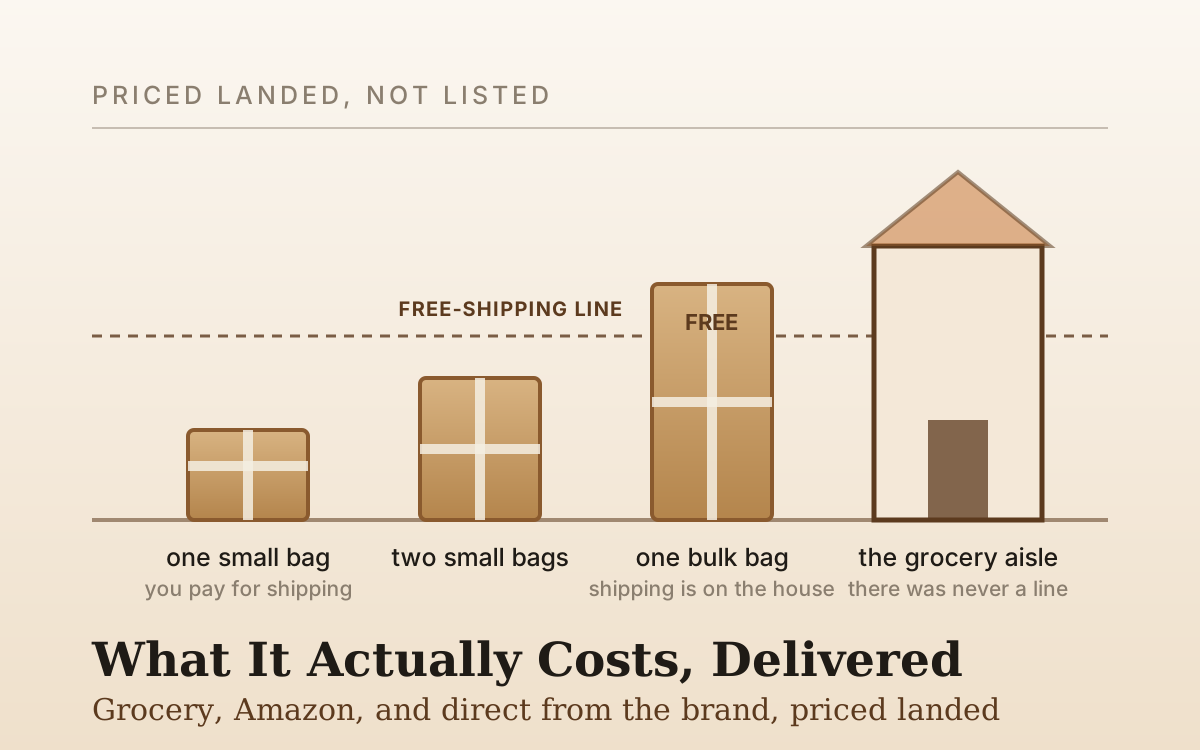
Grocery. There’s no threshold because there’s no delivery — you’re standing in the aisle. This is the channel’s whole advantage, and it’s easy to undervalue because it’s so unglamorous. Our grocery-store guide maps which aisle to check for what.
Amazon. Free shipping is either unconditional (you have Prime, and it’s sold and shipped by Amazon) or governed by a minimum that most non-Prime grocery orders sit below. Subscribe & Save adds a third door: a standing discount and free delivery on the subscription itself, no cart minimum required.
Direct from the brand. This is where the threshold actually bites, because brand sites in this category routinely sell in sizes well under their own free-shipping cutoff. A single 11-ounce bag is a completely normal thing to order and a completely normal thing to fall short on.
The threshold math, worked out with real numbers
Teeccino’s shipping page (opens in a new tab) states free U.S. shipping on domestic orders over $45, live as of this writing. Its French Roast Herbal Coffee (opens in a new tab) sells for $18.49 at 11 ounces (311.85 g at our standard 8-gram mug dose from the cost-per-cup piece) and $98.99 at 5 pounds (2,270 g), at the site’s regular, non-promotional price.
One honest gap: Teeccino calculates below-threshold shipping by carrier at checkout, and we’re not completing a purchase to find that exact number. What we used instead is USPS’s own retail Priority Mail Small Flat Rate Box (opens in a new tab) price, $12.90 — a realistic stand-in for what a light package like this costs to ship, not a claim about what Teeccino specifically charges. Treat the dollar figures below as illustrative of the mechanism, not a quote.
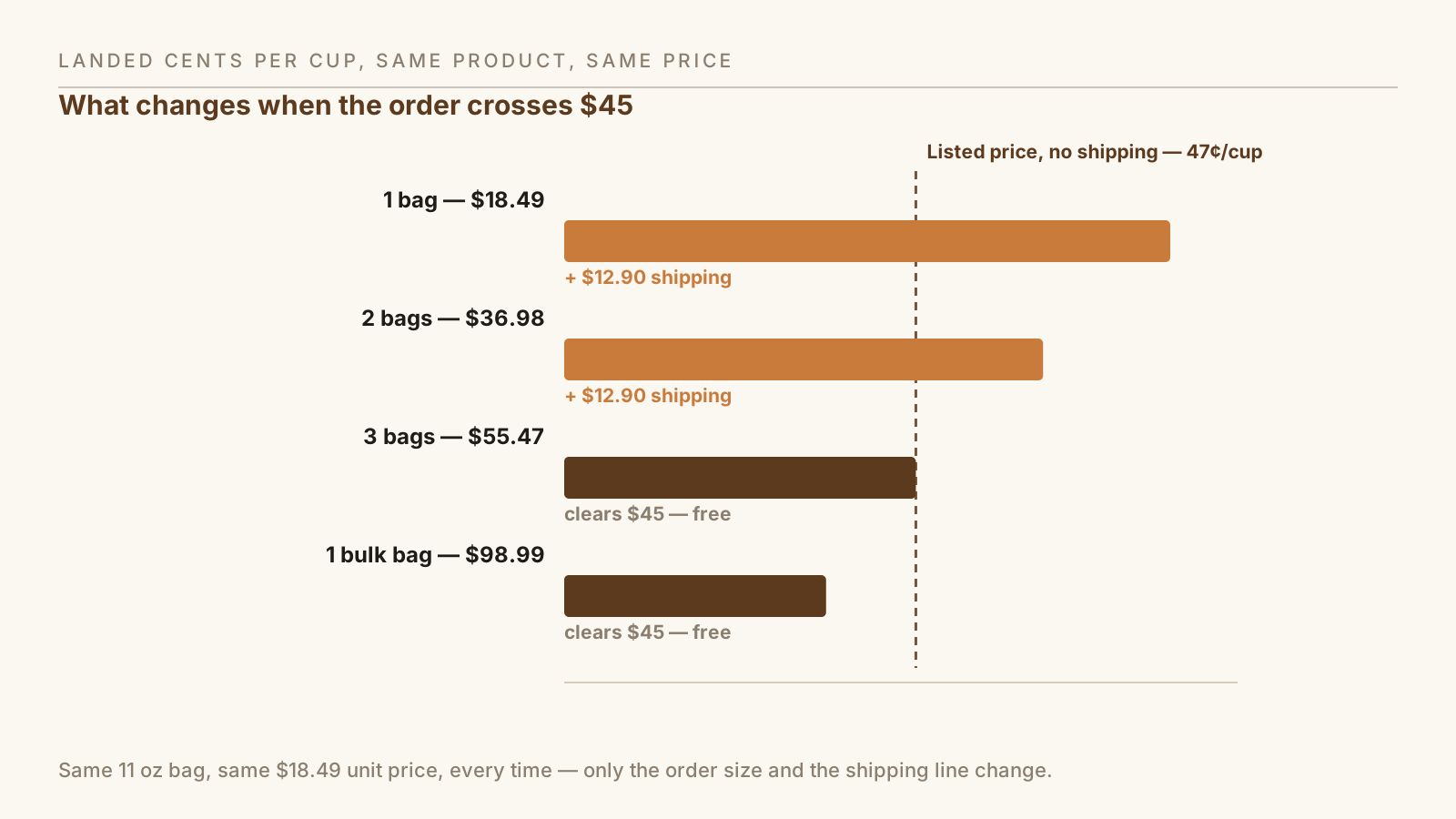
Four ways to place that order, landed:
| Order | Subtotal | Clears $45? | Landed cost/cup |
|---|---|---|---|
| 1 bag | $18.49 | No — add shipping | 81¢ |
| 2 bags | $36.98 | No — add shipping | 64¢ |
| 3 bags | $55.47 | Yes, free | 47¢ |
| 1 bulk bag (5 lb) | $98.99 | Yes, free | 35¢ |
Two things happen at once here, and they’re worth separating. Between 3 bags and 1 bulk bag, the per-unit price itself drops — that’s the bulk-format saving the cost-per-cup piece already covered. But between 1 bag and 3 bags, the unit price is identical — $18.49 every time — and the landed cost still falls by 42%, purely because the order crossed a dollar line. That second effect is the one list-price tables can’t show you, and it’s larger, cup for cup, than most of the brand-versus-brand differences we’ve measured in this category.
It cuts the other way, too. Teeccino’s current Flavor of the Month (opens in a new tab) price on the same bag is $13.60, not $18.49 — a real discount, live as we wrote this, ending August 31. At that price, three bags total $40.80, which no longer clears $45. The deeper the per-unit discount, the more units it takes to cross a flat dollar threshold, not fewer. A shopper doing the old, list-price arithmetic would see a lower number on the tag and reasonably expect a lower landed cost; here the threshold moved further away instead.
Grocery’s real advantage: there was never a line to cross
None of the threshold arithmetic above applies to a walk-in purchase, and that’s the point of this section rather than a caveat to it. Every unit of currency you’d spend on shipping stays in your pocket, at every order size, including an order of one small box.
The tradeoff is real and worth stating plainly: grocery shelves carry a narrower slice of this category, rarely in bulk sizes, and the closest coffee-adjacent instants (Pero, Cafix) sit beside a genuine trap — Café du Monde–style “coffee and chicory” blends are still coffee, carrying real caffeine despite the chicory on the label. That’s a labeling problem about what’s in the bag, not a shipping problem, and it costs you nothing extra to check before you buy — which, dollar for dollar, may be the best fine print in this entire article.
Amazon: Prime erases the question, Subscribe & Save erases it twice
Amazon doesn’t have one shipping policy for this category; it has three, and which one applies to your cart is worth confirming before you assume the cheapest listing is actually the cheapest landed price.
With Prime, shipping is free regardless of order size, for anything sold and shipped by Amazon itself. The threshold question simply doesn’t exist. This is the single cleanest way to buy a small bag of anything in this category without eating a shipping charge on top.
Without Prime, free shipping on Amazon generally requires clearing a minimum widely reported at $35 — lower than Teeccino’s $45 and higher than a single small bag of almost anything here (opens in a new tab). The same bag-stacking logic from the section above applies: one bag likely falls short, several bags likely clear it.
Subscribe & Save sidesteps the threshold a second way. Amazon’s own program terms describe a 5% discount on a single subscribed item, rising to 15% when five or more subscriptions land on the same delivery day, with free standard shipping on the subscription itself. You’re trading a small standing discount and a fixed delivery day for never having to think about a cart minimum again — a genuinely good trade for something you already know you’ll keep drinking.
One correction to make honestly, because we went looking for it directly rather than assuming it: we could not verify a specific pattern of “caffeine-free” mislabeling unique to Amazon listings. The real trap in this category is a naming problem, not a marketplace problem — it shows up identically on a grocery shelf and a marketplace listing. Café du Monde–style blends and mushroom “coffees” built on a real coffee base carry caffeine no matter who ships the box. Read the ingredient list wherever you’re buying; the channel isn’t the safeguard.
When the threshold math doesn’t actually help you
Buying three bags or sizing up to bulk to clear a shipping line is only a good trade if you were going to buy that much anyway. Two honest limits, both already flagged in the cost-per-cup piece and worth repeating here because landed pricing makes them more tempting to ignore, not less:
Roasted botanicals go flat over months, so a 5-pound bag or a triple order is three to five months of committed daily drinking, sealed and stored cool, or the saving evaporates into a stale cupboard. And crossing a threshold on a product you haven’t tried yet just moves the risk from “I overpaid for shipping” to “I own five pounds of something I don’t actually like” — which is a worse outcome by a wide margin.
Not every brand’s line sits where Teeccino’s does, either. Rasa’s free-shipping cutoff is $50 (opens in a new tab), five dollars higher, and subscribers there get free shipping unconditionally the same way Amazon Prime does. There’s no shortcut that avoids checking the specific number on the specific site you’re buying from — the mechanism in this piece is universal, the dollar figure never is.
What to actually do, by situation
New to the category, don’t know if you’ll like it: buy the smallest size, on whichever channel, and eat the shipping charge once if you have to. It’s cheap tuition compared to a bulk bag going stale.
Committed daily drinker, buying direct from a brand: size the order on purpose to clear the threshold — combine flavors into one checkout, or step straight up to the bulk size if you’re confident you’ll finish it. Check the current threshold and the current promotional price before you do the arithmetic; both move.
Amazon Prime member: the threshold question is close to moot. Buy the size you actually want and let Prime absorb the delivery cost.
No Prime, no local stock, want to commit: Subscribe & Save is built for exactly this — it removes the cart-minimum problem the same way a bulk order does, without requiring you to store five pounds of anything.
Have a car and a store that stocks it: grocery remains the one channel where this entire article’s math is irrelevant, because there was never a line to clear. Our grocery-store guide has the aisle-by-aisle map.
Sources & further reading
- Shipping & Returns — free domestic shipping over $45 (opens in a new tab) — Teeccino
- French Roast Herbal Coffee — 11 oz and 5 lb pricing (opens in a new tab) — Teeccino
- Original Rasa — free shipping on orders over $50 (opens in a new tab) — Rasa
- Priority Mail Flat Rate box pricing (opens in a new tab) — USPS
- Subscribe & Save — discount tiers and delivery terms (opens in a new tab) — Amazon
- Amazon's free-shipping minimum for non-Prime orders (opens in a new tab) — ParcelPath
Reader conversation (4)
We read every response. Selected reader notes below.
I did not expect a comment I left eleven days ago to turn into an entire article, and I definitely did not expect the answer to be “buy three bags in one order,” which is not something I would have worked out on my own. The 42% swing between one bag and three of the identical bag is the number that’s going to stick with me — I’d assumed shipping added something, but I hadn’t clocked that it could matter more than the whole bulk-versus-small-bag question I originally asked about.
That 42% was the number that surprised us too, and it’s the whole reason this got its own piece rather than a patched table. Thank you again for the original nudge — “I suspect it reorders the middle” turned out to be exactly right, just in a different place than either of us guessed.
Confirmed the Prime math on my own account this afternoon out of curiosity: added a single 11 oz bag of a chicory blend to an otherwise-empty cart, Prime-eligible, and it went straight to free two-day shipping with no threshold shown anywhere in checkout. So for anyone with Prime already, this whole threshold conversation is genuinely a non-issue, at least for anything sold and shipped by Amazon directly rather than a third-party seller.
That’s a good real-world check on the part of this piece we couldn’t verify by checkout ourselves, and it matches what Amazon’s own program terms say. Worth flagging back to any reader without Prime, though: your test was the best case. A third-party seller on the same listing can and does set its own minimum, so “Prime-eligible” on the badge is the thing to look for, not just “on Amazon.”
This whole article assumes I can even place the order, which I can’t — I just tried to check out on teeccino.com with a Calgary address and got stopped at shipping. Went and found the line on their own policy page afterward: no international shipping, and Canada specifically is called out as currently unavailable, with iHerb suggested instead. Might be worth its own note for the considerable number of us north of the border who keep landing on this site.
You’re right, and we should have flagged it rather than writing the whole piece as if a US address were the only case. Teeccino’s own shipping page says the same thing you found — no international shipping, Canada specifically excluded for now, iHerb named as the workaround — and we haven’t verified what landed cost actually looks like through that channel or through a grocery/Amazon.ca equivalent. That’s a real gap and a fair-sized audience, so it’s going on the list as its own piece rather than a line we bolt on here without checking it.
I appreciate that you labeled the $12.90 shipping number as an estimate instead of pretending you knew Teeccino’s actual carrier rate. Too many “cost comparison” articles present a guess with the same confidence as a receipt, and then everyone quotes the number in the comments a year later like it was verified. Small thing, but it’s the difference between trusting a site and just liking it.
Have something to add? Email us and we may include it in a future update.