Fasting for Ramadan and quitting caffeine at the same time? Here's the taper that skips the headache
About 55 percent of regular caffeine drinkers get a moderate-to-severe headache on the first day of Ramadan, and it's not the fasting doing it — it's the sudden absence of caffeine landing on top of it. A two-to-four-week taper avoids most of that, and there's still a workable plan if the month starts tomorrow.

If you drink coffee or tea every day and you’re fasting for Ramadan this year, there’s a decent chance the first day or two isn’t going to be about hunger. It’s going to be a headache — the kind that sits behind your eyes by mid-afternoon and doesn’t care that you knew it was coming.
That headache has a specific, well-documented cause, and it’s fixable in advance. Not with willpower on the day. With a taper, started early enough that your body has already mostly adjusted by the time the fasting starts.
The short answer
The Ramadan headache most people describe isn’t caused by fasting itself — it’s caused by caffeine leaving your system on a schedule you didn’t choose. A cross-sectional study of caffeine-withdrawal headache on the first day of Ramadan found it in roughly 55 percent of regular caffeine consumers, and found the risk tracked with how much caffeine someone drank daily and whether their caffeine use met criteria for caffeine use disorder — not with anything about the fast itself.
The fix isn’t complicated: reduce your intake gradually over the two to four weeks before Ramadan starts, so your body has already done most of its adjusting before the first fasting day arrives. If you’re reading this with less notice than that, there’s still a workable version — it’s just a rougher couple of days instead of none.

Why day one hits so hard
Caffeine withdrawal is a real, mechanistic thing, not a character flaw — we’ve written about the vascular mechanism behind it in how long caffeine withdrawal actually lasts: your body upregulates adenosine receptors to compensate for daily caffeine blocking them, and when the caffeine stops arriving, those extra receptors and the blood-vessel dilation that follows produce a pressure headache. That process runs on its own clock regardless of why the caffeine stopped.
What makes the first day of Ramadan a uniquely bad time to hit that clock is timing, not chemistry. If you fast from before dawn until sunset, the caffeine from your last cup is wearing off deep inside a window where you also can’t reach for water, food, or a quick dose of anything to take the edge off. A withdrawal headache that would normally get managed with an aspirin and a glass of water at 2pm on an ordinary day instead has to be sat with until iftar. The Johns Hopkins Aramco Healthcare guide on this puts the typical onset at four to six hours after your last caffeine intake, peaking between 20 and 48 hours — which lines up almost exactly with a full fasting day if your last real dose was at suhoor the night before Ramadan started.
The same source names 350mg of daily caffeine — a bit under three 8oz cups of brewed coffee — as a rough threshold above which withdrawal tends to get worse, though individual sensitivity varies a lot more than any single number suggests.
The taper that actually works
The core idea is the same one behind quitting caffeine without the headache in general: a gradual reduction gives your adenosine receptors time to recalibrate before you hit zero, instead of forcing the whole adjustment into one unlucky day.
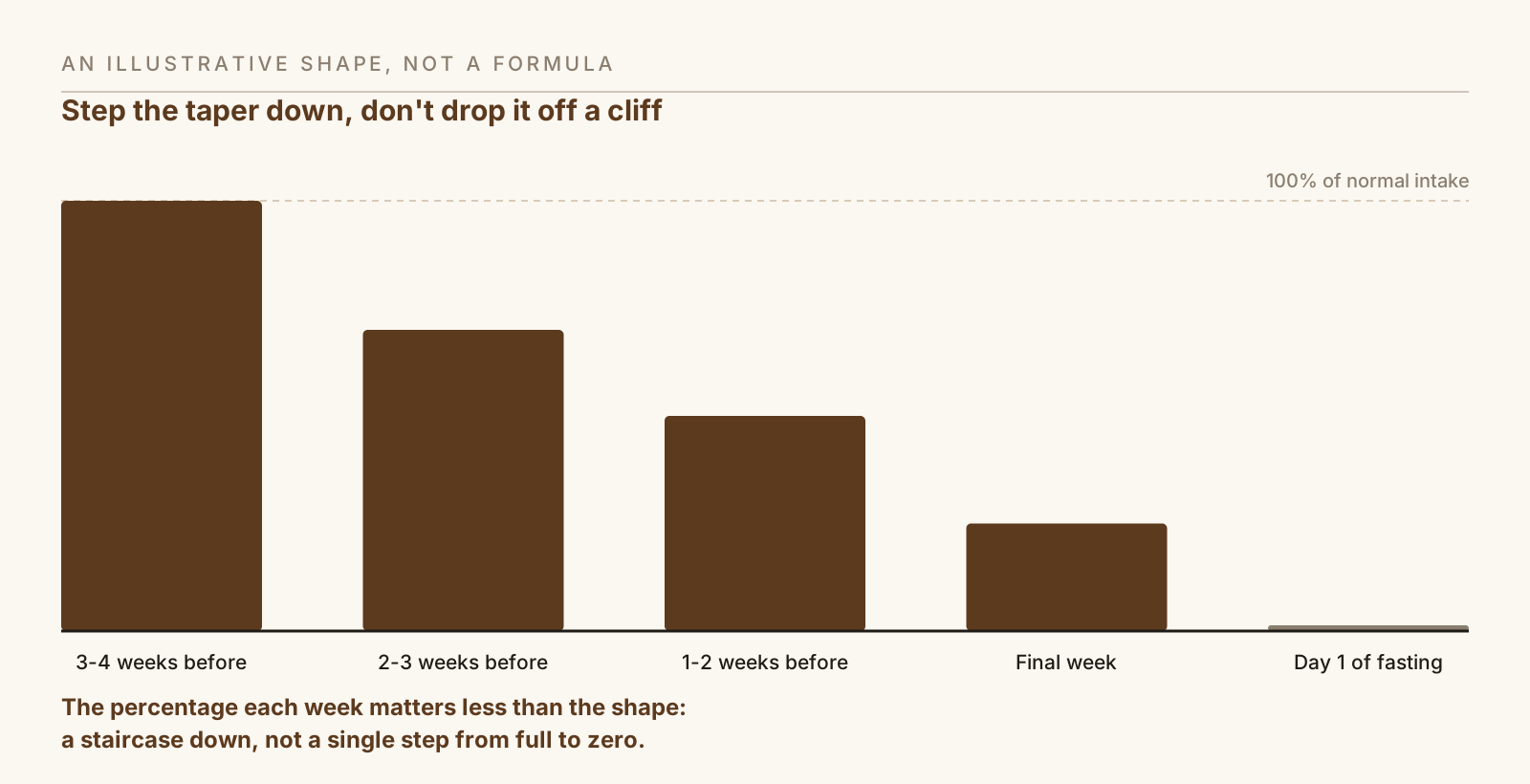
Applied to a Ramadan start date, the shape clinical guidance points to looks roughly like this:
A few practical notes on running this yourself:
- Cut by roughly a quarter to a third at each step, not by a fixed number of cups — a quarter reduction means something different to someone who drinks one cup a day than to someone who drinks four.
- Swap format before you swap amount, if that’s easier. Replacing your afternoon cup with a caffeine-free herbal coffee gets you a real reduction without touching your morning routine, which is often the harder one to give up first.
- Don’t aim for a perfectly smooth line. Real life doesn’t taper evenly — a rough day where you drink more than planned doesn’t undo the two weeks before it. The trend across the month is what matters, not any single day’s number.
If Ramadan starts tomorrow and you haven’t tapered at all
This is a genuinely common situation, and it doesn’t mean you’re stuck with the full headache. Cut your intake by about half immediately, rather than trying to go from your normal amount to zero in one step. It won’t prevent withdrawal entirely, but a 50 percent cut the day or two before your first fast is measurably gentler than a 100 percent cut with zero notice.
Then plan for two to three rougher fasting days rather than one bad one — that’s roughly what the research on withdrawal timing suggests it takes for symptoms to peak and start easing, and knowing that in advance changes how it feels to sit through it. Front-load anything you can control around those specific days: an earlier bedtime, a lighter schedule if you have any say over it, and the expectation that you’ll feel better by day three or four rather than needing to.
Suhoor or after iftar — timing matters as much as amount
Where you place caffeine in your remaining window matters almost as much as how much you’re cutting.
Suhoor is the worse time for it. Caffeine is a strong enough diuretic to matter here, and a cup at suhoor is still active in your system as you head into a fasting day where you can’t replace fluids for another twelve-plus hours. Clinical guidance is fairly consistent on this: if you’re keeping any caffeine at all during the reduction period, place it one to two hours after iftar instead, when you have several hours of drinking water ahead of you rather than behind you.
That timing shift does double duty during the taper itself, too — moving your remaining cup to the evening, rather than dropping it from the morning, tends to be the easier cut for most people, because it’s usually the afternoon or evening cup that’s more habit than necessity.
What to drink instead, if you want to keep the cup
One thing worth naming honestly: a caffeine-free herbal coffee will not prevent or fix the withdrawal headache. The headache is caused by caffeine leaving your system, and a genuinely caffeine-free drink has no caffeine in it to soften that specific mechanism. If you’re hoping a swap solves the chemistry, it won’t.
What it can do is keep the part of your routine that isn’t actually about the caffeine — the ritual of a warm, dark cup in your hands at suhoor or after iftar, which is a real thing people miss when they cut caffeine cold. A roasted-chicory or roasted-grain blend, like Teeccino’s or Pero’s, pours dark and drinks close enough to coffee that the habit stays intact even as the caffeine amount drops toward zero during your taper. Teeccino’s French Roast (opens in a new tab) is one option we’ve covered elsewhere; it contains barley and almonds, so it’s not the pick if you’re avoiding gluten or tree nuts — Teeccino’s Dandelion Dark Roast is gluten-free if that’s the constraint, and there’s a wider field in the best caffeine-free coffee alternatives if none of those fit.
If you’d rather go a different direction entirely, rooibos and other naturally caffeine-free herbal teas work the same way — warm, dark-ish in the case of red rooibos, and genuinely stimulant-free. In parts of the world where Ramadan is widely observed, this isn’t a novel idea: karkade, Egypt’s hibiscus infusion, is already a fixture at iftar tables for exactly this reason — it’s a real drink people reach for at this exact meal, not a workaround invented for this article.
None of this is about eliminating caffeine as a life philosophy. It’s a scheduling problem for one month, and how you solve it during the taper is more about what keeps your hands and habits occupied than what’s in the cup.
If the headache still hits anyway
Even with a full taper, some people still get a mild version of the headache — individual sensitivity to caffeine withdrawal varies more than any guide can fully account for. A few things genuinely help within what fasting allows:
- Hydrate deliberately at iftar and suhoor, rather than assuming a normal amount of water will cover it. Dehydration headaches and withdrawal headaches can compound each other, and you can only treat the one you have water for.
- Rest during the worst hours if you can. The peak window is typically mid-to-late afternoon on the first couple of days — if your schedule allows a quieter stretch then, use it.
- Don’t reach for caffeine to fix it during the fast. It’s the one thing that would actually work chemically, and it’s also not available until iftar — resetting the clock with an evening dose just moves the same problem to the next afternoon.
And watch for the difference between “this is annoying” and “this is a different problem.” A headache that’s unusually severe, comes with fever or vision changes, or isn’t easing by day four or five of the fast is worth a conversation with a doctor rather than something to just wait out — not every headache during Ramadan is caffeine, and dehydration or low blood sugar can produce very similar symptoms with a different fix.
The bottom line
The first-day Ramadan headache that catches so many regular coffee and tea drinkers off guard has a name, a mechanism, and roughly a 55 percent hit rate among daily caffeine drinkers who don’t prepare for it — and a two-to-four-week gradual taper is the single most effective thing you can do about it before the fasting starts. If you’re starting late, a same-day 50 percent cut and two or three rough days is a real plan, not a consolation prize. And if you want to keep a warm cup in your routine while the caffeine amount drops, that’s a completely reasonable thing to want — just go in knowing it’s solving a different problem than the one giving you the headache.
This article is educational and not medical advice. If you have a condition that affects fasting safely — including pregnancy, diabetes, or a chronic illness — talk with a doctor about your specific plan before Ramadan, caffeine tapering included.
Sources & further reading
- Prevalence, characteristics, and factors associated with caffeine-withdrawal headache during the first day of Ramadan (opens in a new tab) — cross-sectional study, 2023
- Reducing Caffeine and Soft Drinks During Ramadan (opens in a new tab) — Johns Hopkins Aramco Healthcare
- Preparing for Ramadan: how to avoid headaches, poor sleep and caffeine withdrawal symptoms (opens in a new tab) — The National
Reader conversation (5)
We read every response. Selected reader notes below.
Every single year I tell myself I’ll taper and every single year I don’t start until three days out. Screenshotting the “starting late” section because that’s going to be me again this time, at least I’ll know what to expect instead of being blindsided by day two.
Good to see someone actually cite the suhoor-versus-after-iftar timing instead of just saying “cut back.” Moving my one allowed cup to after iftar made a bigger difference for me last year than the amount did.
That matches what I heard from a few other readers too — the timing shift seems to be the underrated lever compared to the raw percentage cut. Glad it held up for you two years running.
Appreciate that this didn’t oversell the herbal coffee swap as a fix for the headache itself. I made that exact mistake two years ago, switched to a caffeine-free blend the week before Ramadan and still got flattened on day one because I hadn’t actually reduced the caffeine, just changed what cup it came in.
The 350mg threshold is a useful number to have — I’m right around there most days and never connected it to why my withdrawal always feels worse than my sister’s, who drinks maybe half that.
Question: does the same taper logic apply to black tea, or is the timeline different since the caffeine dose per cup is lower? I drink about six glasses of çay a day and I’m not sure how that maps onto the “cups of coffee” framing.
Same mechanism, same taper logic — it’s total daily caffeine that your receptors adjust to, not the specific drink it comes from. Six glasses of black tea adds up faster than people expect (each is roughly a third to half a cup of coffee’s worth), so it’s worth roughly estimating your daily total in coffee-equivalent terms and applying the same gradual step-down to that number rather than assuming tea gets a pass.
Have something to add? Email us and we may include it in a future update.