Does coffee affect depression risk? Four analyses point to a lower risk, with caveats that matter if you're deciding whether to quit
Four published analyses link regular coffee to a lower risk of depression, but the evidence is observational and mostly low to moderate certainty. What the numbers say, why they can't tell you to start or stop, and where to take real worries.


If you’re thinking about giving up coffee and you’ve ever had a low stretch, a headline saying coffee is linked to less depression can feel like a reason to hold on. The research is real. It is also easy to over-read, so here is what it does and doesn’t say.
The short answer
- Four published analyses, each pooling many studies, found that people who drink more coffee had a lower risk of depression.
- The gaps are modest, roughly 10 to 25 percent lower risk in the highest-intake groups.
- All of it is observational. It shows an association, not that coffee prevents anything.
- Nothing here is a reason to start drinking coffee, or to avoid quitting it.
Four analyses, one direction
A meta-analysis combines results from many studies into one pooled estimate. A relative risk below 1.0 means a lower risk in the higher-intake group, and a range that stays entirely below 1.0 is the usual bar for calling a result statistically clear.
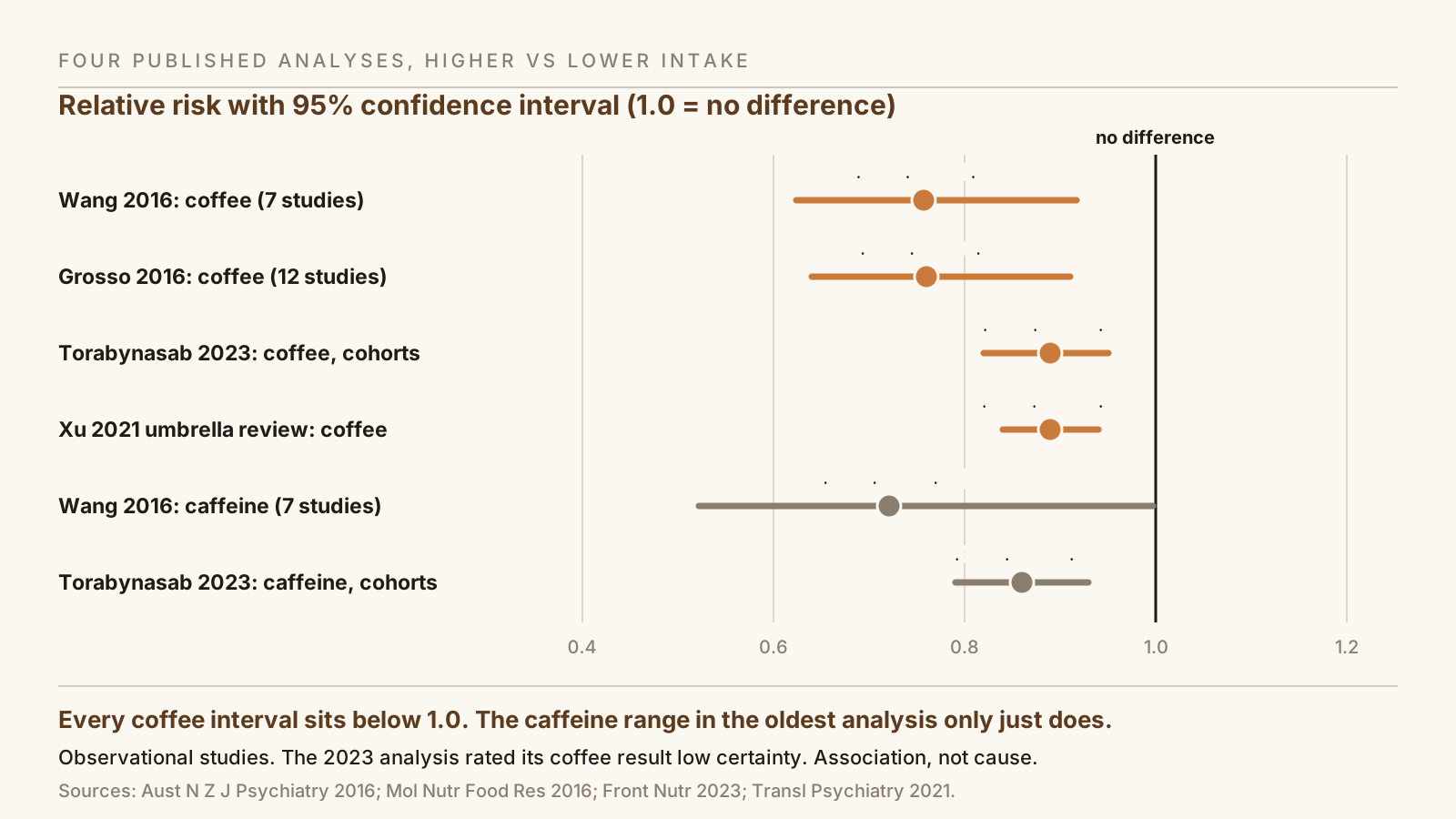
- 2016, Australian & New Zealand Journal of Psychiatry. Eleven observational articles (opens in a new tab), with 330,677 people in the coffee analysis, gave a pooled relative risk of 0.757 (0.624 to 0.917) for coffee. For caffeine, from a smaller group of 38,223 people, it was 0.721 (0.522 to 0.997).
- 2016, Molecular Nutrition & Food Research. Twelve studies (opens in a new tab) with 346,913 people and 8,146 cases of depression found 0.76 (0.64 to 0.91) for coffee. For caffeine, only the prospective studies reached a clear result, at 0.84 (0.75 to 0.93).
- 2023, Frontiers in Nutrition. Twenty-nine studies (opens in a new tab) with 422,586 people found 0.89 (0.82 to 0.95) for coffee in cohort studies, which the authors rated low certainty. Caffeine came in at 0.86 (0.79 to 0.93), rated moderate.
- 2021, Translational Psychiatry. An umbrella review (opens in a new tab), meaning a review of existing meta-analyses, reported 0.89 (0.84 to 0.94) for coffee and called the evidence moderate quality. It also noted that none of the dietary factors it examined reached high quality, and that most of the meta-analyses it drew on were low or very low in methodological quality.
Each of the four used somewhat different studies and methods, so they aren’t independent confirmations of a single number. The two analyses that restricted to cohort studies or reviewed prospective work land closer to 1.0 than the two 2016 ones, so a lower risk of roughly 10 percent may be a fairer reading than 25.
How many cups?
Three of the analyses tried to find a pattern by amount.
- The 2016 psychiatry analysis reported a linear trend, with risk falling 8 percent (0.92, 0.87 to 0.97) for each additional cup a day.
- The Molecular Nutrition analysis instead found a J-shaped curve, with the most favorable result at about 400 mL a day, which is a bit under two mugs.
- The 2023 analysis reported a 4 percent lower risk for each extra 240 mL a day (0.96, 0.95 to 0.98).
These are fitted curves from observational data, and they don’t agree on the shape. We wouldn’t treat any of them as a target.
Why this can’t tell you what to do
None of these is a trial, so none shows that coffee changes the risk. A few reasons the pattern could appear without coffee doing the work. These are our reading, not the authors’ conclusions:
- Reverse causation. Low mood often comes with poor sleep, low appetite and less energy for a morning ritual, so people who are struggling may drink less coffee. That could make drinkers look healthier.
- Who drinks coffee. Coffee habits track with work, social life, smoking and activity, and adjustments only partly account for those.
- Self-reported intake. “Cups a day” is a rough memory, often taken once.
- Different outcomes. The analyses mix clinical diagnosis with questionnaire scores for depressive symptoms.
- Heterogeneity. The 2023 coffee result carried a measure of inconsistency (I² of 63.7 percent) that indicates the underlying studies varied quite a bit.
The studies also looked at risk over time in groups of people. They can’t say anything about how coffee will affect your own mood this week.
If you’re cutting back anyway
If you’re quitting caffeine for sleep, jitters or a headache-free taper, this research isn’t a reason to stop. It doesn’t show you’d be giving up a protective effect.
- Watch the first weeks. Withdrawal can include low mood and irritability for a short time, which is different from depression itself. How long withdrawal lasts covers the usual timeline.
- Sleep comes first. Late caffeine can fragment sleep, as we explain in caffeine and sleep architecture, and poor sleep affects mood on its own.
- Medication is a separate question. If you take an antidepressant, read caffeine and antidepressants and ask your prescriber.
- Persistent low mood deserves a clinician. A drink can’t stand in for an assessment, in either direction. If you’re having thoughts of harming yourself, contact a crisis line or emergency services where you live. In the US you can call or text 988.
If you want a warm cup without caffeine, herbal coffee versus decaf lays out the differences. The research above was about coffee, tea and caffeine, so it says nothing, good or bad, about chicory, carob or other herbal blends.
The bottom line
Across four analyses, people who drank more coffee had a somewhat lower risk of depression, and the gap is smaller in the stricter, more recent work. It’s an association in observational data, with no high-quality evidence behind it. Keep your coffee or leave it for other reasons, and take low mood itself to someone who can help.
Sources & further reading
- Coffee and caffeine consumption and depression: a meta-analysis of observational studies (opens in a new tab) — Australian & New Zealand Journal of Psychiatry, 2016
- Coffee, tea, caffeine and risk of depression: a systematic review and dose-response meta-analysis of observational studies (opens in a new tab) — Molecular Nutrition & Food Research, 2016
- Association between dietary caffeine, coffee, and tea consumption and depressive symptoms in adults: a systematic review and dose-response meta-analysis of observational studies (opens in a new tab) — Frontiers in Nutrition, 2023
- Role of dietary factors in the prevention and treatment for depression: an umbrella review of meta-analyses of prospective studies (opens in a new tab) — Translational Psychiatry, 2021
Reader conversation (4)
We read every response. Selected reader notes below.
Thank you for saying plainly that low mood can make people drink less coffee in the first place. I’d never thought of the arrow pointing that way round.
That reading is ours rather than the authors’, so we labelled it that way, but it’s one of the main reasons observational numbers need care.
I quit coffee in September and felt flat for about ten days. Good to see the withdrawal timeline separated from the depression question.
Appreciated that the post didn’t tell me to start drinking coffee. The comparison of the four ranges on one chart made it easy to see how close to 1.0 they sit.
My doctor asked me about caffeine when we talked about my sleep and mood. This gave me better questions to bring back to her.
Have something to add? Email us and we may include it in a future update.