Does coffee curb your appetite? Small trials mostly say no, so don't count on a cup to skip breakfast
Five studies on coffee, caffeine and appetite: most found no change in hunger or how much people ate, and the one small dip didn't repeat at a higher dose. What that means if you're dropping coffee.


Plenty of people use a morning coffee as breakfast, and plenty of people worry that giving it up will leave them hungry. Both ideas rest on a belief that coffee dulls appetite. We went looking for trials that tested it.
The short answer
- In three small crossover trials, coffee or caffeine didn’t change appetite ratings in a clear way.
- One trial found people ate about 10% less at breakfast after a low caffeine dose, but not after a higher one, and not later in the day.
- One trial found a lower intake at a higher coffee dose, only in the group with a higher body weight, and still no change in how hungry people said they felt.
- None of these studies tested people who quit, so they can’t tell you what happens when you stop.
What the breakfast trials found
The cleanest design is a crossover: the same people try each drink on different days, so each person is their own comparison. A 2018 trial in the Journal of the Academy of Nutrition and Dietetics (opens in a new tab) used that design with 50 adults. They drank a beverage with 0, 1 or 3 mg of caffeine per kilogram of body weight, and half an hour later ate from a breakfast buffet.
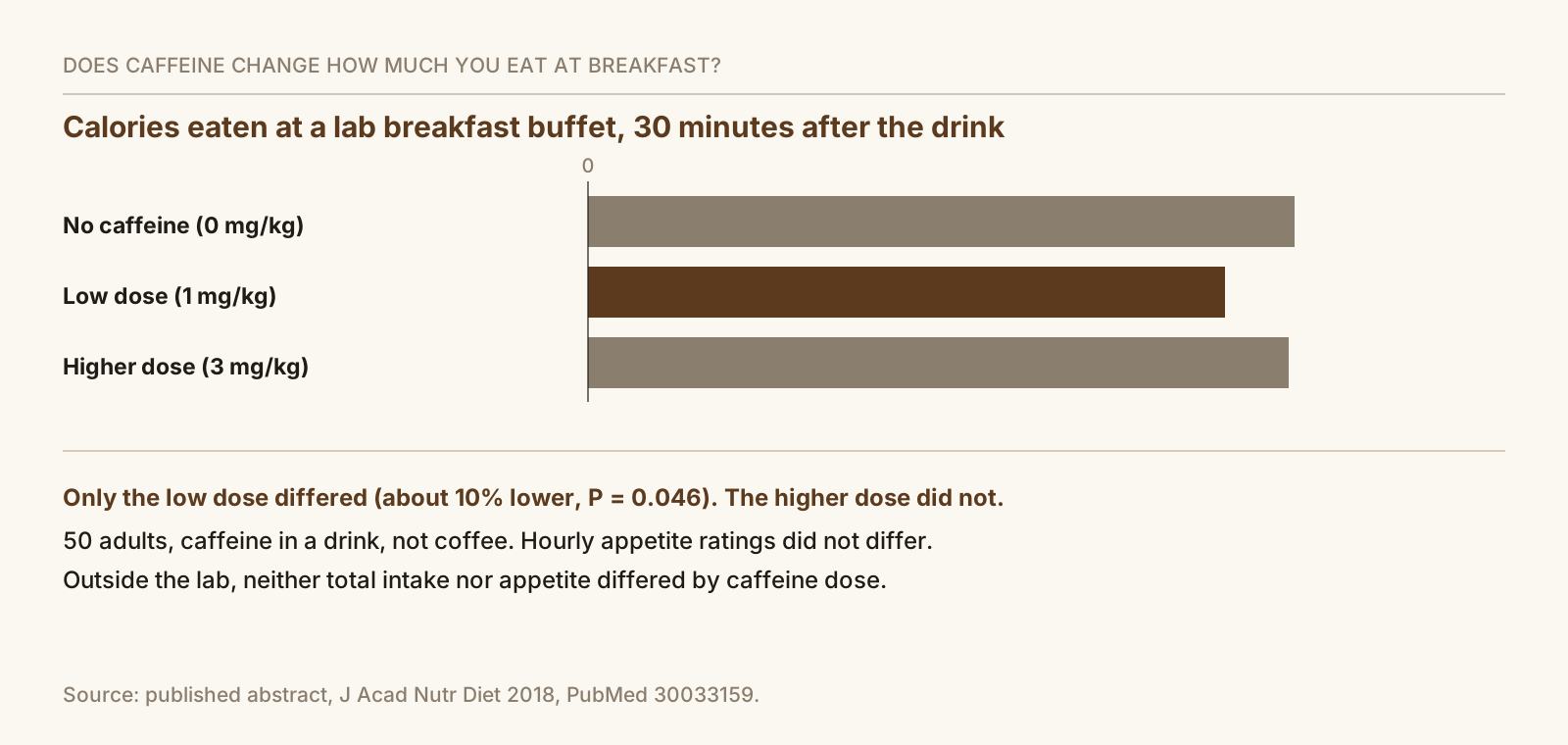
People ate about 650 kcal after the low dose, against about 721 after none and 715 after the higher dose (P = 0.046 for the low-dose difference, per the authors). Appetite ratings in the lab didn’t differ, and neither total intake nor appetite differed for the rest of the day outside it. The authors called the effects weak and transient and said the results don’t support caffeine as an effective appetite suppressant.
Our arithmetic, not theirs: 1 mg/kg is about 70 mg for a 70 kg adult, a small amount of caffeine, and the larger dose looked like the zero one. A dip that shows up at one dose and not the other is hard to build a habit on.
An earlier 2014 trial in Appetite (opens in a new tab) had 12 people try placebo, decaf coffee, caffeine and coffee with caffeine across a morning, then offered a lunch buffet. Energy intake, appetite ratings, blood glucose and gastric emptying didn’t differ across the four. The authors said longer-term effects “warrant further investigation.”
The trials that found something
Two studies are worth knowing about because they’re where the “coffee curbs hunger” idea gets some support.
A 2013 trial in Obesity (opens in a new tab) had 33 volunteers, 16 at a lower body weight and 17 at a higher one, try water, a coffee at 3 mg/kg caffeine and one at 6 mg/kg with breakfast. Intake at the next meal and over the whole day was lower after the larger coffee, but only in the higher-weight group, and appetite ratings didn’t change in either group. Our reading: people ate less without reporting feeling less hungry, which is a reason to treat it as a result about one small sample and not a rule.
A 2022 study in the International Journal of Obesity (opens in a new tab) combined an 18-person crossover with a survey of 284 people. It reported that associations between coffee, appetite and body mass index differed by a gene variant that affects how fast people clear caffeine, with the clearest pattern in fast metabolizers. Some of the interaction values the authors reported were close to the usual cutoff, and the survey half can only show association, so we hold this loosely.
Going the other way, a 2011 trial in the Journal of Nutrition (opens in a new tab) of 16 healthy men found caffeinated coffee, decaf and water made no difference to appetite feelings or later intake. It did find cortisol stayed higher after the caffeinated cup, which we cover in our piece on coffee before a cortisol test.
Shared limits across all five: small groups, a few hours of follow-up, caffeine given as a drink or capsule in a lab, and no herbal drinks tested. We read abstracts, not full papers.
If you’re quitting and notice hunger
Nothing above tested people who stopped, so what follows is practical advice from us, not a study result:
- Notice before you fix. If a morning cup was standing in for breakfast, the gap you feel may be a missing routine, not a missing drug.
- Keep the ritual. A warm roasted-grain or chicory brew gives you the hands-on part. Our guide to caffeine-free alternatives lists options.
- Taper if you can. Dropping gradually keeps other withdrawal symptoms down, which makes it easier to tell what’s hunger. Our taper guide has a schedule.
- Check in on a fast. If you drink coffee while fasting, our look at coffee alternatives while fasting covers what to swap in.
If you’re changing how much you eat for a medical reason, tell your clinician before changing your caffeine too.
The bottom line
The trials we found don’t support coffee as a reliable appetite switch. Most showed no change; the few signals were small, dose-specific or limited to one group. If you drop coffee, you may notice a change in routine more than in hunger, and a warm substitute can cover the routine. And if you’re skipping breakfast, a cup isn’t doing the job people assume it is.

Sources & further reading
- Coffee for morning hunger pangs. An examination of coffee and caffeine on appetite, gastric emptying, and energy intake (opens in a new tab) — Appetite, 2014
- Caffeine Transiently Affects Food Intake at Breakfast (opens in a new tab) — Journal of the Academy of Nutrition and Dietetics, 2018
- Caffeinated coffee does not acutely affect energy intake, appetite, or inflammation but prevents serum cortisol concentrations from falling in healthy men (opens in a new tab) — Journal of Nutrition, 2011
- Effect of different amounts of coffee on dietary intake and appetite of normal-weight and overweight/obese individuals (opens in a new tab) — Obesity, 2013
- CYP1A2 polymorphisms modify the association of habitual coffee consumption with appetite, macronutrient intake, and body mass index (opens in a new tab) — International Journal of Obesity, 2022
Reader conversation (4)
We read every response. Selected reader notes below.
I always assumed the coffee was why I never wanted breakfast. Funny to see that the trials mostly shrug at that. Maybe it’s just my routine.
Routine is a big part of it for a lot of people, Marcy. The trials are small, so I’d treat your own mornings as the better evidence.
The chart helps. A dip at the low dose and nothing at the higher one looks like noise to me, though I’m no statistician.
I quit coffee in September and was hungrier for about a week. Switched to a warm chicory drink in the mornings and it settled. Anecdote only, of course.
Good to see you said the studies didn’t test herbal coffees. Most articles skip that part.
Read this and have a question or something to add? Send us a note. With your OK, we may publish it here with an editor's follow-up. We only publish notes you've said we can.