Quitting caffeine with young kids: the exhausted-parent version of going caffeine-free
Every quit-caffeine guide assumes you can control your own sleep. With a baby or toddler, you can't — the wake-ups aren't yours to schedule. Here's an honest, non-absolutist look at cutting caffeine when the sleep debt is imposed, from someone who did it at 5am.

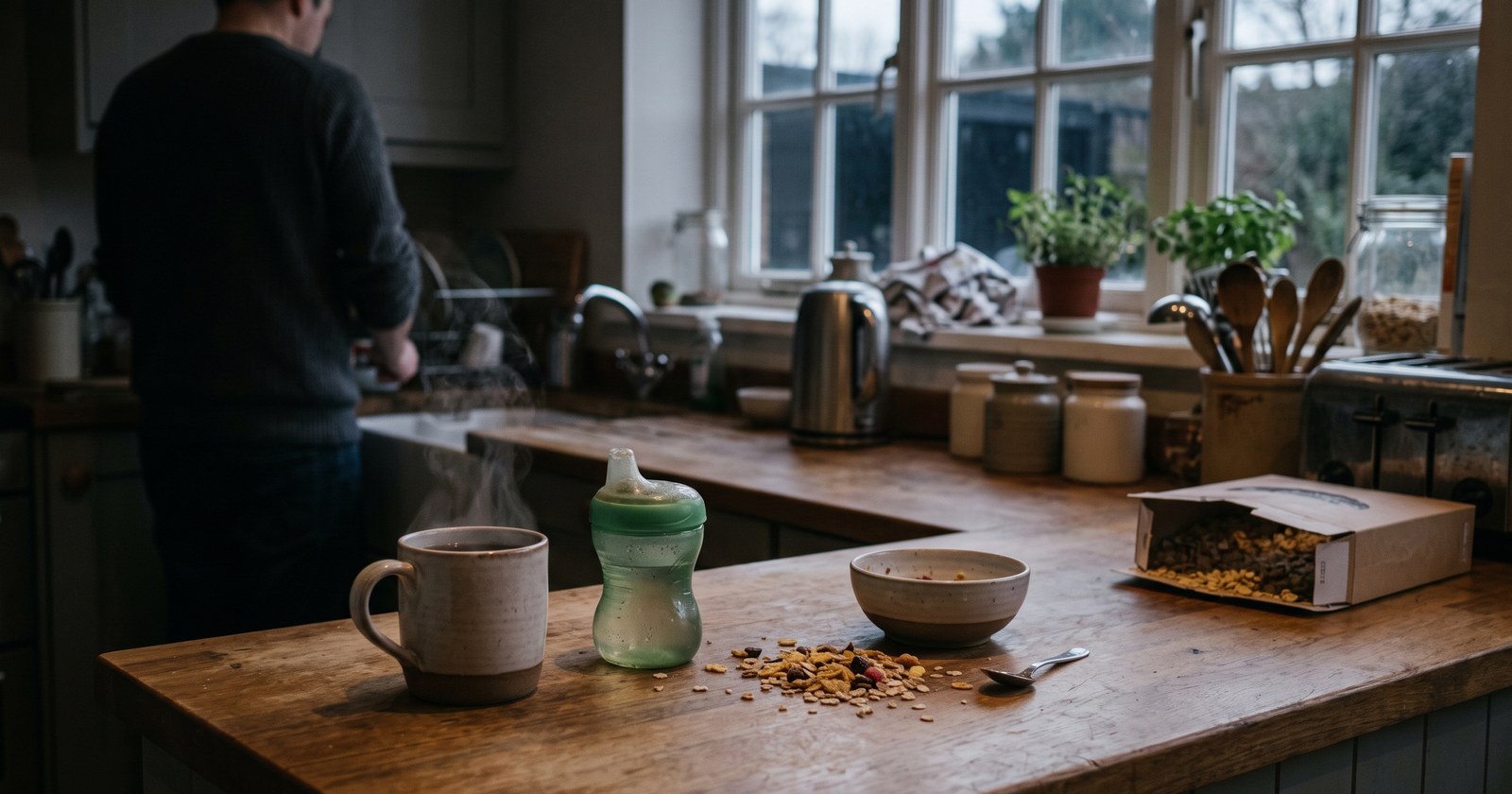
Every guide to quitting caffeine — including some I’ve written — quietly assumes one thing: that you’re the one in charge of your sleep. Go to bed a little earlier. Skip the late cup so you fall asleep faster. Nap on Saturday to catch up. All good advice, and all of it built for a person whose nights belong to them.
Then you have a baby, and your nights stop being yours. The wake-ups aren’t a habit you can taper. They arrive at 2am and 4:15 and 5:50 on a schedule set by a person who can’t yet tell time, and no amount of sleep hygiene negotiates with them. So the standard advice lands wrong, and the standard conclusion — “just get more sleep instead of relying on coffee” — feels almost insulting. If I could get more sleep, I would. That’s not the lever I have.
I went caffeine-free in the thick of it, with a toddler who still woke twice a night and a baby who thought 5am was morning. It’s a different project than quitting when your time is your own, so this is the version nobody writes: cutting caffeine when the sleep debt is imposed on you and “power through on coffee” feels less like a choice than a survival requirement.
Why tired parents lean hardest on caffeine
Let’s start honest: there’s a good reason the coffee feels non-negotiable. When you’re running a real, involuntary sleep debt (opens in a new tab) — the accumulated deficit from weeks of broken nights — caffeine is the one thing that reliably papers over it on demand. You didn’t choose the deficit, you can’t repay it on your own timeline, and here’s a cheap legal molecule that buys back an hour or two of feeling functional right when you need to be. Of course you lean on it. I did too, harder than I ever had in my life.
But leaning on it clears up one thing fast when you say it plainly: caffeine doesn’t add sleep to the account. It just lets you keep spending from an overdrawn one. It masks the tiredness — hides the signal — without touching the debt underneath. And with young kids, the debt keeps growing no matter what, so the masking dose creeps up: one cup becomes two, two becomes an afternoon third, and your tolerance climbs until you need the coffee just to reach the baseline a rested person wakes up at for free.
That’s the trap I actually wanted out of. Not caffeine itself — the escalating relationship with it, where I was drinking more and more to feel less and less awake. Quitting, in this season, isn’t about virtue. It’s about getting off a treadmill that speeds up on its own.
The real question is about the sleep you DO get

Here’s the reframe that changed everything for me, and it’s the opposite of what you’d expect.
You can’t control the wake-ups. Fine. But you can influence the quality of the sleep you get between them — and when sleep only comes in fragments, protecting each fragment matters more, not less. That’s where the afternoon cup turns out to be quietly working against you.
Caffeine has a long half-life. A real fraction of what you drink in the afternoon is still circulating at bedtime (opens in a new tab) — that’s the whole half-life problem I’ve written about before, and it doesn’t just make it harder to fall asleep. It makes the sleep you do get lighter, and — this is the killer for parents — it makes it harder to drop back off after a night waking. Anyone who’s lain awake for forty minutes at 3am after a feeding, wired and furious about it, knows this feeling. Some of those nights, the caffeine from 4pm was still in the room with me.
So the real question isn’t “can I function today without coffee.” It’s: is this afternoon cup buying me an hour of alertness now in exchange for making the little sleep I’ll get tonight even shallower and harder to return to? For me, once I ran that trade honestly, the afternoon cup lost. It was borrowing from the one account I most needed to protect. Cutting caffeine didn’t stop the 2am wake-up — nothing was going to — but it made the sleep on either side of it deeper, and the drop back off faster. That’s a real win when fragments are all you’ve got.
Tapering when you can’t control your wake times
The usual quit-caffeine playbook says taper slowly to dodge the withdrawal headache, and it’s right — but it assumes you can lean on rest to smooth the rough days. You can’t, so the taper has to do more of the work, and you have to be even gentler about it. A withdrawal headache stacked on top of a 5am start with a teething toddler is a genuinely bad day, and it’s completely avoidable.
What worked for me was slow and back-to-front:
- Cut from the end of the day first. Drop the latest cup, keep the earliest. Your morning coffee is doing the least damage to your sleep and the most for your survival, so it goes last. The afternoon and evening caffeine — the stuff sabotaging your fragments — goes first.
- Move by quarter-cups, not whole ones. Shave a little every few days. Slow enough that your body barely registers the change is the whole point; there’s no medal for speed, and the headache window is exactly what you’re trying to avoid when napping it off isn’t an option.
- Hydrate like it’s a job. Mild dehydration feels almost identical to both caffeine withdrawal and ordinary parent-exhaustion, so it’s easy to misread and “solve” with another coffee. A glass of water before you reach for anything sorts out a surprising amount.
- Don’t quit during a bad week. A growth spurt, a sleep regression, the first daycare cold — those are not the weeks to also be tapering caffeine. Hold steady, get through, and start the taper when the ground is a little less shaky. There’s no deadline.
This is the same gentle, no-heroics approach I’d give anyone doing a two-week caffeine taper — it just matters more here, because the safety net of “I’ll rest if it gets bad” isn’t under you.
The 5am ritual, kept — just decaffeinated
The thing I was most afraid of losing wasn’t the caffeine. It was the cup. That first warm mug in the pre-dawn dark, before anyone else needs anything from you, is sometimes the only two minutes of the day that are yours. When you’re this depleted, the ritual isn’t a luxury — it’s load-bearing.
So I kept the whole thing and just changed what was in it. The 5am cup is still the 5am cup: still the warm mug, still the quiet, still the small ceremony that says okay, here we go. It’s a caffeine-free roast now instead of coffee, and honestly, at that hour and that level of tired, my mouth could not tell you the difference — it just wanted something warm to hold. The ritual was the medicine. The caffeine was incidental.
The practical constraint that rules this whole season is that whatever you drink has to survive being abandoned. You will set the mug down for a diaper, a spill, a small emergency, and come back to it fifteen minutes later lukewarm. So the bar is low and specific: warm, one-handed, forgiving of being reheated. A roasted herbal coffee clears it easily — something like Teeccino (opens in a new tab) brews in a regular drip machine the same way coffee does, so the ritual is identical, and it’s one option among several roasted chicory and grain blends. But I’ll be just as honest as always: the best one is whichever you’ll actually make at 5am on four hours of sleep, and some mornings that’s a jar of instant by the kettle because a full pot is one step too many. If you’re still hunting for the cup that sticks, the caffeine-free options worth drinking is where I’d start.
The 4-to-7 witching hours

Every parent of young kids knows the specific hell of the late afternoon — the stretch from about 4pm through bedtime when everyone’s tank is empty, the kids are melting down, and dinner-bath-bed still has to happen. It’s exactly when the old me reached for a “second wind” coffee to power through. And it’s exactly the worst possible time to have caffeine, because it lands right in the window that wrecks the night.
This is the same trap as using a late cup to push through the afternoon slump, just with higher stakes and smaller humans. The slump is partly real and physiological — your body clock has a genuine low-alertness dip in the early afternoon — so you’re not failing, you’re just human and under-slept. But a 5pm coffee to muscle through bath time is borrowing alertness at the exact hour the loan comes due at 2am.
What actually helped me through the witching hours without the caffeine:
- Daylight, if there’s any left. Getting the kids outside in the late afternoon — even ten minutes in the yard — lifts my alertness more than a cup would, wears them out, and doesn’t charge anything to tonight.
- A warm caffeine-free cup as the ritual anchor. Sometimes I just need a hot thing to hold while I referee. The morning-brewed pot, reheated, is exactly that — the ceremony with none of the sleep cost.
- Front-loading the hard stuff. I do the tasks that need a sharp brain earlier, and save the low-focus, high-patience work (dinner, tidying, the bedtime marathon) for when I’m running on fumes anyway. Reshaping the day beat trying to chemically out-muscle it.
If your version of imposed sleep debt comes from working odd hours on top of all this, the shift-worker’s caffeine-free morning routine is a close sibling to this piece — same core problem of a sleep schedule you didn’t choose.
Some seasons you keep the morning cup
I want to be clear about something, because the internet loves an absolutist quitting story and this isn’t one.
There are seasons of parenting where you keep the morning coffee, and that’s fine. A newborn’s first eight weeks, a brutal sleep regression, the stretch where you’re solo-parenting through an illness — those are not the times to also be white-knuckling a caffeine quit. The goal was never purity. The goal is getting out of the loop where you need more and more caffeine to feel less and less awake, and you can step out of that loop without swearing off every last cup forever.
For me, “caffeine-free” mostly means I broke the escalation. I’m not chasing a bigger dose to hit a lower baseline anymore. Most days that’s a fully caffeine-free morning; some hard weeks it’s a single real cup at dawn and caffeine-free the rest of the day, and I’ve made my peace with that. Progress in this season is measured in “I’m not spiraling upward,” not in a perfect streak. Be as kind to yourself here as you’d be to a friend running on the same amount of sleep. You’d never tell them they’d failed for having a coffee on the worst day of the month.
The one move that makes it stick
If I compress all of this into a single habit, it’s this: make the caffeine-free cup the night before, or first thing, before the day gets away from you — because it always gets away from you.
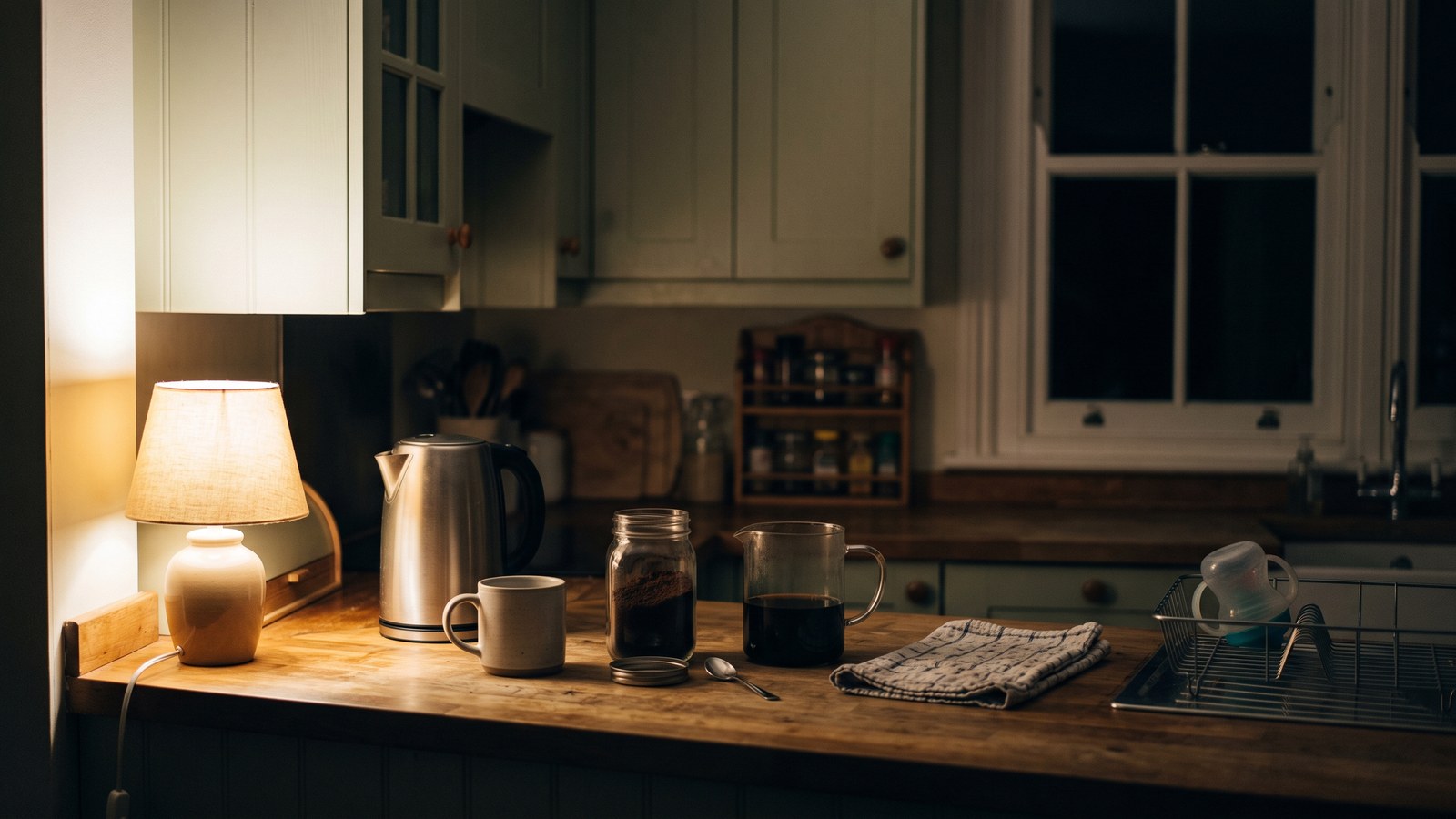
The hard moments of a parenting day — the 4pm meltdown, the after-bath collapse, the wired 3am you can’t drop back off from — are all moments where the easy reach is caffeine and the good option requires having thought ahead, which you will not have the bandwidth to do in the moment. So do the thinking once, when you have a spare hand: brew the pot, fill a jug for the fridge, set the jar of instant by the kettle. Then all day the path of least resistance already points the right way, and you don’t have to make a good decision while holding a screaming toddler.
The stretch where I finally went caffeine-free with young kids wasn’t the one where I heroically resisted the coffee at 5pm on no sleep. Nobody wins that fight on no sleep. It was the stretch where I’d already made something better, and left it where my tired hand would find it first. You can’t control when the baby wakes up. You can control what’s waiting in the mug when you do.
If the afternoon crash is the part that’s grinding you down, the half-life math nobody does explains why that late cup costs more than it looks. If you’re just starting out, a gentle two-week taper is the least-painful way through — and if it’s the wake-up itself you’re dreading, how to wake up without coffee is built for exactly that. When you’re ready to find the cup that sticks, start with the caffeine-free options worth drinking.
Sources & further reading
- Caffeine: How Long It Lasts and How Much Is Too Much (opens in a new tab) — Sleep Foundation
- Sleep Debt and Catching Up on Sleep (opens in a new tab) — Sleep Foundation
Reader conversation (5)
We read every response. Selected reader notes below.
Thank you for the “some seasons you keep the morning cup” section. I have an eight-week-old and I nearly closed the tab at the top thinking here comes another guilt trip about my coffee. Instead you gave me permission to just cut the afternoon one for now and leave the rest. That felt doable in a way “quit caffeine” never has. Bookmarked for when we’re past the newborn fog.
Eight weeks in is exactly the season to keep the morning cup and not feel one ounce of bad about it. You’re not failing at anything — you’re triaging, which is the correct move right now. Cut the afternoon one if it’s easy, hold everything else, and revisit when the ground stops shaking. Congratulations, and go easy on yourself.
The bit about not being able to drop back off after a 3am waking hit hard. I always blamed the baby for those forty-minute stares at the ceiling, but I’d been having a cup at four every afternoon to survive the nursery pickup. Moved it to lunchtime as an experiment and the middle-of-the-night wakes got noticeably shorter. Same number of wake-ups, but I actually go back to sleep now.
That’s the exact win I was trying to describe, and you found it faster than I did. The wake-ups you’re stuck with; the getting-back-to-sleep you had more say over than it felt like. Moving the cup earlier instead of cutting it entirely is a great first step — often it’s all it takes. Glad the nights are a little kinder.
“Whatever you drink has to survive being abandoned” — I laughed out loud because it’s so true. My coffee goes cold every single morning between the diaper and the spilled cereal. Started brewing a caffeine-free roast instead and honestly reheating it doesn’t feel like a loss the way reheated coffee did. Lukewarm herbal coffee is somehow fine. Lukewarm real coffee is sad.
Solo-parenting a toddler and a baby through back-to-back colds right now, and I appreciate you saying out loud that this is NOT the week to also quit caffeine. I felt weirdly guilty for still drinking coffee. Reading a parenting-and-caffeine piece that didn’t make me feel worse about it was the whole reason I finished it. Saving the taper for calmer waters.
The 4-to-7 witching hours section is my whole life. I’d been having a 5pm coffee to get through bath and bedtime and then wondering why I was wired at 11 when I finally sat down. Swapped it for taking the kids in the yard for ten minutes and a warm mug of something caffeine-free, and both the meltdowns and my own late-night buzz got better. Didn’t expect the daylight thing to do so much.
Have something to add? Email us and we may include it in a future update.