Caffeine-free pumpkin spice latte: the espresso was never the point
Starbucks' original 2003 Pumpkin Spice Latte had no real pumpkin in it for twelve years — the espresso was always doing less of the flavor work than the spice syrup. That makes a caffeine-free version an easier swap than most, with one real catch: what a thin herbal cup can't hide from.

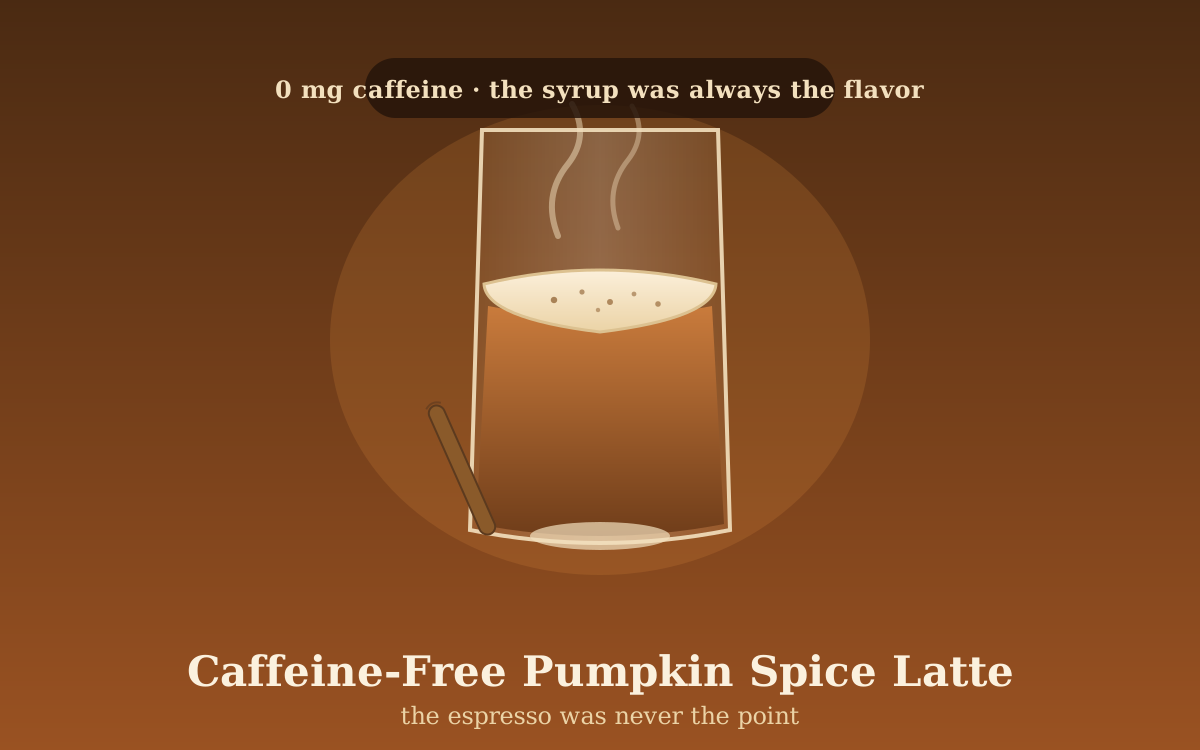
Every fall, somebody asks a version of the same question in the comments here: is Pumpkin Spice Latte season just off-limits once you’ve cut caffeine, or is there an actual way to keep the drink? It’s a fair thing to wonder, because the PSL reads like it should be coffee-dependent in a way a lot of other espresso drinks aren’t — it’s the drink people plan their whole September around. But the history of the thing gives away the answer before you’ve brewed anything: for the first twelve years Starbucks sold it, the “pumpkin” in Pumpkin Spice Latte wasn’t in the cup at all. If the drink survived that long on syrup and spice alone, it can probably survive losing the espresso too.
What’s actually in a Pumpkin Spice Latte
Starbucks introduced the Pumpkin Spice Latte in the fall of 2003, developed by Peter Dukes, the company’s director of espresso at the time, after a small R&D team had already found success with the Eggnog Latte and Peppermint Mocha and wanted a third seasonal drink to round out the fall lineup. According to Trade Coffee’s account of the drink’s history (opens in a new tab), the team tested the concept at around 100 stores in Vancouver and Washington, D.C. before rolling it out more broadly — it went on to become, by Trade’s count, Starbucks’ single best-selling seasonal drink, with more than 424 million sold since launch.
Here’s the detail that matters for a caffeine-free version: the original spice sauce, per Tasting Table’s reporting on the early recipe (opens in a new tab), was built from cinnamon, clove, and nutmeg — and contained no real pumpkin whatsoever. That wasn’t a secret exactly, but it also wasn’t obvious from drinking one. Starbucks didn’t add actual pumpkin puree to the recipe until 2015, more than a decade after the drink became a cultural fixture, as part of a broader reformulation that also swapped out an artificial caramel coloring for vanilla syrup. For thirteen years, “pumpkin spice” flavor was doing all of the identity-forming work with zero pumpkin behind it — cinnamon, clove, and nutmeg dissolved into sugar syrup, poured over espresso and steamed milk.
That’s not a knock on the drink. It’s useful information, because it means the flavor most people associate with a PSL was never load-bearing on the coffee being real coffee, or even on the pumpkin being real pumpkin. The syrup was always doing the identity work. The espresso was doing something else.
How much caffeine a real one carries
Worth stating plainly, since it’s the reason this article exists: a regular Pumpkin Spice Latte is not a low-caffeine drink by default. A tall (12 oz) hot PSL runs about 75 mg of caffeine from a single espresso shot. Grande and venti hot sizes step up to a double shot, at roughly 150 mg — Food Republic’s reporting on Starbucks’ own nutrition figures (opens in a new tab) confirms both numbers. Order it iced in a venti and baristas pull three shots rather than two, pushing it to around 225 mg — more caffeine than most people get from a full 12 oz mug of home-brewed coffee. Starbucks also lists a decaf option at around 5 mg, for anyone who wants the ritual without meaningfully changing their evening.
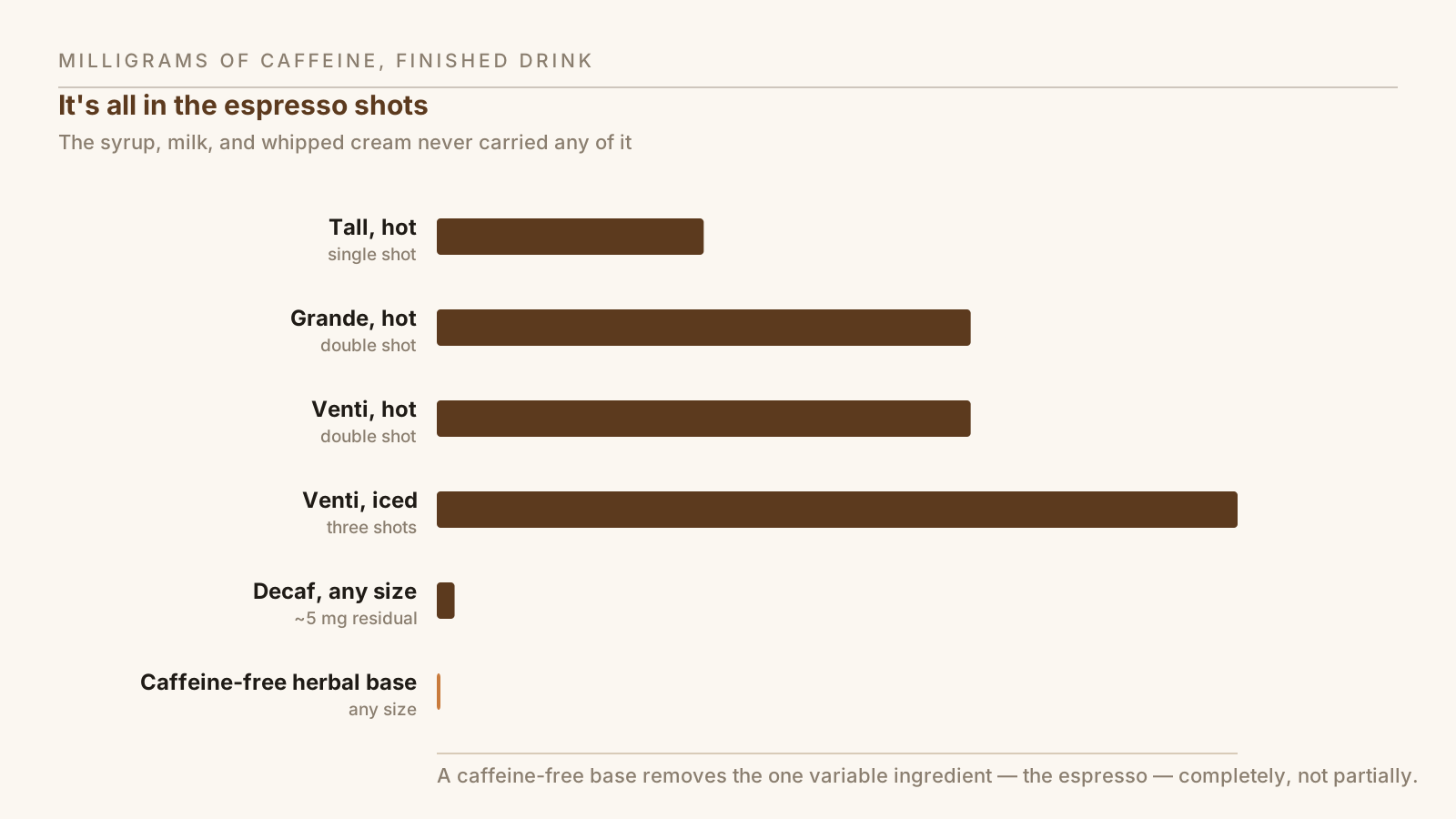
None of that caffeine lives in the syrup, the milk, or the whipped cream. It’s entirely a function of how many espresso shots go in, which means it’s also the one ingredient a caffeine-free version removes completely rather than just reduces.
What actually breaks when you pull the espresso
The genuine risk with a caffeine-free PSL isn’t the coffee flavor disappearing — the syrup was always carrying that. It’s sweetness with nothing to cut it. Real espresso brings a bitter, roasted backbone that keeps a very sweet, very spiced syrup from tipping into tasting like spiced milk with a name attached. Pull that backbone out and replace it with something thin or under-brewed, and you don’t lose “coffee flavor” so much as you lose the one thing standing between the drink and a glass of warm pumpkin pie-flavored milk.
This is close to the lesson the caffeine-free Irish coffee piece landed on, but for a different reason. There, weak herbal brew failed because it wasn’t dense enough to hold cream on top — sugar chemistry, not flavor. Here, a weak brew fails because it doesn’t have enough roasted bitterness to balance a genuinely sugar-heavy syrup. Same fix, different mechanism: brew your caffeine-free base strong — double the concentration you’d use for a mug you’re drinking black. A pale, quick-steeped herbal cup gets steamrolled by pumpkin spice syrup exactly the way it gets steamrolled by whiskey and cream, and for the same underlying reason covered in why iced herbal coffee tastes watery: most chicory, dandelion, and grain-based brews extract lighter than coffee unless you deliberately overbuild them.
The syrup, from scratch
Store-bought pumpkin spice syrups exist and work fine in a pinch, but a homemade version takes about ten minutes and lets you control the sugar, which matters more here than in most lattes given how much work the syrup is doing.
Makes about 1 cup — enough for 6–8 drinks:
- 1 cup water
- 1 cup granulated or light brown sugar
- 3 tbsp canned pumpkin puree (plain, not pumpkin pie filling — check the label)
- 2 cinnamon sticks
- 4 whole cloves
- 1/2 tsp ground nutmeg
- 1 tsp vanilla extract
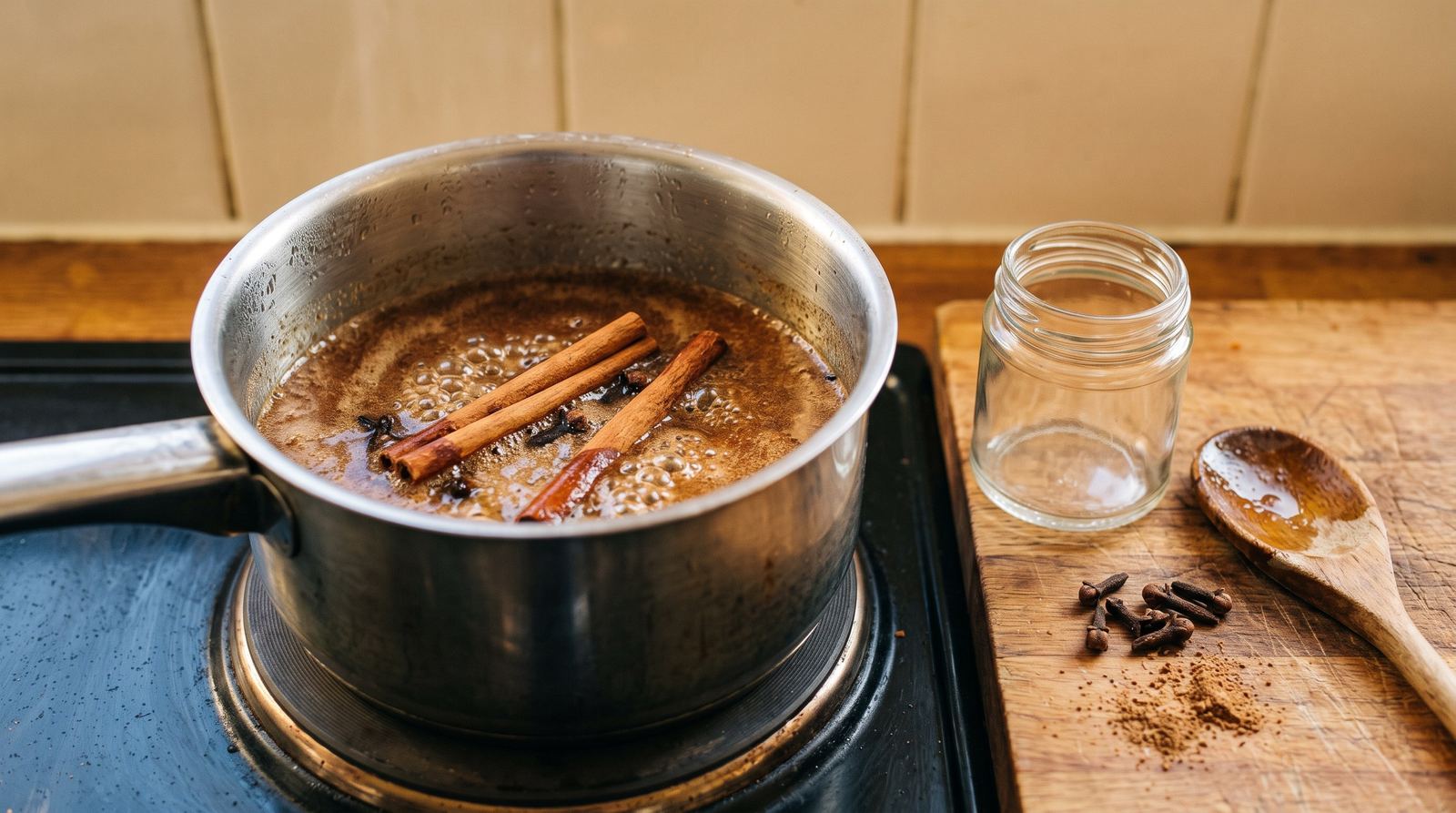
Combine the water, sugar, pumpkin puree, cinnamon sticks, and cloves in a small saucepan over medium heat. Whisk until the sugar dissolves, then let it come to a low simmer for about 5 minutes, whisking occasionally so the puree doesn’t settle and scorch on the bottom. Remove from heat, stir in the nutmeg and vanilla, and let it steep for 10 minutes before straining out the cinnamon sticks and cloves. Store in the fridge in a sealed jar for up to two weeks.
The pumpkin puree here is optional in the sense that the drink survives without it — Starbucks’ own history proves that beyond argument — but it’s worth including anyway. It adds body and a faint vegetal roundness under the spice that syrup alone doesn’t have, and since a can of puree costs a few dollars and keeps for weeks, there’s little reason to skip it now that home cooks know to add it, even though Starbucks itself didn’t for over a decade.
Caffeine-free Pumpkin Spice Latte, step by step
Makes one 12 oz drink; multiply for a group. This mirrors the standard latte build — hot brew, steamed milk, syrup — with the base brewed to the double-strength standard above.
You’ll need:
- 4 oz caffeine-free coffee-style brew, built at roughly double strength (see the buying section for what to start from)
- 6 oz milk of choice (whole milk steams the most reliably; oat milk is the closest non-dairy match for body)
- 2 tbsp pumpkin spice syrup (from above, or store-bought), plus more to taste
- Whipped cream and a pinch of cinnamon or pumpkin pie spice, for topping (optional)
Steps:
- Brew your caffeine-free base at double strength — a French press or a stovetop simmer gets you there faster than a quick drip pass. You want something closer to a concentrate than a casual mug.
- Warm the syrup briefly in the bottom of your mug or a small saucepan — 15–20 seconds is enough. This isn’t strictly necessary, but a cold syrup added to a hot drink takes longer to fully incorporate and can leave a faint grainy pocket at the bottom.
- Steam or froth the milk. A handheld frother, a French press plunged rapidly, or a jar shaken hard and microwaved for 30 seconds all work if you don’t have a steam wand.
- Pour the hot brew over the warmed syrup and stir until fully combined.
- Top with the steamed milk, holding back the foam with a spoon until last, then spoon the foam on top.
- Finish with whipped cream and a pinch of spice if you’re using it, and serve immediately.
If it tastes thin, or too sweet, or grainy
- Tastes like spiced sweet milk, barely any “coffee.” Your base was brewed too weak. Go back to double strength — more grounds in the same water, not a longer or hotter brew, which adds bitterness without adding body.
- Syrup won’t fully dissolve, leaves a grainy layer at the bottom. Either the syrup was too cold going in, or it needs another pass on the stove — pumpkin puree can make a syrup separate slightly if it hasn’t simmered long enough. Reheat gently and whisk before using.
- Too sweet even at the standard 2 tbsp. Cut back to 1–1.5 tbsp and lean harder on the double-strength brew to carry the flavor instead. The syrup and the brew strength are doing opposite jobs — sweet versus bitter — so if one’s too loud, adjust the other rather than just diluting both with more milk.
- Milk won’t foam. Whole milk and oat milk (labeled “barista” blend specifically) foam most reliably. Skim milk and most standard oat milks foam thin or not at all — that’s a milk-fat and protein issue, unrelated to anything about the caffeine-free base underneath it.
Iced, and the no-coffee-at-all version
Iced: Brew the base double-strength as above, let it cool slightly, then build over ice with cold milk and syrup stirred in first so it doesn’t need to dissolve against ice-cold liquid. Because the caffeine-free base was never carrying caffeine to begin with, there’s no real-PSL equivalent of the extra-shots-when-iced bump to account for — the strength adjustment here is purely about not diluting the flavor with melting ice, the same fix covered in more depth in the iced herbal coffee piece.
No coffee-adjacent base at all: If you want the spice and the milk without anything reading as “coffee,” skip the herbal brew entirely and steam the milk with just the syrup — closer to what most cafes call a steamer, and the same fix the off-menu cafe ordering piece covers for ordering a caffeine-free pumpkin drink at a counter without any special substitution request. It’s a genuinely different drink from the one above — sweeter, milkier, no bitter backbone at all — not a lesser version of it.
Which caffeine-free brew to start from
As with Irish coffee, body matters more than flavor delicacy here, so reach for something dark and assertive rather than a lighter, more floral blend — you need a brew that can stand up to a fairly sweet, heavily spiced syrup without disappearing under it.
Teeccino’s French Roast (opens in a new tab) is a reasonable starting point — a chicory, carob, barley, date, and almond blend built to read as close to coffee as herbal roasts get, with enough body to hold up brewed concentrated. It contains barley and almonds, so it isn’t gluten-free or nut-free. If either is a concern, Teeccino’s Dandelion Dark Roast (opens in a new tab) is gluten-free, though it’s lighter in flavor, so brew it even more concentrated than usual to compensate. Pero and plain roasted chicory root, brewed as a stovetop concentrate the way the chicory brewing guide walks through, are two more starting points — Pero also contains barley and isn’t gluten-free. For a broader spiced-latte comparison, the caffeine-free chai latte and golden milk turmeric latte recipes use the same double-strength-base logic with different spice profiles, if pumpkin spice isn’t the fall drink you’re chasing. And if none of these are already in your cupboard, the broader roundup of caffeine-free coffee alternatives is a good place to start comparing.
Once you’ve got a strong enough base, the rest of this drink is the part Starbucks proved thirteen years before anyone asked: the spice syrup was always doing the identity work. The espresso was just along for the ride.
Reader conversation (5)
We read every response. Selected reader notes below.
Genuinely did not know Starbucks’ original PSL had zero real pumpkin in it for twelve years. I have been smugly telling people mine is “more authentic” because I use canned pumpkin, and it turns out I was just doing the 2015 version.
Ha — you’re doing the 2015-and-later version, which is genuinely the better one. The pumpkin isn’t fake authenticity, it’s just an addition nobody required for over a decade.
Made the syrup last night and used Teeccino’s French Roast at double strength like you said. Was worried it would taste like watered-down spice milk but the bitterness actually held up fine. Cinnamon stick garnish was a nice touch, made it feel less like a compromise.
The caffeine chart is what I needed. I had no idea the iced venti was basically two and a quarter cups of coffee worth of caffeine. My kid orders those after school and I’m now rethinking that entirely.
Tried the no-coffee steamer version linked from here instead since I don’t own a frother and don’t want to deal with brewing anything. Worked exactly as described, tastes like dessert, kid loved it.
We don’t really do pumpkin spice as a cultural thing here so this was more anthropology than recipe for me, but the syrup itself is basically a mulled-wine spice mix without the wine. Made a batch and I’ve been putting it in plain black tea, works nicely.
That’s a great use for it and not one I’d tried — the spice ratio really is closer to mulled wine or chai than to anything coffee-specific, which tracks with the whole point of this piece.
Have something to add? Email us and we may include it in a future update.