Irish coffee doesn't need coffee — it needs a brew strong enough to float the cream
The trick that makes Irish coffee showy — cream floating on top instead of sinking — is sugar chemistry, not coffee chemistry, so a caffeine-free version works on the first try. What actually goes wrong is body: a normal-strength herbal brew disappears under whiskey and cream. Here's the 1950s method, adapted, and the one fix that saves it.

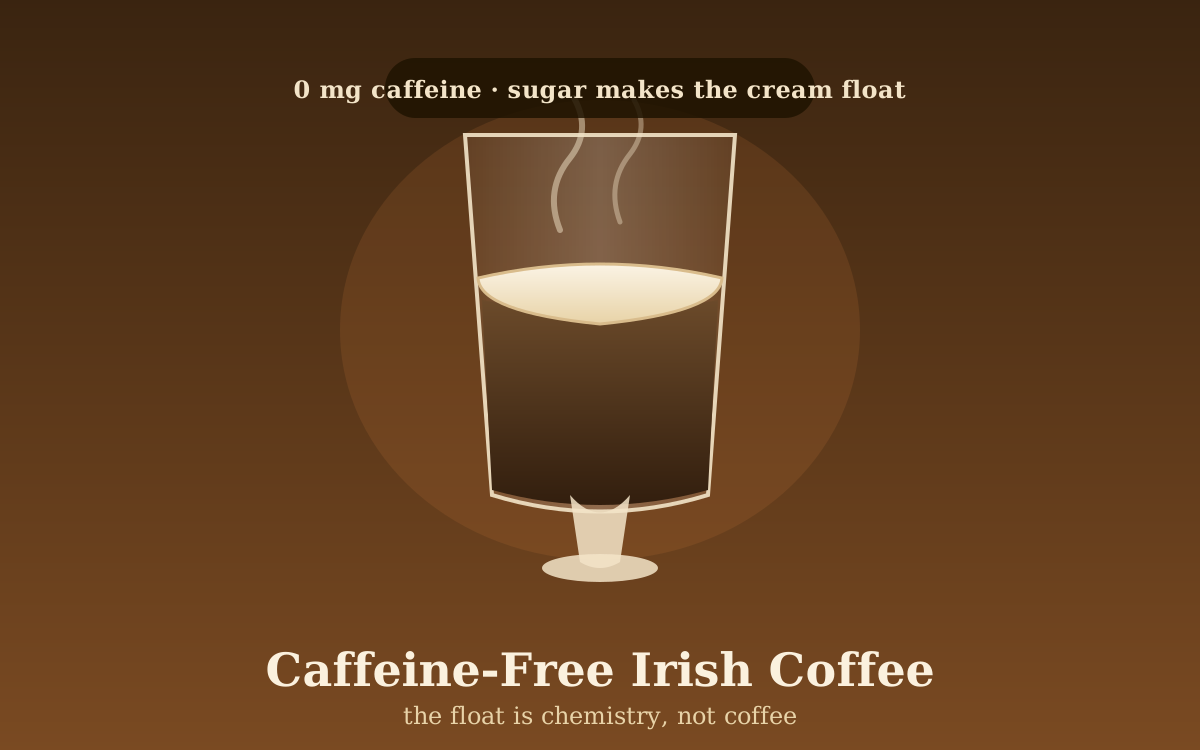
A reader emailed after the dalgona piece with a version of the same question, aimed at a very different drink: does a caffeine-free Irish coffee actually work, or is it one of those swaps that looks fine in a photo and tastes like sweetened whiskey water? It’s a fair thing to wonder, because Irish coffee’s whole appeal is a bit of theater — a layer of cream sitting improbably on top of a hot, dark drink, refusing to sink or mix in until you want it to. That looks like it should depend on something delicate and coffee-specific. It doesn’t. It depends on sugar, and sugar doesn’t care what’s dissolved with it.
What Irish coffee actually is, and where it came from
The drink has an unusually well-documented origin for something this old-fashioned-feeling. On a cold night in 1943 at Foynes, a flying-boat airbase in County Limerick, a Pan Am flight bound for New York turned back because of bad weather. Chef Joe Sheridan was called in to warm up the stranded passengers, and according to RTÉ’s own account of the invention (opens in a new tab), he mixed hot coffee with whiskey and sugared cream on the spot. Asked whether it was Brazilian coffee, he’s remembered as saying: “No, that’s Irish coffee.”
The drink crossed the Atlantic nine years later. San Francisco Chronicle travel writer Stanton Delaplane tasted it at Foynes, then convinced Jack Koeppler, who owned the Buena Vista Cafe in San Francisco, to figure out how to make it properly. According to the Buena Vista’s own account (opens in a new tab), Koeppler and Delaplane spent the night of November 10, 1952 working through two separate problems — getting the flavor right, and getting the cream to actually float — before Koeppler traveled to Shannon Airport in Ireland to study the original and came back knowing that cream had to be “aged” and “frothed to a precise consistency” to sit on top instead of sinking. That second problem, the float, is the one this whole article is about, because it’s the part people assume is fussy and coffee-dependent when it’s neither.
The cream float is sugar chemistry, not coffee chemistry
Here’s the part that makes a caffeine-free version possible without any workaround: the reason cream floats on Irish coffee instead of sinking into it is density, and the density comes overwhelmingly from dissolved sugar. Culinary explainers of the technique are consistent on this point — sugar “increases the density of the coffee further,” (opens in a new tab) on top of balancing the bitterness, and that denser liquid below is what a lightly whipped, aerated cream can rest on top of rather than disappear into. Nothing about that mechanism references caffeine, coffee beans, or roasted anything. It’s the same reason a spoonful of syrup sits at the bottom of an unstirred iced tea: dissolve enough solids into a liquid and it gets heavier than a liquid without them, full stop.
The cream side of the equation is technique, and it transfers unchanged too. Tasting Table’s rundown of the classic method (opens in a new tab) calls for heavy cream in the 33–40% fat range, whipped lightly — “never to stiff peaks” — then poured over the back of a warmed spoon held just above the surface so it spreads out gently instead of plunging in and mixing. None of that cares what’s underneath it either. A caffeine-free base that’s hot, sweetened, and dense enough will hold a properly whipped float exactly the way a real coffee base does, because the float doesn’t know the difference. This is the same lesson the dalgona piece landed on from the opposite direction — that drink’s whip depends on concentration, not caffeine, and it turned out the caffeine-free swap only fails where the underlying physical property (there, solubility; here, density) fails, not because caffeine was secretly load-bearing.
What actually breaks when you take the caffeine out
So if the float isn’t the risk, what is? Body. This is the honest complication, and it’s the same one covered in depth in why iced herbal coffee tastes watery: roasted chicory, dandelion, and grain blends generally extract thinner and lighter than coffee unless you deliberately overbuild the brew. Coffee, brewed at a normal ratio, is already dark and assertive enough to stand up to a slug of whiskey and a float of cream without disappearing. A herbal blend brewed the same casual way — the strength you’d use for a mug you’re drinking on its own — tends to go pale and thin under the same treatment, and what you end up tasting is mostly whiskey, sugar, and cream, with the “coffee” reduced to a rumor at the bottom of the glass.
The fix is the identical one that piece already worked out for iced drinks: more grounds, not more heat or time. Brew your caffeine-free base at roughly double the strength you’d use for a cup you’d drink black — closer to a concentrate than a casual mug — and it holds its own against whiskey and cream the way real coffee does by default. This isn’t a workaround so much as recognizing that Irish coffee has always been a strong-coffee drink; a regular-strength pour undersells even the real thing.
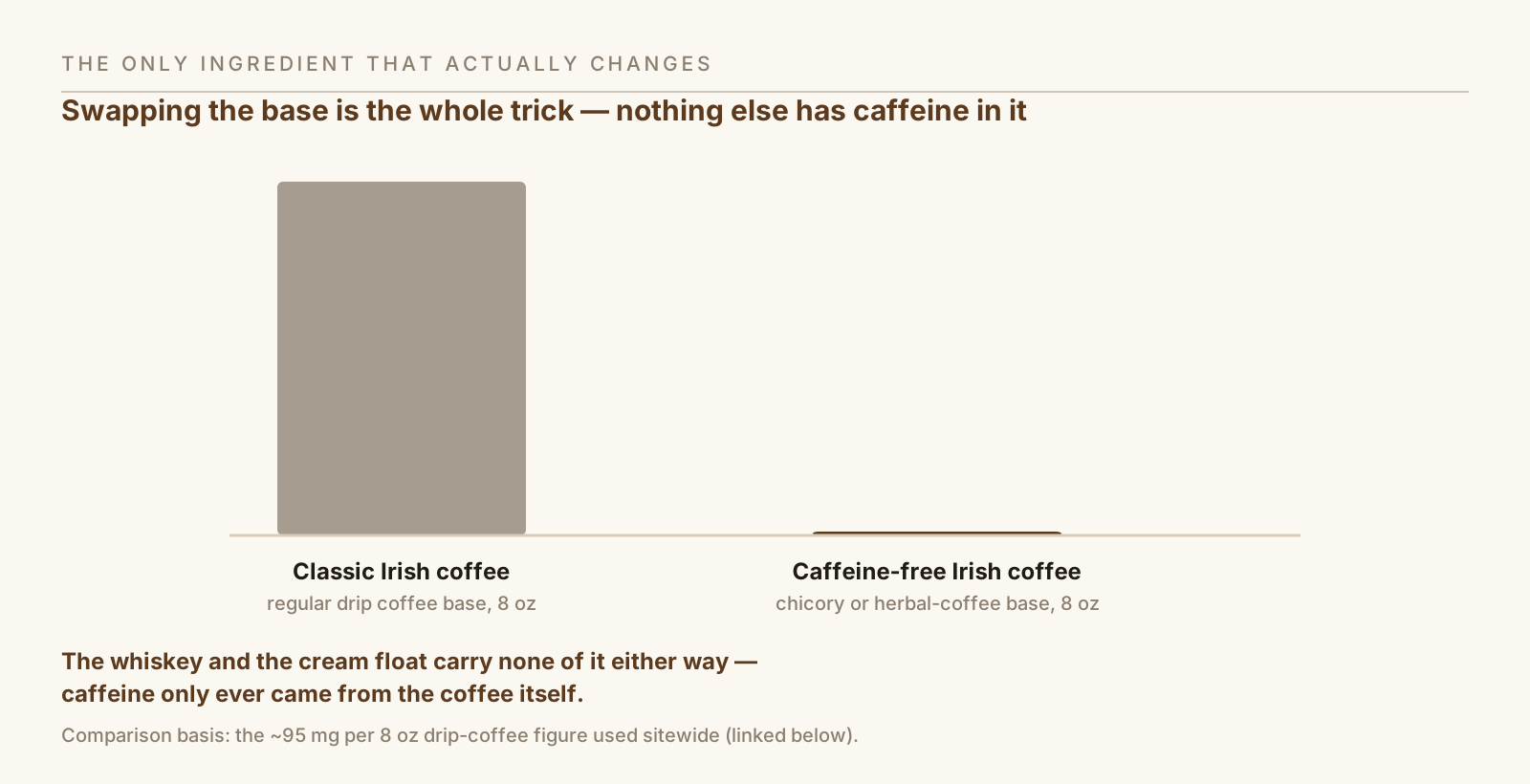
Body is the only real risk. Caffeine content isn’t — it tracks the base ingredient exactly, with nothing else in the glass contributing any. The ~95 mg figure for a regular 8 oz cup is the same one used everywhere else on this site, for exactly this reason: it doesn’t move depending on what the coffee gets dressed up as afterward.
Caffeine-free Irish coffee, step by step
This follows the same basic proportions the classic drink uses — hot brew, sugar, a generous pour of whiskey, a float of cream — with the base built to the double-strength standard above. Makes one drink; multiply for a group.
You’ll need:
- 1 glass Irish-coffee goblet or footed mug, warmed (see below)
- 4 oz caffeine-free coffee-style brew, built at roughly double strength — see the buying section for what to start from
- 1–2 tsp brown or cane sugar, to taste
- 1.5 oz Irish whiskey (or bourbon, rye, or a light blended Scotch)
- 2–3 oz heavy cream, lightly whipped (33–40% fat; see the cream section for the method)
Steps:
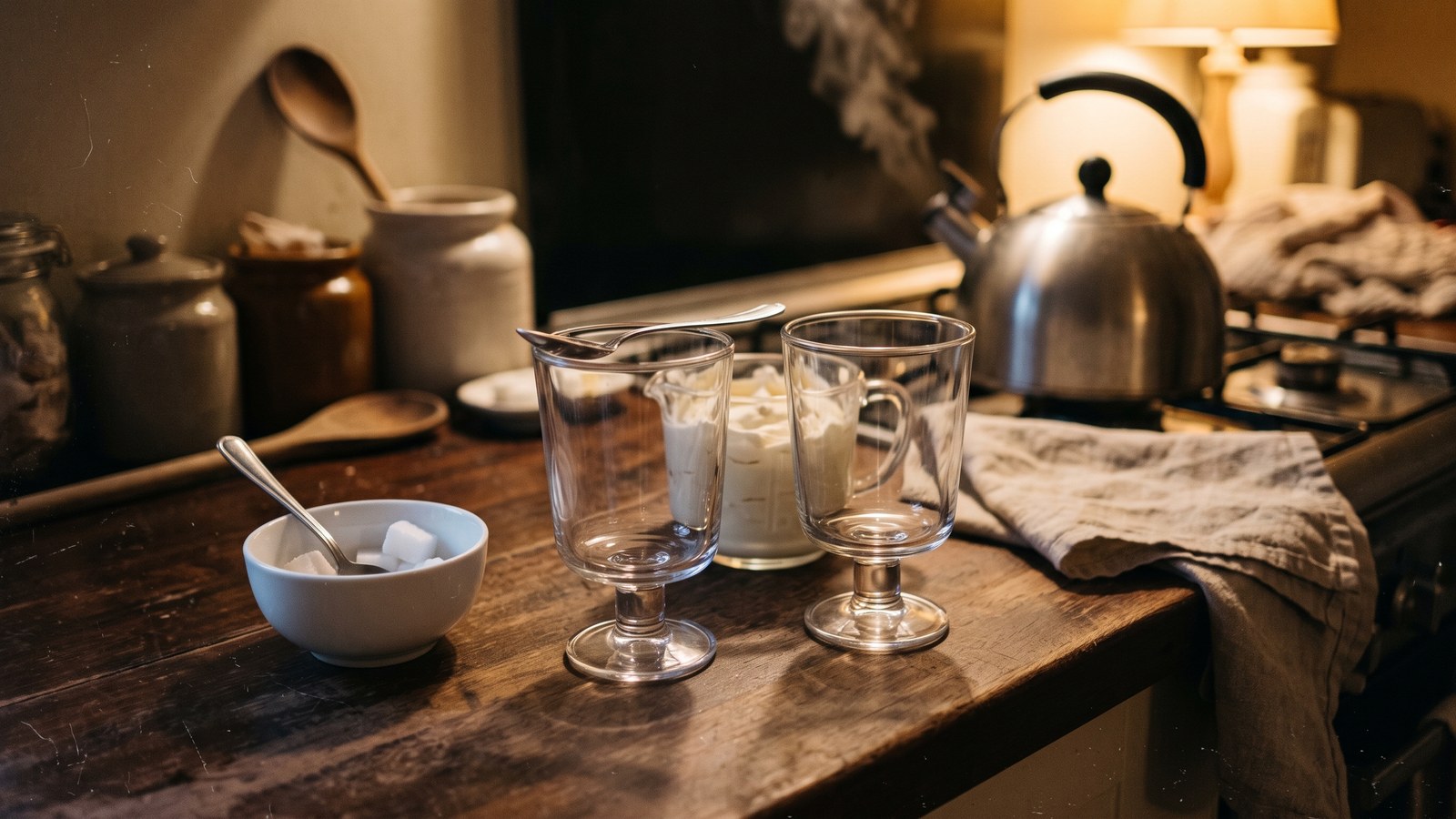
- Warm the glass. Fill it with hot water, let it sit 30–60 seconds, then pour it out. A cold glass chills the drink fast and makes the cream harder to float cleanly.
- Brew your caffeine-free base at double strength — think French press or stovetop-simmer concentration, not a quick drip pass. Pour 4 oz, still hot, into the warmed glass.
- Stir in the sugar while the brew is hot enough to dissolve it completely. Don’t skip this even if you don’t take sugar normally — it’s doing structural work here, not just sweetening.
- Pour the whiskey in and stir once, gently, to combine.
- Lightly whip the cream (see below) and float it on top using the spoon method. Don’t stir it in — that’s the whole point of the drink.
- Serve immediately, before the glass cools. Sip through the cream; don’t stir it under unless you want to.
Getting the cream to float, for real
This is the step people skip past, and it’s the one that decides whether the drink looks the way it’s supposed to.
- Use real cream in the 33–40% fat range — heavy or double cream, not half-and-half or a low-fat substitute. Lower-fat creams don’t whip enough structure to stay buoyant.
- Whip it lightly, to the point where it’s thickened and pours in a slow ribbon rather than splashing — nowhere near stiff whipped-cream peaks. Overwhipped cream is harder to pour evenly and can taste more like dessert topping than a drink garnish.
- Chill the cream, warm the spoon. Cold cream whips more reliably; a spoon warmed briefly under hot water (then dried) won’t shock the cream into clumping as it crosses onto the surface.
- Pour over the back of a spoon, held just above the drink’s surface, tilted so the cream runs off gently and spreads rather than dropping straight in. Go slowly around the edge of the glass rather than dumping it in the center.
- Add sugar if the float won’t hold. If cream keeps sinking despite good technique, the base likely isn’t dense enough yet — an extra half-teaspoon of dissolved sugar is a more reliable fix than fighting it with technique alone.
If the cream sinks, or the drink tastes thin
- Cream sinks or mixes in immediately. Either the base isn’t sweet enough (add sugar, stir until fully dissolved), the cream is too thin (use higher-fat cream, whip it a little more), or you poured it in too fast. Slow the pour and use the spoon.
- The drink tastes like whiskey and cream with barely any “coffee” flavor. Your base was brewed too weak. Go back to double strength — more grounds in the same amount of water, not a longer or hotter brew, which mostly adds bitterness rather than body.
- The whole thing tastes bitter or scorched. You over-brewed trying to fix weakness with heat and time. Back off, and add more grounds instead — the same lesson the iced herbal coffee strength piece covers for cold drinks applies here too.
- The glass cracked or got too hot to hold. Use tempered glass rated for hot liquid, and don’t skip the warming step — going straight from room temperature to a hot pour is the more common cause of a crack than the warmed-water preheat is.
A version without whiskey, either
If you’re cutting caffeine but keeping the drink, the recipe above is already complete as written — nothing about it requires you to also skip the alcohol. But if you want both out:
Virgin version: Drop the whiskey. Add an extra half-teaspoon of sugar and a couple drops of vanilla extract to fill the flavor gap it leaves, and serve a touch hotter than usual — whiskey’s slow alcohol warmth is part of what makes the drink feel indulgent, and a virgin pour benefits from starting a little warmer to compensate. The float mechanics don’t change at all; sugar is still doing the same job.
Whiskey-free but still boozy-tasting: A splash of a coffee-flavored syrup or a non-alcoholic “spirit” alternative built to mimic whiskey’s warmth can stand in, though neither is something we’ve tested for this specific drink — treat it as a starting point to adjust, not a guaranteed swap.
Which caffeine-free brew to start from
Body matters more than delicacy of flavor here, so reach for something dark and chicory-forward rather than a lighter or more floral blend.
Among ready-made options, Teeccino’s French Roast (opens in a new tab) is a reasonable place to start — it’s a chicory, carob, barley, date, and almond blend built to read as close to coffee as herbal blends get, and it holds up better than lighter blends when you brew it concentrated. Worth knowing before you buy: it contains barley and almonds, so it isn’t gluten-free and isn’t nut-free. If either of those is a concern, Teeccino’s Dandelion Dark Roast (opens in a new tab) is gluten-free, though its flavor is lighter than French Roast, so lean even harder into the double-strength brew if you use it. Pero and plain roasted chicory root, brewed as a stovetop concentrate the way the chicory brewing guide walks through, are two more options worth trying — Pero contains barley too, so it isn’t gluten-free either. Whichever you pick, the broader roundup of caffeine-free coffee alternatives is a good next stop if none of these are already in your cupboard.
Once you’ve got a brew you like brewed strong enough to taste like something under the whiskey and cream, the rest of this drink takes care of itself — which is really the whole discovery here. Irish coffee’s signature trick was never a coffee trick. It was always a sugar trick wearing a coffee costume, and a caffeine-free base gets to borrow the costume for free.
Sources & further reading
- A short history of the Irish coffee (opens in a new tab) — RTÉ Brainstorm
- Irish Coffee Story (opens in a new tab) — The Buena Vista Cafe, San Francisco
- How To Perfect Your Irish Coffee's Whipped Cream Topping (opens in a new tab) — Tasting Table
Reader conversation (5)
We read every response. Selected reader notes below.
Local reading this with one eyebrow raised, but the Foynes history checks out and so does the float logic — my grandmother always said “the sugar does the work,” and I never once believed her until just now. Going to try it with a strong chicory brew this weekend, mostly out of spite for every diet Irish coffee I’ve been served that skipped the sugar entirely and wondered why the cream sank.
Your grandmother was right and I wish I’d had that line to quote in the article. The number of “healthier” versions that cut the sugar and then blame the cream for sinking is genuinely a pattern — it’s not a garnish step here, it’s structural.
Made this with French Roast brewed stovetop-concentrate style and it held up better than I expected — dark enough that a coworker asked if I’d “decaffeinated” my Irish coffee, which is not quite the right word but I got what she meant. The float worked first try, spoon and all.
Tried the virgin version for a dry-January-in-September personal experiment and the extra vanilla plus serving it hotter genuinely closed most of the gap. Still missed the whiskey a little, not going to pretend otherwise, but it didn’t taste like a sad consolation drink either.
That’s about the honest ceiling I’d set for the virgin version too — closes most of the gap, not all of it, and the warmth adjustment is doing real work. Appreciate you actually running the experiment instead of me just asserting it.
Scottish whisky drinker here so I went rogue and used a light Speyside instead of Irish, mostly because it’s what was in the cupboard. Worked fine, no fighting with the chicory the way I half-expected from something peatier. Would still reach for an Irish whiskey first if buying specifically for this, but good to know it’s not a hard requirement.
The density explanation finally answered something I’d wondered about for years without ever looking up — why my mother’s home-style coffee with extra jaggery always held a milk float better than the unsweetened filter coffee my father drinks. Same principle, completely different drink and country. Chemistry doesn’t care about the recipe’s nationality, apparently.
Have something to add? Email us and we may include it in a future update.