Does coffee make your hands shake? Two lab studies split on it, and the everyday jitter is real but small
A 1987 trial found 325 mg of caffeine didn't raise measured hand tremor, while a 1998 study found it did at a higher dose per kilogram. What the research says about coffee and shaky hands, and what to try if yours shake.


You hold out a cup, and the surface ripples. Or you try to thread a needle after your second coffee and can’t. Plenty of readers write to us about shaky hands and wonder whether caffeine is the cause. We read the abstracts of the studies we could find to see what they actually measured.
The short answer
- Lab studies on healthy people are mixed. One gave 325 mg of caffeine and saw no measured increase in hand tremor. Another saw an increase at 3 mg per kilogram of body weight, but not at 1.
- In a 1987 questionnaire, 2% of people without a tremor condition said coffee made their hands shaky.
- Surveys of people with a long-term tremor diagnosis found they drank less caffeine than other people, which the authors read as people cutting back.
- None of this is a study of coffee quitters, decaf swaps or herbal coffee.
- Shaking that is new, one-sided, getting worse or comes with other symptoms is a doctor’s question, not a coffee question.
What the lab studies found
Researchers measure tremor with sensors, which picks up movement you’d never notice. Two small studies tested caffeine that way, and they don’t line up.
In a 1987 study in Neurology (opens in a new tab), a single 325 mg dose of caffeine did not increase tremor at 1, 2 or 3 hours after it was taken. That held for healthy people and for people whose tremor had other causes. The authors concluded that caffeine only infrequently induces tremor in normal people.
A 1998 study (opens in a new tab) looked at young adult men who were moderate, non-smoking caffeine users. Caffeine increased whole-arm tremor at 3 mg per kilogram of body weight, but not at 1 mg per kilogram. The authors also found that time of day made no difference.
To give a rough feel for 3 mg per kilogram: for a 70 kg (154 lb) person that is 210 mg. That is our arithmetic, not a figure from the abstract, and caffeine in a cup varies a lot. Our caffeine half-life guide covers why the same dose lingers differently from person to person.
What people report
The same 1987 paper asked people directly. About 2% of people without a tremor condition said coffee made their hands shaky. Among people with diagnosed tremor of other kinds, the numbers were higher, 6% to 8%, but still a small minority.
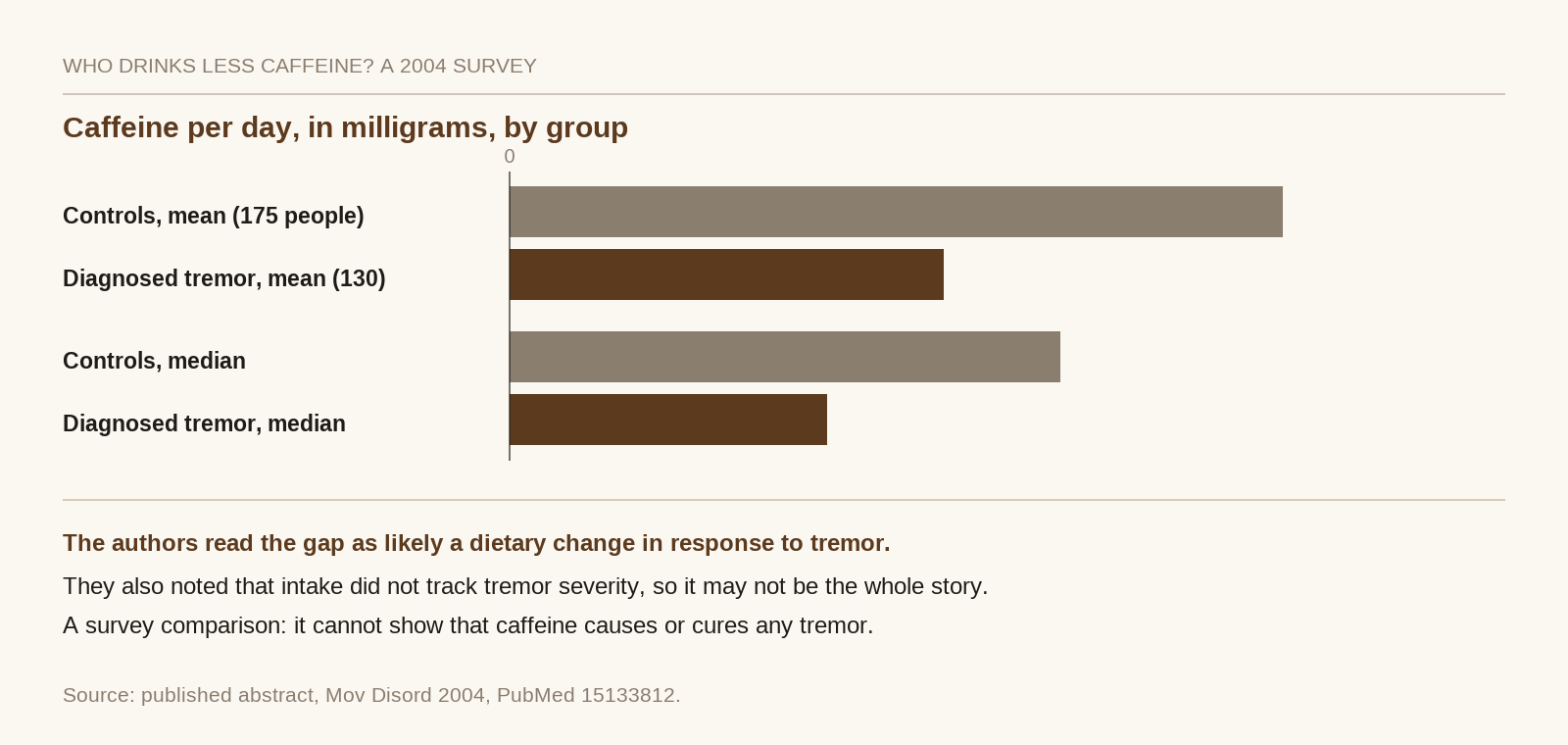
Then there’s a different kind of evidence: who drinks coffee at all. In a 2004 survey in Movement Disorders (opens in a new tab), 130 people with a diagnosed long-term tremor averaged 138 mg of caffeine a day, against 247 mg for 175 controls. The authors thought this was likely people changing their diet in response to tremor. They also found that daily intake did not track how severe the tremor was.
A 2006 case-control study in Singapore (opens in a new tab) went the other way at first: caffeine intake looked higher in the tremor group, but the difference disappeared after adjusting for other factors. A 2018 study (opens in a new tab) found that unaffected relatives of people with the condition drank a lower share of caffeinated coffee and tea than controls. The authors raised the question of whether people adjust their caffeine before a diagnosis. That is a question, not an answer.
What the studies can’t tell you
They’re old and small. The two lab studies date to 1987 and 1998. We read abstracts only, so we can’t tell you how many people each included or how they were screened.
Single doses in the lab aren’t your morning. Neither study looked at a daily habit, a third cup, or coming off caffeine. Withdrawal has its own shaky, unsettled feel for some people, which we cover in our caffeine withdrawal timeline.
Doses and measures differ. One study used a flat 325 mg and the other scaled by body weight. Sensor-measured tremor is also not the same as noticing your hand wobble.
The surveys can’t show direction. Lower intake in people with a tremor fits with them cutting back. It doesn’t say what coffee does to anyone’s hands.
No herbal evidence. We found nothing on chicory, carob, barley or mushroom blends and tremor.
If your hands shake
None of this is a study result about what to do, so treat it as ordinary practical sense.
- Run a simple test. Note when your hands shake and what you had to drink that day. If it clusters after strong coffee or an energy drink, try a smaller serving for a week.
- Check the hidden caffeine. Pre-workout powders, energy drinks and some teas add up. See our guide on the fastest ways to cut caffeine without a headache.
- Notice other triggers. Skipped meals, poor sleep and stress can all feel like shakiness, and none are in the studies above.
- Try a swap if you want to. A roasted-grain or chicory drink keeps the ritual. Our guide to caffeine-free alternatives lists options, and it’s worth reading each label for caffeine.
- Mind the racing heart too. If shakiness comes with a pounding pulse, read our piece on caffeine and heart palpitations.
- See a doctor if the shaking is new, mostly on one side, getting worse, or comes with other changes in how you move or feel.
The bottom line
Caffeine can make some people’s hands tremble, and one study saw it at a dose of 3 mg per kilogram. Another found nothing at 325 mg. Surveys of people with persistent tremor show lower caffeine intake, which the authors read as people cutting back. If your hands shake after coffee, a smaller cup is a cheap experiment. If they shake without it, that is a conversation for your doctor.

Sources & further reading
- Caffeine and tremor (opens in a new tab) — Neurology, 1987
- Caffeine, but not time of day, increases whole-arm physiological tremor in non-smoking moderate users (opens in a new tab) — Clinical and Experimental Pharmacology and Physiology, 1998
- Semiquantitative study of current coffee, caffeine, and ethanol intake in essential tremor cases and controls (opens in a new tab) — Movement Disorders, 2004
- Exploring the relationship between caffeine intake and essential tremor (opens in a new tab) — Journal of the Neurological Sciences, 2006
- Caffeine Consumption in First-Degree Relatives of Essential Tremor Cases: Evidence of Dietary Modification Before Disease Onset (opens in a new tab) — Neuroepidemiology, 2018