Teeccino Matcha Latte review: a good matcha latte that is not a caffeine-free coffee alternative
An honest review of Teeccino's Miraculous Mushrooms Matcha Latte — how much caffeine it actually has, what the mushroom and MCT claims are worth, why it costs $2 a cup, and who it suits.

What we liked
- A creamy, complete latte from powder alone — oat milk, coconut milk and MCT oil are already in it
- Sweetened with dates rather than added sugar
- Matcha's caffeine arrives with L-theanine, which is a real and reasonably well-studied pairing
- Instant. No whisk, no bamboo scoop, no brewing
What we didn't
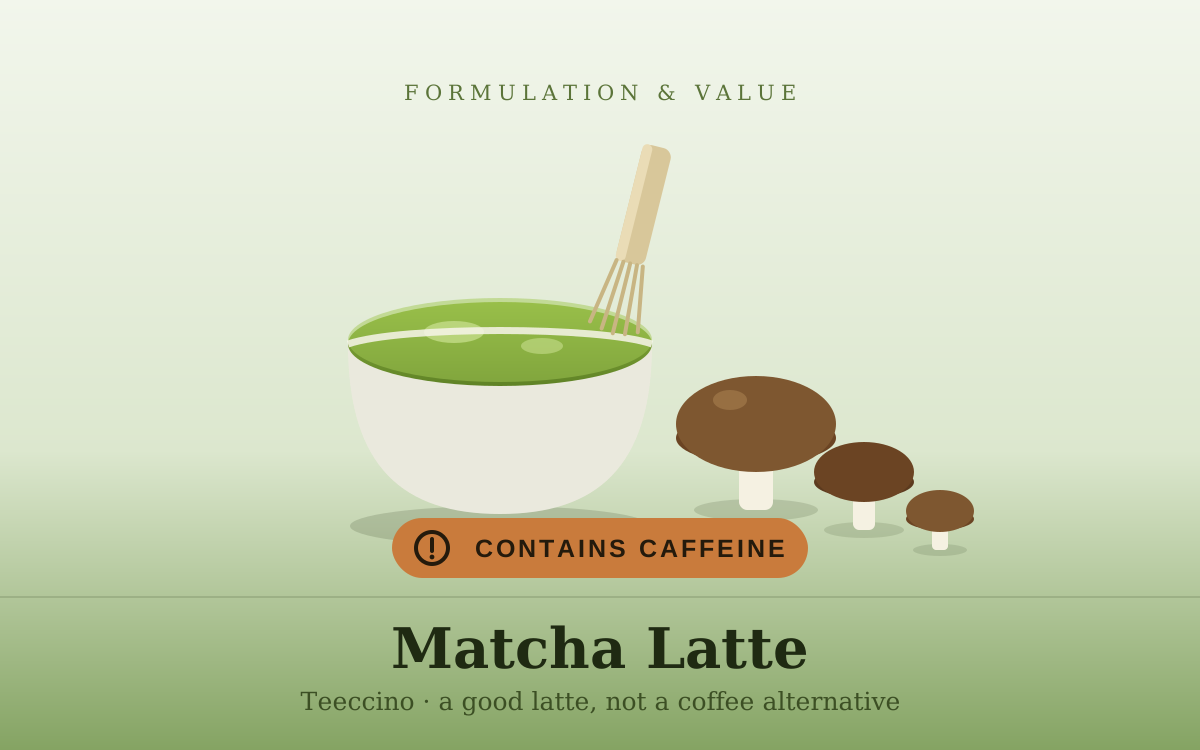
- It contains caffeine. On a site about coffee alternatives this is the headline, not a footnote
- The per-cup caffeine figure is approximate and we could not independently verify it
- Teeccino's own page description still says "without the caffeine" — wrong, and live
- About $2.14 a cup at MSRP — more expensive per cup than caffeine-free K-Cup pods
- Three mushrooms declared, not the five the product line is built around
- No allergen statement on file, and no gluten-free certification despite gluten-free labelling
How we assessed this one. A formulation, labelling and value assessment, from the published ingredient declaration, the certification records, the serving size and the price. We have not run our own brew panel on it, so the flavour section below is Teeccino’s own description, attributed, plus what the ingredient order predicts — not our tasting notes in disguise. No score, for the same reason. Both get added when we have made it properly.
I want to be straightforward about the awkward thing first, because it determines whether this product is for you at all.
Teeccino’s Matcha Latte contains caffeine. It is made with real matcha, matcha is green tea, and green tea contains caffeine — there is nothing surprising in the chemistry. What is surprising is the shelf position. This is a caffeine-bearing product sold under the Miraculous Mushrooms name, in a line whose flagship Adapt & Protect is a true zero, by a company whose thirty-year identity is caffeine-free herbal coffee. Three signals all point one way, and the product goes the other.
At the time of writing, Teeccino’s own page for it still carries a description reading “All the satisfaction without the caffeine and acidity of coffee.” That is template copy inherited from the caffeine-free instants and it is simply wrong about this product. We reported it. Until it is fixed, the page is actively telling caffeine-avoiders the opposite of the truth.
So this is not a caffeine-free coffee alternative and we are not going to shelve it as one. It is a matcha latte — a legitimate, often excellent thing to drink, and a legitimate step down from coffee, which is a different claim. Judged as that, it has real strengths. Judged as what a reader of this site is usually looking for, it is the wrong product on the shelf.
How much caffeine, honestly
Teeccino’s product page states about 35 mg of caffeine per cup. We are attributing that rather than asserting it, for two reasons: the word “about” is theirs, and there is no published certificate of analysis for this product that we could check it against. We asked for confirmation and did not get a settled figure. Treat it as approximate, and treat the panel on the bag you buy as the authority. If a firm number is published we will update this review and note the change.
What we can say with confidence is the magnitude, because the magnitude follows from the ingredient. Matcha is whole powdered green-tea leaf, so a serving delivers more caffeine than a steeped green tea of similar volume. Somewhere in the 30s of milligrams is exactly where a matcha serving of this size should land.
For orientation:
| Drink | Caffeine |
|---|---|
| Teeccino Adapt & Protect | 0 mg |
| Decaf coffee | 2–7 mg |
| Teeccino Cacao + 5 | 5 mg |
| Teeccino Matcha Latte | ~35 mg (Teeccino’s figure, unverified) |
| Steeped green tea, 8 oz | 30–50 mg |
| Black tea, 8 oz | 40–70 mg |
| Brewed coffee, 8 oz | 80–100 mg |
That is a real dose. It is roughly a third to a half of a cup of coffee, and it is well above the threshold at which caffeine measurably affects sleep. Our piece on sleep architecture covers the part people underestimate: caffeine reshapes the structure of a night even when you fall asleep fine and feel fine. 35 mg in the afternoon is not a free action.
If you are in caffeine withdrawal, this will interrupt it. If you are tapering deliberately, it can be a useful rung on the ladder — which is a genuine role, and one we would encourage more brands to be explicit about. If you are at zero and intend to stay there, this is not your product and the line’s flagship is.
The one place the caffeine is a feature
Matcha delivers caffeine alongside L-theanine, an amino acid that appears to blunt some of caffeine’s rougher edges. That pairing is the best-supported claim on this entire product page, and we have gone through what the L-theanine research actually shows in detail. The honest summary: the combination has been studied more than most things in this category, the effects on attention and on subjective jitteriness are real but modest, and it does not make caffeine disappear.
Teeccino’s phrasing — “about 35mg of caffeine per cup, balanced by L-theanine for calm, steady focus” — is, unusually for this genre, roughly in line with the evidence. Our matcha vs coffee comparison goes further into why matcha’s caffeine tends to feel smoother than coffee’s, and also into when that framing gets oversold.
What’s actually in it
Dates*, Oat Milk*, Proprietary blend of organic mushrooms (Lion’s Mane extract*, Cordyceps extract*, Tremella Extract*), Matcha*, Acacia*, Coconut Milk*, MCT Oil*, XOS*, Guar Gum* *Certified Organic
Three things jump out of that list.
The mushroom blend is three, not five. Lion’s mane, cordyceps, tremella. This is a line built around a five-mushroom blend and this member has three of them, with tremella — the “beauty mushroom” — appearing in place of the chaga, reishi and turkey tail that Adapt & Protect carries. Nothing wrong with that; it is a different formulation for a different drink. But do not buy this expecting the flagship blend.
Dates are the first ingredient. By declaration order, dates are the largest component — ahead of the oat milk, well ahead of the matcha. This is a sweet drink by construction, and the sweetness comes from fruit rather than from added sugar, which is a real point in its favour. It also means the matcha is a flavor note in a sweet latte rather than the centre of the cup, and if you are used to drinking ceremonial matcha thin and grassy this will not read as that.
It is a complete latte in a bag. Oat milk, coconut milk, MCT oil, acacia and guar gum are all in the powder. Add hot water and you get creaminess with no dairy and nothing else added. For a hotel room or an office that is genuinely a better proposition than most instants, and it is the strongest practical argument for this product.
A note on the MCT oil, which Teeccino markets as “quick energy” and “brain boosting.” MCTs are metabolised faster than longer-chain fats and there is a real literature on ketone production. The dose in a beverage serving is a small fraction of what the cognitive studies use, and the well-known gastrointestinal ceiling on MCT is worth knowing — if a cup gives you an unhappy stomach, that ingredient is a likely culprit.
Prebiotic fiber, twice. Acacia and XOS are both prebiotic fibers. Between them and the dates, this is a reasonably fermentable cup, so if you have IBS or a sensitive gut, start with a half serving rather than a full one.
Allergens and gluten
Contains oat and coconut, both declared.
Beyond that: there is no allergen statement on this product. No “contains” line, no shared-equipment line. Other products in this line disclose almond cross-contact on their packaging and this one discloses nothing, which is an absent record rather than a clean one. The page carries a “Nut Free” merchandising tag; a shop filter is not an allergen record and we would not treat it as one. Tree-nut allergy: ask Teeccino in writing.
Gluten. The copy specifies gluten-free oat milk and the page carries a gluten-free dietary tag, but there is no gluten-free certification on file for this item — unlike two of its Adapt & Protect siblings, which are GFCO certified. Oats are also the classic cross-contact grain. For coeliac disease, “labeled gluten-free” and “third-party certified” are not the same assurance, and this product has the first.
Organic is published for this product but there is no independent certification record we could check, so we are not naming a certifier. Non-GMO: no record, not claiming it.
Preparation
Instant powder. 2 tbsp (18 g) per serving, stirred or whisked into hot water or milk. No published temperature or ratio, which for matcha is a slightly bigger omission than usual — real matcha is temperature-sensitive and water much above about 175°F/80°C turns it bitter. Whether that applies to a date-sweetened blend is exactly the kind of thing a tasting has to establish.
One practical note we can give without tasting: if it turns out bitter, try cooler water before you try more sweetener. Matcha’s bitterness is temperature-driven, and a kettle at a full rolling boil is the most common cause of a harsh cup.
Flavour: what the brand says, and what the declaration predicts
What Teeccino says. “Sip all the goodness of Matcha in a creamy latte with organic, gluten-free oat & coconut milks that are enriched by organic MCT oil for a quick energy boost. Sweetened by organic dates for a low glycemic response.” Their words, and a positioning statement rather than a finding.
What the ingredient order predicts, and this is the part worth reading:
- Dates are the first ingredient and matcha is seventh, behind the oat milk and the mushroom extracts. Declaration order is by weight, so this is a sweet oat-and-coconut latte with matcha in it, not a matcha with milk added. If you drink ceremonial matcha thin and grassy, this will not read as the same drink and it is not trying to.
- Expect sweet. Dates leading the list, at an 18 g serving, points to noticeably sweet — closer to a café’s sweetened matcha latte than to anything unsweetened.
- Grassiness will be muted. Sweetness and fat both suppress the vegetal green-tea note. The mushroom earthiness will be muted for the same reason.
- Oat milk, coconut milk, MCT oil, acacia and guar gum are a full emulsifier-and-fat package, so the texture should be genuinely creamy from powder and water alone. That is the product’s strongest structural claim.
- MCT oil can read as an oil slick if the water is not hot enough to emulsify it, or if it is under-stirred. Worth knowing before you conclude the product is faulty.
What we can’t offer yet: whether it dissolves cleanly, how sweet it actually is, and the comparison that decides whether a $30 bag is worth it — against a supermarket matcha latte powder at a third of the price, and against whisking real matcha into your own oat milk. Those need a real cup, and so does a score.
Cost per cup, and this is the hard part
The 8.9 oz bag is about 252 g. At Teeccino’s stated 18 g serving, that is 14 cups.
$29.99 ÷ 14 = about $2.14 a cup.
Our calculation from the published weight, serving size and MSRP — not a figure Teeccino publishes.
Set against the full cost-per-cup table we built for this category, that is remarkable:
| Per cup | |
|---|---|
| Instant grain or dandelion powder | 12–18¢ |
| Loose chicory root | 18¢ |
| Coffee brewed at home | 17–31¢ |
| Bagged herbal coffee, 11 oz | 47¢ |
| Teeccino Adapt & Protect, 10 oz ground | ~71¢ |
| Teeccino Cacao + 5 | ~$1.53 |
| Caffeine-free K-Cup pods | $1.58 |
| Teeccino Matcha Latte | ~$2.14 |
| Café hot coffee | $3.75 |
It is the most expensive make-it-at-home drink we have costed in this category — above pods, which we previously called the top of the market, and about three times the per-cup cost of the caffeine-free flagship in its own product line. One a day for a year is roughly $780.
The large serving size is doing most of that. 18 g is more than double the 8 g we use for grounds and four times a typical instant, because most of the powder is the milk and the dates rather than the active ingredients. You are buying a whole latte, not a concentrate — which is a fair trade for convenience, and still a lot of money per mug.
There is a real comparison that flatters it: a café matcha latte runs $5–7 in most US cities, and against that this is a saving. If you are replacing a daily café habit, it wins. If you are replacing a mug of something you make at home, it does not.
Who it’s for
Strong fit
- People stepping down from coffee who want a real but smaller caffeine dose with L-theanine alongside it
- Anyone who buys café matcha lattes regularly — this is cheaper than that and much faster
- Hotel rooms, offices, travel: it is a complete dairy-free latte from a kettle
- People who want mushrooms in something that doesn’t taste like roasted root
Weaker fit
- Anyone avoiding caffeine. This is the wrong product; Adapt & Protect is the right one, same line, actual zero
- Pregnancy and breastfeeding, without counting it into the daily total — see our breastfeeding piece
- Anyone in the middle of a caffeine taper who doesn’t want to restart the clock
- Cost-sensitive daily drinkers. At $2.14 a cup this is a treat, not a routine
- Coeliac disease, given the absent certification
- Tree-nut allergy, given the absent allergen record
- People who want actual matcha. Dates lead this declaration
The verdict
No score, because we haven’t tasted it and a number would imply we had. What we will say on the record:
This is a well-built convenience latte with the wrong name on it, in the wrong aisle. The formulation is not the problem. The emulsifier-and-fat package makes a genuinely creamy dairy-free latte from a kettle, the sweetening is fruit rather than sugar, and the caffeine-plus-L-theanine framing is the single best-supported claim anywhere in this product line — which is not something we get to say often in this category.
The shelf placement is the problem. A caffeinated drink, sold under the Miraculous Mushrooms name whose flagship is a true zero, by a brand whose entire thirty-year identity is caffeine-free, on a page that at the time of writing still tells readers it has none. Each of those is survivable. Stacked, they will send caffeine-avoiders home with the wrong bag, and that is a labelling failure rather than a product failure.
And it is expensive. ~$2.14 a cup makes it the priciest make-it-at-home drink we have costed in this category, above pods, about three times its own line’s caffeine-free flagship. Against a $5–7 café matcha latte it is a saving. Against anything you already make at home it is not.
So: a good product for somebody, and probably not for you. If you read this site because you are getting off caffeine, Adapt & Protect is the product in this line you actually want. If you buy café matcha lattes and want them faster and cheaper, this is a real answer — just buy it knowing it is a matcha latte, which is a caffeinated drink, and not a coffee alternative.
Also reviewed in this line
- Teeccino Adapt & Protect — the caffeine-free one. 0 mg, four formats, about a third of the price per cup.
- Teeccino Cacao + 5 — 5 mg of caffeine from cacao. Chocolate rather than green tea.
- Teeccino French Roast — caffeine-free, no mushrooms, the closest thing to coffee.
Related reading: matcha vs coffee, does L-theanine take the edge off caffeine, and the best mushroom coffee for the wider category.
Disclosure: This site is owned by Teeccino, Inc., and some outbound product links are affiliate links. Neither changes our assessment — see the full disclosure. We would rather tell a reader of this site not to buy a Teeccino product than let them buy the wrong one.