Does coffee protect against Parkinson's? Studies of drinkers say risk is lower, but treatment trials found no symptom benefit
Regular caffeine drinkers have a lower rate of Parkinson's disease in observational studies. A 2020 meta-analysis, two randomized trials and a gene study show what that does and doesn't mean.


The short answer
People who drink coffee or otherwise consume caffeine regularly tend to be diagnosed with Parkinson’s disease less often than people who don’t. That finding has held up across many studies. What the studies haven’t shown is that the coffee is the reason, and the two trials that tested caffeine as a treatment didn’t deliver a clear symptom benefit.
So this is an interesting research thread, not a reason to change what’s in your cup. I’m not a clinician, and this isn’t medical advice. If you have a family history or a diagnosis, your neurologist is the person to ask.
What the risk studies show
A 2020 meta-analysis in Nutrients pooled 13 studies. Nine followed healthy people over time, and in that group regular caffeine consumers had a hazard ratio of 0.797 (95% confidence interval 0.748 to 0.849). In plain terms, about 20 percent lower rate of diagnosis during follow-up compared with people who consumed little or none.
The other four studies followed people who already had Parkinson’s. Regular caffeine consumers there had a hazard ratio of 0.834 (0.707 to 0.984) for outcomes the authors counted as progression: dyskinesia, motor fluctuation, symptom onset and starting levodopa. That’s about 17 percent lower, with a confidence interval that comes close to 1.
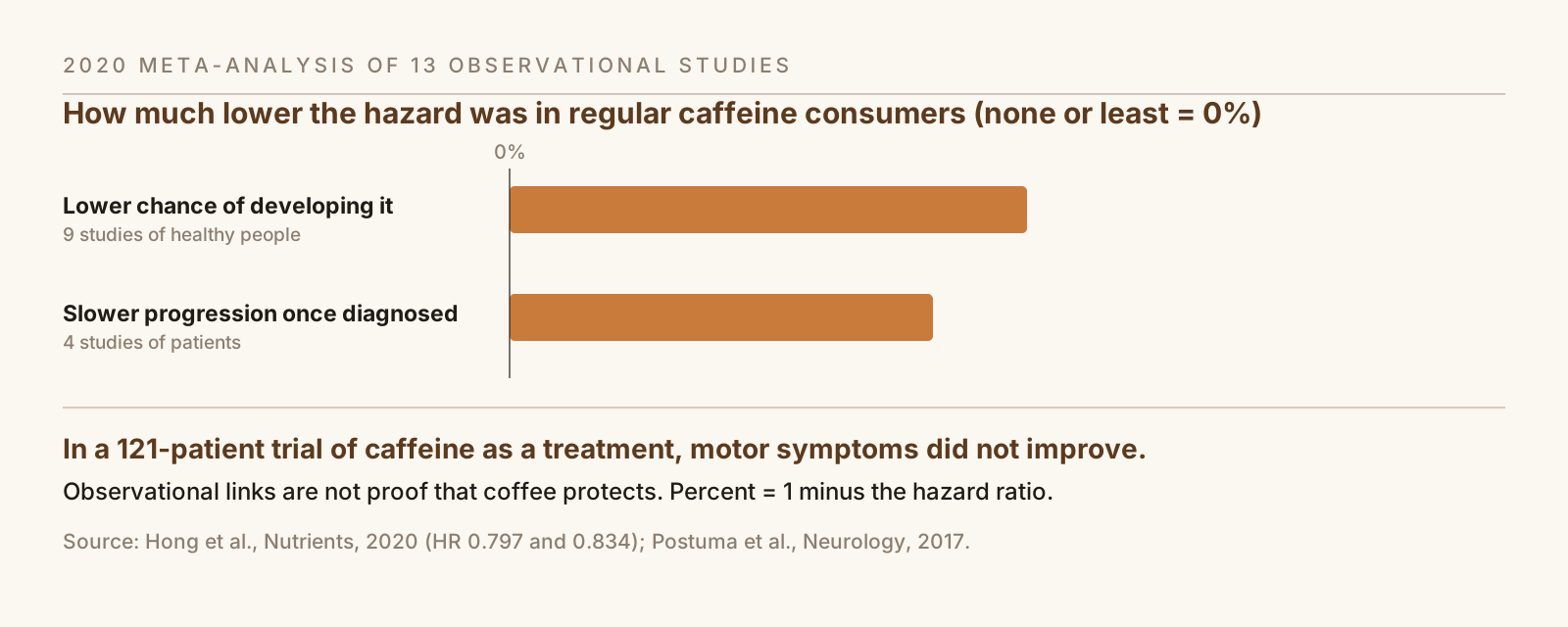
One caveat on those figures: the journal published a correction to this paper in January 2023. The notice we could access gives only a stub, so we can’t say what changed. We’ve used the numbers from the abstract as indexed, and you should read them as approximate.
A wider 2021 overview in the Journal of Parkinson’s Disease looked at 46 systematic reviews and listed coffee, caffeine and tea among the factors tied to lower risk in prospective studies. It also noted that 39 of the 46 reviews (84.7 percent) were of critically low methodological quality, and that study design explained much of the disagreement between them. The authors called for better-designed primary studies.
Why that isn’t proof
Observational research compares people who chose their habits. It can’t assign them. Two cautions apply here.
First, the 2020 authors describe the idea that coffee protects as something “speculated.” They suggest adenosine 2A receptor antagonism, the same pathway caffeine uses to keep you alert, as a possible reason, and say it needs further investigation.
Second, a Danish case-control study of 1,556 patients and 1,606 matched controls found something worth pausing on. It warned that survivor bias may affect studies that enroll people who already have the disease. That’s our plain-language reading of the term: studies that enroll people already living with the disease can end up comparing a filtered group. The Danish team analyzed newly diagnosed and long-diagnosed patients separately for that kind of reason.
None of this means the link is false. It means the studies can’t tell us which way, if any, the cause runs. The consistency is why it keeps getting studied.
What the treatment trials found
If caffeine acts on a pathway that matters in Parkinson’s, a natural test is to give it to patients and measure their symptoms.
A 2012 randomized trial of 61 patients gave 6 weeks of caffeine (100 mg twice a day, then 200 mg twice a day) or placebo. Its main measure, daytime sleepiness, improved by a nonsignificant 1.71 points on the Epworth scale. Total motor scores looked better on caffeine (a 3.15-point improvement on the objective motor component), so the authors called for a larger long-term trial.
They then ran one. The 2017 Café-PD trial put 121 patients (60 on caffeine, 61 on placebo) on 200 mg twice a day for 6 to 18 months. The primary result: no improvement in motor symptoms. The difference between groups was 0.48 points on the MDS-UPDRS-III scale, with a confidence interval running from a 3.21-point benefit to a 2.25-point worsening. There was a slight improvement in sleepiness over the first 6 months that faded. Dyskinesia scores were slightly higher on caffeine, and cognitive test scores were 0.66 points worse than placebo.
The authors’ conclusion was direct: caffeine did not provide clinically important improvement of motor symptoms, and the epidemiologic link to lower risk doesn’t appear to be explained by symptom effects. Both trials were run in people who already had the disease. They can’t tell us whether years of coffee before diagnosis changes risk.
Genes and the cup
The Danish study also tested whether gene variants matter. It found an interaction between heavy versus light coffee drinking and a variant in the gene for the adenosine A2A receptor (ADORA2A) in newly diagnosed patients (interaction odds ratio 0.66, 95% CI 0.46 to 0.94). It found none for variants in CYP1A2, the gene for the enzyme that breaks caffeine down. A pooled analysis with earlier studies suggested the association with daily coffee was strongest in carriers of variant alleles in both genes.
That’s a reminder that average numbers hide a lot, and that “coffee and Parkinson’s” is not one clean effect. It’s a hypothesis researchers are still pulling apart.
If you’re cutting back anyway
If you’re easing off caffeine because of sleep, anxiety or a racing heart, nothing here is a reason to stop. The observational link is modest, uncertain and applies to populations, not to you. Our guide to quitting caffeine without the headache covers the taper, and how caffeine affects sleep architecture explains one of the better-documented reasons people cut back.
Two related reads: caffeine and migraine shows another case where the picture for people with a condition differs from the picture for everyone else. Coffee and your liver follows a similar pattern of consistent observational studies that still don’t amount to a reason to start drinking it.
If you’ve already switched to something caffeine-free, such as a roasted chicory or barley brew, none of this evidence applies either way. It covers caffeine and coffee, and no one has tested herbal coffee for this question. Our piece on herbal coffee versus decaf explains how they differ.
This article is general information, not medical advice. If you or someone close to you has Parkinson’s, talk to your care team before changing caffeine intake, particularly if you take levodopa or other medication.
Sources & further reading
- The Effect of Caffeine on the Risk and Progression of Parkinson's Disease: A Meta-Analysis (opens in a new tab) — Nutrients, 2020 (Hong, Chan and Bai)
- Non-Genetic Risk Factors for Parkinson's Disease: An Overview of 46 Systematic Reviews (opens in a new tab) — Journal of Parkinson's Disease, 2021 (Chen et al.)
- Caffeine as symptomatic treatment for Parkinson disease (Café-PD): A randomized trial (opens in a new tab) — Neurology, 2017 (Postuma et al.)
- Caffeine for treatment of Parkinson disease: a randomized controlled trial (opens in a new tab) — Neurology, 2012 (Postuma et al.)
- Gene-Environment Interaction in Parkinson's Disease: Coffee, ADORA2A, and CYP1A2 (opens in a new tab) — Neuroepidemiology, 2016 (Chuang et al.)
Reader conversation (4)
We read every response. Selected reader notes below.
My father has Parkinson’s and someone told him coffee would help his tremor. Thank you for spelling out that the trials didn’t show that.
Thanks, Helen. I’m sorry that’s something your family is dealing with. His neurologist is the right person to ask about caffeine, especially alongside his medication.
I quit coffee last year for sleep reasons and then read a headline about Parkinson’s. This puts it back in proportion.
The point about the 2017 trial being a follow-up to the earlier one is useful. Headlines usually only mention whichever came first.
Does anyone know if the decaf question has been studied? I only drink decaf now.
Not in the sources I read for this piece, Dale, so I can’t say either way. If I find solid decaf data I’ll add it.
Have something to add? Email us and we may include it in a future update.